Feeds:
Posts
Comments

Archive for the ‘Skinny Guinea’ Category

scampi

Recipe: Scampi with Almonds, Mint, and Lemon

I went out to dinner a lot as a child, mostly to Italian places in Nassau County, Long Island, and in Manhattan (the City, as we called it). My father was a golf pro, which meant he had erratic hours, especially in warm weather, so dinner at home was hit or miss. He also loved to party, and taking everyone out to dinner was very much a part of his ring-a-ding life. I’m grateful for it. The flavors of the 1960s Italian-American food on all those usually fun restaurant evenings are permanently embedded in my palate memory. Shrimp scampi, as it was always called then, was something I ordered constantly. I became quite the snotty little expert on the scampis served in the greater New York area. Scampi then meant lots of garlic (sometimes burnt black and acrid), lots of olive oil, and lots of lemon. It also more than occasionally meant horrendously overcooked shrimp, which was a big disappointment. This glamorous dish, I discovered, could be amazingly delicious or disgusting, depending on the time and place. But I was always up for the confrontation.

Going home with the garlic burps after a night out with my father, my clothes stained with  olive oil, red wine, and Shirley Temples and reeking of cigarette smoke, was a recurring experience of my childhood. It was also the beginning of my culinary education. What I learned back them was that a good scampi was gentle on the garlic and not hammered to death.

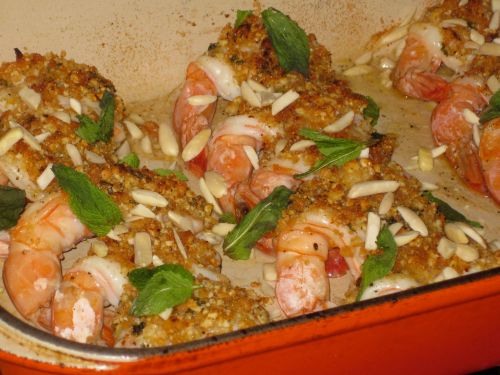
In Italy real scampi look like beautiful mini lobsters, but with a thinner shell (or maybe a better description is that they look like big shrimps with claws). They’re most often served just cracked down the middle and sautéed or grilled with a simple mix of olive oil, herbs, garlic, and breadcrumbs. I don’t often see real scampi here, but Citarella almost always stocks jumbo shrimp. They’re excellent for what I suppose should be called shrimp scampi-style (or gamberi (the Italian word for actual shrimp) scampi-style). I make variations on this dish often. This time I decided I wanted a springtime feel to it. I added ground almonds, which lighten it up, since they don’t soak up oil the way the straight breadcrumbs do. I added fresh mint instead of parsley. I also decided to serve the shrimp on a bed of watercress. It came out pretty springlike, I think.

real-scampi
True Italian scampi.

Scampi with Almonds, Mint, and Lemon

(Serves 4)

12 jumbo shrimp
Extra-virgin olive oil
The juice and grated zest from 1 small lemon, plus lemon wedges for garnish
¼ cup dry white wine
2 garlic cloves, very thinly sliced
Salt
Freshly ground black pepper
⅓ cup homemade dry breadcrumbs, not too finely ground
½ cup whole lightly toasted almonds, half finely ground, the rest roughly chopped
1 heaping tablespoon grated Grana Padano cheese
A handful of fresh mint leaves, half chopped, the rest left whole for garnish
2 bunches watercress

Peel the shrimp, leaving the tails on. Then make a deep slice into the back of each shrimp, removing the vein. You’ll want to go about halfway in, just far enough so the shrimp will open up and lay flat in the baking dish. Put the shrimp in a large bowl.

In a small bowl, mix together the lemon juice, about ¼ cup olive oil, the white wine, and the garlic. Season with salt and black pepper. Pour this over the shrimp, giving them a good toss.

Preheat your broiler.

Place the shrimp in a shallow sided baking dish, cut side up, curling their tales to the side so they can lay flat. Pour any remaining marinade over the shrimp.

In another small bowl mix together the breadcrumbs, ground almonds, Grana Padano, lemon zest and chopped mint. Season well with salt and black pepper. Add about 2 tablespoons olive oil, and mix well.

Place the watercress in a salad bowl.

Broil the shrimp about 4 inches from the heat source for about 4 minutes. Pull the dish from the broiler, and scatter the breadcrumb mixture over the shrimp. Return the dish to the broiler, and cook until the breadcrumbs are a nice golden brown, about another 4 minutes. Pull the dish from the broiler, and garnish the shrimp with the chopped almonds and the mint sprigs.

Dress the watercress with a little olive oil and lemon juice, and serve alongside the shrimp. You can drizzle any juices left in the dish over the shrimp if you like. Serve with lemon wedges.

Read Full Post »

eat-sicily
Eat Smart in Sicily, by Joan Peterson and Marcella Croce, published by Ginkgo Press in 2008.

Recipe: Penette con Pesto di Pistacchio e Mandorle

Considering the size of my apartment, I have to say my collection of Italian cookbooks is almost out of control. But whenever I try thinning it out, I find there’s a fine and true reason to keep every one of them. They’re a family, and I can’t break them up. These books comfort me when my sense of identity slacks off. They remind me of things I need to remember, of specific dishes I love and want to cook again, and of flavor combinations I shouldn’t forget to play with. Most of all they bring back to me all my trips to Italy that can sometimes feel so far in the past. I especially treasure the little regional Southern Italian cookbooks and pamphlets I’ve collected from various excursions into Sicily, Campania, Puglia, Basilicata, and Calabria. Those are my people, that is my food, and now these are my books. They are where I find recipes for the home cooking in little corners of the world, for traditional dishes that may be fading out of people’s lives. These little paperbacks, often sold in the town hall or visitor center of a village (a room in a church), written by local cooks or historians, their covers decorated with illustrations of elaborate pastries or coiled sausages, or people picking olives, or a photo of a lady in a ridiculous regional outfit, complete with wacky headgear, taken during some sagra, make me cook with heart. When I cook from one of these books, I travel back to a place no big chef’s book can take me to.

Recently I entered “Sicily” in the Barnes & Noble search window, as I do from time to time, just to make sure there isn’t something new needed on my shelves, and up came Eat Smart in Sicily, part of an Eat Smart travel series published by Ginkgo Press. With its generic-looking travel-guide cover, I imagined it would be the opposite of the pinpointed, regional ones I love. But since I have to keep nurturing my big collection, I ordered it anyway.

In format the book turned out to be what I expected , but its content was much more involved than I’d imagined, more homey and intimate, with no slick edges. In fact it was like my beloved little regional books. The dishes and the names of the dishes, often presented in Sicilian dialect—a kind of Arab-looking and -sounding form of Italian—were truly foreign and distinct, drawing me right in with their poetry.

The book begins, as it should, with a rundown of Sicily’s checkered past, with all its Greek, Roman, Arab, French, and Spanish invaders, and how each contributed to what Sicilians eat and why. Interesting, but I’ve been there before. Once I got past that, and the authors started talking about the food, I was knocked out by its richness.

The next chapter is called, plainly enough, “Local Sicilian Food.” Just  scanning through it, picking out words on the pages, got me really tasting true Sicilian food. Some of the words that popped out at me: sesame seeds, swordfish, tuna, capers, fichi d’india, citrons, pine nuts, tomatoes, artichokes, sheep’s milk ricotta, olives, eggplants, cipolle, zucchina lunga, tenerumi, peperoncini, ceci, fiori di zucca, lumache, mint, parsley, wild fennel, saffron, maiali, agnello, capretti, horse meat, gamberi, calamari, seppie, polpo, fava, ricci (I love sea urchin), sarde, lenticchie, blood oranges, limone, aceto, chestnuts, caciocavallo, tuma, primosale, pecorino, honey, vino, acqua minerale, espresso, wild asparagus, almonds, figs, pistachios. What a glorious jumble.

Which leads to what in my opinion is the best part of the book, its “menu guide.” This is an extensive alphabetical list of Sicilian dishes that reads like a great nonfiction book (at least to me). Here’s a sampling of the names of some of the amazing dishes that it covers (for a description of what these things actually are and how they’re made, you’ll have to look at the book itself). I love the sound of ammogghiu, babaluci con aglio e prezzemelo, cappidduzzi (my favorite), ericini, filetto di suino, frascatole in brodo di pesce e gamberi, gelo di melone, impanatigghi, latte di mandorla, minne di vergini, olivette di Sant’Agata, pane e panelle, quaresimali, rosolio, salame di cinghiale, tagliancozzi, uva al liquore, vurrania bollita, zucca all’agrodolce, and zuppa di crastuna, to name a few.

And just to hep you up further, and get you wondering why you’re not booking a trip to Sicily right now, the authors include a handful of recipes, both traditional home-cooking types and contemporary restaurant dishes. I’ve always been fascinated by Sicilian nut pestos, the classic one being a mix of almonds, tomato, garlic, mint, and basil. But evidently the pure nut pestos like the one I made from this book, which contain almost nothing but ground pistachios and almonds, are more contemporary (you’d think it would be the other way around, since tomatoes came along relatively late in Italian history, but that’s evidently not the case).

Pennette with pistachio and almond pesto, the recipe I chose, turned out to be a great dish, but I do have a few things to say about making this opulent pasta outside of Sicily. As with all pestos, this one is best when prepared no more than about an hour before serving, so that it stays fresh and brightly colored (and it’s really quick to make, just a few ingredients thrown into a food processor). I did, however, have to make several changes to the original recipe, because the nuts I find here at not all that flavorful. I can sometimes track down Sicilian Bronte pistachios and decent almonds, if I run all over town, but I usually have to make do with nuts from a health food shop, which seem to have more flavor than supermarket ones. At any rate, I found I needed to toast them a little to bring up their taste. Even with the toasting, I found I needed to add a little garlic, which is not present in the original recipe. I didn’t cave in and add cheese or black pepper, though, two ingredients most Americans seem to think belong in every Italian dish.

I have to say, this pesto was delicious. If you find the freshest, best nuts you can, and use good Sicilian olive oil (I would suggest Ravida), you’ll get excellent results. Maybe not quite as wonderful as you could get in Sicily; for that, you’ll just have to book a trip.

nut-pesto

Penette con Pesto di Pistacchio e Mandorle

This recipe is my adaptation of one in Eat Smart in Sicily. The authors got it from Giovanni Farruggio, chef at the Ristorante La Pigna in the Hotel Villa Paradiso dell’Etna, in San Giovanni La Punta in the province of Catania.

(Serves 4 as a first course)

½ cup unsalted, shelled pistachios, lightly toasted
½ cup blanched almonds, lightly toasted
1 small garlic clove, roughly chopped
Extra-virgin olive oil, preferably an estate-bottled Sicilian oil such as Ravida
Salt
About 20 basil leaves
¾ pound pennette (small penne)
A handful of chopped fennel fronds for garnish (if you can find wild fennel that will be best, but I used the fronds from bulb fennel, which weren’t bad)

Put up a pot of pasta cooking water and bring it to a boil. Add a generous amount of salt.

Put the pistachios and the almonds in the bowl of a food processor. Add the garlic, and give it a few quick pulses. Add about a third of a cup of olive oil and some salt, and pulse a few times more. You want to chop the nuts into little pieces, but you don’t want to create a paste. When the nuts are fairly uniformly chopped, add the basil, and pulse once or twice more, just to break it up. The texture should be pebbly.

Cook the pennette al dente, and drain, saving about a cup of the pasta cooking water.

Pour the pennette into a warmed serving bowl. Add the nut pesto and a few tablespoons of the cooking water. Toss well. Add a drizzle of extra olive oil if needed for texture. Taste for salt. Garnish with the fennel fronds. Serve.

Read Full Post »

sea-f-000185-0000the-old-man-of-artimino-palatine-gallery-florence-posters2
A picnic from your wildest dreams, by Giovanna Garzoni.

Recipe: Roast Lamb Sandwich with Ricotta and Caper Pesto

Pasquetta sounds wonderful to me. That’s Easter Monday, when Italians pack up a picnic lunch and head to the countryside to spread it all out under the Italian sun. We generally don’t have the weather for a Pasquetta picnic in New York, where I live, so this nice little celebration is out. Plus we don’t get the day off, so we’re doubly out of luck here.

Come to think of it, Americans generally don’t have picnics. We do barbecues, don’t we? I certainly didn’t grow up having any picnics on Long Island, but we had plenty of barbecues. Picnics are European. You can bring pâté to a picnic, and wine. There was, though, that William Inge play Picnic, which was made into a movie with William Holden as the handsome but creepy drifter who slips into town to cause trouble on Labor Day. Maybe in Kansas they have picnics.

If I lived in Italy and were packing up a big basket for Pasquetta, this is what I’d include (you’ve got to do something with all the leftover lamb). By the way,  the painting above by Giovanna Garzoni is my idea of a great picnic. How can you go wrong with a spread that contains a scary dog,  a dead bird, and a bunch of cardoons?

Happy Pasquetta to you.

Roast Lamb Sandwich with Ricotta and Caper Pesto

(Serves 2)

¼ cup salt-packed capers, soaked for 20 minutes and then rinsed
1 small garlic clove, peeled and roughly chopped
A small handful of flat-leaf parsley leaves
⅓ cup extra-virgin olive oil
Freshly ground black pepper
½ a large baguette, sliced horizontally
6 good-size slices of roasted leg of lamb, not too rare, at room temperature
Salt
½ cup whole-milk ricotta (sheep’s milk, if you can find it)
A handful of baby arugula

Place the capers, garlic, parsley, olive oil, and a few grindings of black pepper in the bowl of a small food processor, and pulse to a rough paste.

Smear the insides of the baguette with a thin layer of caper pesto. Lay the lamb on the flat sides of the bread, and make a layer of ricotta on the rounded sides. Season the lamb with salt and black pepper, and top with the arugula. Close up the sandwiches, and wrap them in aluminum foil. Grab a cold bottle of Frascati and a pint of strawberries, and head for the warm sun.

Read Full Post »

pasolinijesus92
Pier Paolo Pasolini relaxes with Jesus between takes while filming The Gospel According to St. Matthew.

Recipe: Torta Salata Pasquale

The earthquake in the Abruzzo on Monday made me terribly sad. It is a beautiful region. Many friends of mine have family ties to the area, east of Rome.

When I was working on my book The Flavors of Southern Italy, I stopped in the Abruzzo while making my way from Rome to the Gargano, in northern Puglia. My husband and I decided to spend a few nights in Sulmona, a lovely little city in the province of L’Aquila. The town called L’Aquila, which is the capital of the province, is where Monday’s earthquake hit hardest. I haven’t heard of any destruction in Sulmona from the quake, but in 1706 that city was nearly razed to the ground by a devastating one. Abruzzo is and always has been earthquake country. Some Medieval structures survived Sulmona’s big quake, but most of the city was rebuilt in eighteenth-century Baroque style, which gives it a sort of fairy tale glow that I  love. Of course, what I recall most vividly about Sulmona is its food.

On our first night in Sulmona we made our way into an informal-looking little place for a late dinner, one of the only restaurants open on Sundays. I can’t remember its name, but it was owned by a very old, skinny lady, who seemed to be hostess, waitress, and chef. At first I felt guilty watching her run around on her bony legs, but then I realized she was really enjoying herself, chatting up all the dark-haired men in their slick business suits, refilling their wine glasses, grilling up pork chops. I realized she was doing just fine, and I relaxed into the scene.

The flavors of Abruzzo are big and direct. I ordered sautéed caciocavallo, which was huge and served as a main course. It was a big slab of easy-melting, salty cheese, pan sautéed until crisp outside and soft and oozing within and then seasoned with red wine vinegar, black pepper, and fresh marjoram, like an Abruzzese fondue. My husband had fat pork sausages served with onions and chickpeas. The Montepulciano d’Abruzzo red wine was outstanding—deeply colored, mellow, rich, low in tannin. It was a happy meal all around.

We followed our main courses with a plate of broccoli rabe seasoned with garlic and fennel seeds. I love the robust quality of this food, and when it’s cooked brilliantly, as it was in Sulmona, a simple meal can be most elegant. Just in case we didn’t drink enough wine (and we did), we ordered Sulmona’s specialty, cent’erbe, an herbal digestivo that I had tasted before elsewhere but never quite like this. Cent’erbe, as interpreted in Sulmona, is so high in alcohol it evaporates on your tongue (it hovers around 150 proof). I’ve never experienced anything else like it. I brought a bottle home with me, of course, and nobody I’ve served it to could believe its shocking power. Even if I can barely get it down, it’s sort of great to know a drink like it exists.

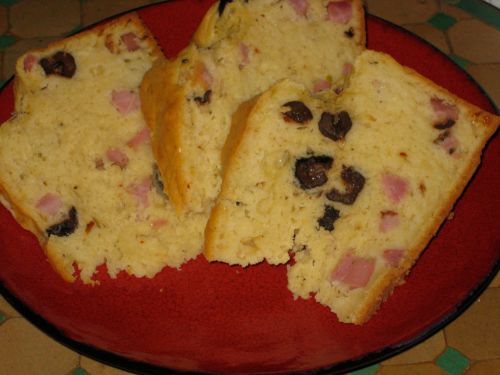
One of my favorite Easter recipes comes from Rome, the Abruzzo, and the areas of central Italy. There are many versions of torta salata Pasquale. The Roman version is more of a bread; in Abruzzo it can be constructed as a two-crusted tart. It always has a filling of prosciutto or salami, often olives, and pecorino or caciocavallo cheese. It’s eaten on Easter morning or Pasquetta, the day after Easter, when Italians pack up a picnic and head outdoors. This year I made mine breadlike, more Roman than not, and I included prosciutto cotto, mortadella, black olives, pecorino , and a hefty dose of white wine. Sounds like it would be a real load, but for an eggy bread it’s in fact surprisingly light.

You’ll need a ten-inch springform pan, lightly greased with olive oil.

A note about the ingredients for this torta: You’d think for authenticity I would have chosen Gaeta olives and a pecorino Romano, but the truth is I can’t usually find decent enough versions of those products here. Both come too salty, and Gaeta olives often have a harsh lye taste. Pecorino Toscano is more reliable, and little black Niçoise olives have a nice mellow flavor, so I’ve gone with those instead. Also, try to find real imported prosciutto cotto and mortadella. They will make a big difference.

torta-psqua1

Torta Salata Pasquale

(Serves 10)

3¾ cups all-purpose flour
A generous pinch of salt
1 tablespoon sugar
A pinch of cayenne
Freshly ground black pepper
A few big scrapings of nutmeg
1½ tablespoons  baking powder
¾ cup fruity extra-virgin olive oil
1 cup Frascati or another dry white wine
6 large eggs
¾ cup small-diced prosciutto cotto
¾ cup small-diced mortadella
¾ cup  pitted and roughly chopped black olives, such as Niçoise
¾ cup grated pecorino Toscano cheese

Preheat the oven to 350 degrees.

Pour the flour into a large bowl. Add the salt, sugar, cayenne, black pepper, nutmeg, and baking powder. Stir everything around well to blend.

Mix the olive oil, wine, and a cup of water together in a small bowl, and then pour it over the flour. Stir well with a wooden spoon to blend. The dough will be quite stiff at this point.

In another small bowl, whisk the eggs lightly, and slowly pour them into the flour mixture, mixing as you do, until they’re well incorporated (use an electric mixer if you like).

Add the prosciutto cotto, mortadella, olives, and pecorino, and mix briefly.

Pour the batter into the pan, and bake for about an hour, or until the bread puffs and the top is dark golden and springy. Let cool, and then loosen the springform. Serve at room temperature. In my experience this bread loses texture when refrigerated. Just cover it with plastic wrap to keep it moist. It will stay fresh for about five days.

Read Full Post »

A Roman Easter

elsamartinellib06
Elsa Martinelli, il Colosseo, and a fluffy white kitty.

Recipe: Easter Eggs with Asparagus, Guanciale, and Pecorino

Easter in Rome—what a lovely fantasy. It sounds grand and enveloping, old-world Catholic, except that if you’re a tourist and don’t have anyone to freeload off of, you’ll discover that most of the restaurants are closed, and you’ll wind up eating leaden fettuccine Alfredo with a bunch of Japanese in an overpriced hotel dining room. And the Vatican will be a mob scene. Oh, well. Another glamorous bubble burst. I guess I’ll stay put in slick and godless Manhattan, hanging out with the cats and my freshly laid-off friends to cook up some solid Roman food.

Roman Easter food has always had a big allure for me. It’s creative, seasonal Italian cooking at its best. Lamb, ricotta, eggs, artichokes, asparagus, shell peas, favas, and wheat all play a part in the Roman Easter feast and springtime celebrations. These are rich tastes, but their freshness and greenness make them renewing to the spirit, which is just what I need this time of year (doesn’t everybody?).

Here’s a Roman dish that I absolutely love. It highlights the beauty of spring asparagus, and I can’t imagine Easter without asparagus. (It’s not quite in season here yet, but what comes from California is pretty decent.) Here you bring together a few simple ingredients—asparagus, eggs, pecorino, guanciale, a handful of herbs—to create a truly opulent dish. Since you leave the egg yolks soft, they run all over the asparagus and the guanciale, creating a cheesy, eggy sauce. Really nice. I think this makes a great first course before another classic Roman Easter dish, braised lamb with fresh green peas. Here’s my recipe for that, if you’d like to give it a try.

And I’ve got more Roman Easter recipes on the way.

roma-eggs1

Easter Eggs with Asparagus, Guanciale, and Pecorino

(Serves 4 as a first course)

1 large bunch medium-thick asparagus, trimmed and peeled
Extra-virgin olive oil
⅓ cup well-chopped guanciale (or use pancetta instead)
2 garlic cloves, peeled and lightly crushed
Salt
Freshly ground black pepper
The juice from ½ a large lemon
4 extra large eggs
½ cup grated Pecorino Romano cheese (the best you can find, and not too salty)
A few chives, chopped
A few large sprigs of fresh mint, the leaves left whole

Set up a pot of water, and bring it to a boil. Drop in the asparagus, and blanch for about 4 minutes. Drain the asparagus in a colander, and then run it under cold water to stop the cooking and to set its green color. Drain well.

Lay the asparagus out in a shallow baking dish.

In a large skillet, heat a tablespoon of olive oil over medium heat. Add the guanciale, and let it get crisp and give up its fat. Add the garlic, and sauté a minute longer, just to release its flavor.

Remove the crisp guanciale bits from the skillet with a slotted spoon, and scatter them over the asparagus. Discard the garlic. Season the asparagus with salt, black pepper, and the lemon juice. Reserve the guanciale cooking fat.

Poach the eggs in just-simmering lightly salted water until the whites are set but the yolks are still runny (you can do this two at time, or one at a time, whatever you’re comfortable with). Scoop them from the water with a slotted spoon, resting them on paper towels for a moment to blot excess water, and arrange them on the asparagus. Spoon a little of the guanciale cooking fat over the eggs, and a little over the asparagus if you have extra, and season the eggs with salt and black pepper.

Sprinkle on the pecorino, and heat the dish under a broiler until the cheese just starts to melt, about a minute or so. Garnish with the chives and the mint. Serve right away.

Read Full Post »

garzoni-pears
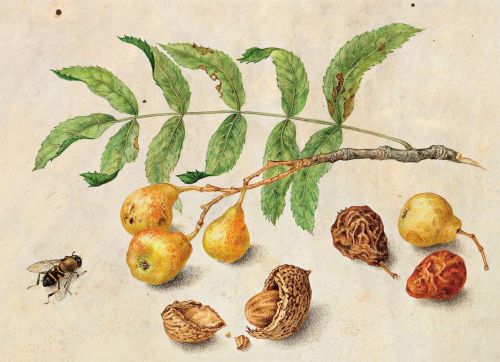
Still Life with Pears, an Almond, and a Bee, by Giovanna Garzoni.

Recipe: Escarole Salad with Pears, Rosemary Almonds, and Pepato

The fruit still-life paintings of Giovanna Garzoni are riveting. Ever since I first discovered them about twenty five years ago in Elizabeth David’s book Italian Cooking (no longer available in the original hardcover with the illustrations, unless you search in a used-books resource like abebooks), I haven’t been able to keep my eyes off them for very long. When I lose my determination, I stare at one of them until I become so focused I  get a little paranoid. When I’m hungover, they bring me hope. If I’m in a  frivolous mood, they force me to dig deeper and just be quiet.

A lady painter in the mid 1600s must have had some particular hurdles to overcome, but this girl from Ascoli, in Le Marche, seems to have been a tireless worker despite any obstacles her sex may have caused her. She produced a lot in her seventy years, and she was rewarded with royal patrons, including Renaissance dukes, duchesses, and princes, among them many Medicis. She won them over with her meticulous, gorgeous tempera-on-vellum miniatures (minatures meaning not tiny paintings but rather paintings done in minute detail). She painted portraits, she painted flowers, but it’s the fruit work that draws me in, with its withered leaves, wormholes, and strategically placed voles and flies. These realistic, slightly spooky interpretations were a fashion at the time, but Garzoni’s were more so than most, more detailed and hence more surreal. This was decorative design at its scientific and artistic best.

I’ve created this salad in tribute to Ms. Garzoni, being inspired specifically by her Still Life with Pears and Almonds (the name it usually goes by, not acknowledging the bee in the title, as I did in my caption above). It seemed the thing to make while waiting for the first spring fruit to arrive (wait till you see Garzoni’s cherries).

garzoni-small
A portrait of Giovanna Garzoni, painted the year she died, by Giuseppe Ghezzi. She seems to be holding a sketch for one of her royal portraits.

If you’d like to experience some of Garzoni’s fruit still lifes, check out either of two cookbooks. I already mentioned Italian Food, by Elizabeth David, originally published in England in 1954 and now hard to find in hardcover, with the illustrations. This was a groundbreaking book in its day, one that really woke up the clunky British palate. Its beautiful illustrations include many of Garzoni’s best fruit paintings. Florentines: A Tuscan Feast, by Lorenza De Medici, put out in 1992 and also now out of print, is another good place to go. This little book is filled with fruit-inspired Tuscan recipes and contains paintings exclusively by Garzoni.

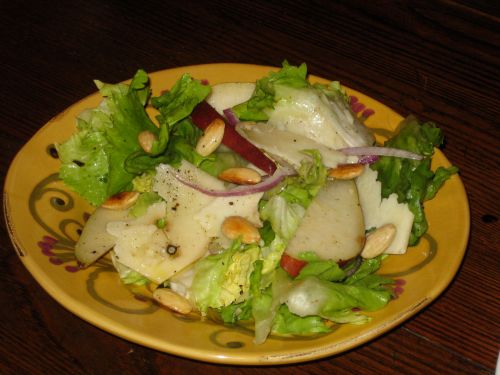
salad-pears

Escarole Salad with Pears, Rosemary Almonds, and Pepato

(Serves 4)

For the almonds:

1 tablespoon extra-virgin olive oil
¾ cup blanched whole almonds
Freshly ground black pepper
Salt
A generous pinch of sugar
2 small sprigs rosemary, the leaves finely chopped

For the rest of the salad:

1 large head escarole, torn into small pieces
2 red d’Anjou pears, cut into slices
½ small red onion, very thinly sliced
¼ pound pepato cheese, shaved or cut into thin, wide slices
1½ tablespoons Spanish sherry vinegar
½ teaspoon light soy sauce
1 garlic clove, peeled and crushed
4 tablespoons extra-virgin olive oil
Salt
Freshly ground black pepper

To make the rosemary almonds, heat the olive oil in a small skillet over medium-low heat. Add the almonds, and sauté, stirring them around frequently, until they just start to turn very lightly golden, about 2 minutes.  Season with black pepper, salt, the sugar, and the rosemary, and continue sautéing until the almonds are golden and very fragrant, about another minute or so. Turn them out onto a large plate or a work space, separating them a little so they don’t stick together, and let them cool for a minute.

In a large salad bowl, combine the escarole, pear slices, red onion, pepato, and almonds.

In a small bowl, whisk together the Spanish sherry vinegar, soy sauce, garlic, and olive oil. Season with a pinch of salt (remember that soy sauce is salty) and black pepper. Pour the dressing over the salad, and give it a good toss. Some of the peppercorns from the pepato will inevitably fall from the cheese into the salad. I love when you bite into a whole black peppercorn (and these have been softened by the cheese-curing process, so they’re tempered). The pepper goes so well with the sweetness of the pears.

Serve right away.

Read Full Post »

balsamic-risotto

Recipe: Risotto with Butternut Squash, Leeks, Parmigiano, and Aged Balsamic Vinegar

In my many years as a devotee of Italian cooking, I’ve several times bought bottles of long-aged, very expensive balsamic vinegar, usually on trips to Italy. I wanted them so badly, with their medieval-looking red wax consortium seal of approval. They’re beautiful, packaged like perfume—so beautiful, in fact, that at times I’ve been scared to use them. Is this the right dish? Is it worthy? Will I be wasting this precious syrup? I’m talking about the real artisanally made balsamico, not the supermarket balsamic that’s mostly red wine vinegar with a little caramel added (although there’s really nothing wrong with that product—it’s fine for dressing salads or adding to marinades—it’s just not real aceto balsamico).

At some point I finally got over my fear of wasting aged balsamico and got on with using it the way they do in Italy, drizzled on cantaloupe or on a chunk of Parmigiano Reggiano, or on grilled scallops or lamb chops, or over braised cannellini beans, or on fresh figs or vanilla ice cream. I’ve tried sipping some  as a fine after dinner drink, the way they do in Modena, but I wasn’t crazy about it. Maybe my bottle wasn’t good enough. Maybe it’s an acquired taste, like drinking Amaro, the bitter herb liqueur, which I now love but at first sipping thought tasted like poison.

Balsamic vinegar originated in Emilia Romagna, in the provinces of Modena and Reggio. It’s been made there for almost a thousand years. Artisanal aceto balsamico must be aged for at least 12 years, and the really special stuff is usually aged longer, getting richer and mellower with time. Real balsamic vinegar should contain no wine vinegar or caramel. It’s made primarily from the juice of Trebbiano grapes, a white wine grape, which is cooked so that it caramelizes ( unlike wine vinegar, which is made by turning alcohol into acid, balsamic vinegar is made by turning sugar into acid). It’s then aged in a progression of casks made from different types of wood until it reaches a mahogany-colored, sweet-tart, wood-kissed, syrupy consistency. A great one tastes to me like a tangy port.

I recently heard very good things about a balsamic vinegar made in New Mexico, of all places. Aceto Balsamico of Monticello is a company started in 1998 by a group of organic farmers who took it upon themselves to start producing balsamic vinegar in true Northern Italian style. This is a huge undertaking. Not only does producing artisanal balsamico take years, but there’s the mystique, history, and peculiarly Italian austere glamor surrounding its production that almost makes it sacrilegious to try. But I guess they figured what the hell and gave it a whirl.

Aceto Balsamico of Monticello makes its vinegar the way it’s made by artisans in Emilia Romagna, using organically grown Trebbiano grapes and wood casks from a master cask maker, Francesco Renzi of Modena. The vinegar is aged 12 years, as required by Italian code, so the company is just coming out with its first batches now. They even feel that Monticello, New Mexico, has an advantage over Modena, because its low humidity allows for a quicker evaporation, concentrating the flavors of the grapes. I suppose this speeds up the aging process slightly, making the vinegar more viscous faster. You can check out their website, www.organicbalsamic.com, for more details on how and why they do what they do.

I ordered a bottle of Aceto Balsamico of Monticello, and I’m glad I did. To me this New Mexico balsamic tastes as lovely as much of the good stuff I’ve brought back from Italy. It’s got that woody port flavor and deep, blackish red color, very much like the best bottles I’ve carried back with me. And I can only imagine that if they can keep it up their vinegar will get even richer and deeper as the years go on.

To show off my new balsamico, I created a simple risotto with leeks, Parmigiano, and butternut squash, three ingredients that to my palate really show off an aged balsamic vinegar’s lush beauty.

Oh, and by the way, that strange spoon with the hole in the center in the photo at top is an actual risotto cooking spoon. It was given to me by my cookbook editor Maria Guarnaschelli when I was working on my first book. The idea is that as you keep stirring the rice, the hole allows the liquid in the pan to stay at a steady flow, with no drag,  so the rice cooks evenly . It really works. She bought it in Vicenza, I believe. I’ve never seen it in a cookware shop here.

risotto-plated

Risotto with Butternut Squash, Leeks, Parmigiano, and Aged Balsamic Vinegar

(Serves 4 as a first course)

5 cups light chicken broth (or half broth, half water)
Extra-virgin olive oil
2 tablespoons butter
2 fat leeks, cut into small dice, using the white and only the tender light green part
1 small butternut squash, peeled, seeded, and cut into small dice (you’ll want about 3 cups of dice)
A few large scrapings of nutmeg
Salt
Freshly ground black pepper
2 cups carnaroli rice
¼ cup sweet red vermouth
¾ cup freshly grated Parmigiano Reggiano cheese
2 teaspoons aged balsamic vinegar

Pour the chicken broth into a saucepan, and bring it to a boil. Turn the heat to very low, to keep it at a low simmer.

Choose a wide, low-sided pan to cook the rice in. This will allow fast evaporation of the liquid, which is exactly what you want for a creamy risotto with a good bite.

Heat 2 tablespoons of olive oil and 1 of butter over medium high heat. Add the leeks, and sauté until they’re softened, about 2 minutes. Add the squash, seasoning it with nutmeg, salt, and black pepper, and sauté a minute or so to coat it well with oil. Add the rice, and sauté for another minute. This puts a light seal on the rice, so it will cook up firm and glossy. Add the red vermouth, and let it bubble for a few seconds.

Add a ladle of broth, and start stirring the rice. The rice should cook at a lively bubble. Turn the heat up a touch if you need to. When the broth is almost dry (not completely, though), add another ladle, and keep stirring. Keep adding broth when it gets low until the rice and the squash are both tender but still retain a slight bite. In my experience this takes 16 to 17 minutes. If you run out of broth, just add a little hot water. As soon as the rice is perfectly cooked, add the remaining butter and the Parmigiano, and give it a stir. Take the pan from the heat, and add a little more broth to ensure a slightly loose consistency. Check for seasoning, adding more salt and black pepper if you think you need it.

Ladle the risotto out into shallow serving bowls, and drizzle about a half teaspoon of the aged balsamic vinegar over each serving. Serve right away.

Read Full Post »

Sardines Now

emmaus_large
Christ with Sardines, by  Giovanni Bellini.

Recipe: Grilled Sardines with Hot Pine Nut Vinaigrette

If you’ve never tasted a really fresh sardine, you have an obligation as an Italian food fanatic to do so. They’re rich and delicious and will open up your taste buds and wash away the remnants of all those boneless, skinless chicken breasts that have been too much a part of our lives for too long. I’ve found that fast high-heat grilling shows off their charms the best. When I can find impeccably fresh sardines, I grill them at home. “But, oh, I can’t cook sardines in my kitchen. They’ll stink up the place for days.” Not if you buy really fresh ones.

And therein lies the problem. Sardines are often past their prime at the fish counter. “Are they fresh?” you may think to ask the seller. “Yes, they just came in today.” Well, if so, then they arrived half rotten. Even at Citarella, where the quality is generally so high, I’ve at times been disappointed by the sardines. Sardines and other oily fish go off really fast, and when they do they get that heavy, fishy, rank oil smell that can turn you off to this amazing fish for years. That is not how it should be, and it makes me sad. Eating a really fresh sardine is something every fish lover should experience.

How can you tell if a sardine is super fresh? Usually I can tell by looking. They should be shiny silver and not floppy.  But I always ask to smell. Fish sellers really hate that, since it looks bad to the other customers. I really don’t give a damn. I’ve been burned by bad fish too many times. Just get up your courage and do it.

Where do I go to find fresh sardines in this big city? Nowadays I go to the Chelsea Market. The Lobster Place at the Chelsea Market (at Ninth Avenue and 15th Street in Manhattan) has expanded, and with that expansion has come a big commitment to quality and freshness. It has always been a pretty good fish shop, but its selection used to be smaller. Now they carry everything, tons of whole fish, all sorts of oysters, and lobsters of course, from alive and crawling to chunks of perfectly steamed tail meat to throw into a salad. And very fresh sardines, flown in from Portugal. European sardines have been showing up in New York markets for years, but I  stopped buying them, not trusting anyone. Now I’m into them again. These are the freshest I’ve seen in a long time.

To celebrate finding these beauties, I revamped a recipe from my book The Flavors of Southern Italy, making it a little more chic and streamlined. It’s a variation on my most loved sardines-over-salad concept. Don’t be afraid to grill sardines at home. If they’re really fresh, they’ll fill your kitchen with the aroma of the Italian Riviera. Portofino anyone?

sardines1
Sardines at the Lobster Company.

Grilled Sardines with Hot Pine Nut Vinaigrette

(Serves 4 as a first course)

For the Vinaigrette:

1 cup very fresh pine nuts
¾ cup extra-virgin olive oil (use your best oil for this)
Sea salt
Freshly ground black pepper
A generous pinch of sugar
The grated zest and juice from 2 lemons
A splash of dry white wine

For the sardines:

1 head frisée lettuce, torn into small pieces
1 large endive, separated into leaves and then sliced into thick strips
12 fresh sardines, gutted and scaled but with the heads left on
Extra-virgin olive oil
Sea salt
Freshly ground black pepper
The juice of 1 lemon
A handful of marjoram sprigs, the leaves left whole

To make the vinaigrette, toast the pine nuts over low heat in a medium skillet, stirring them around, until they’re golden. Add the olive oil, salt, pepper, sugar, lemon zest and juice, and let it all warm through for about 30 seconds. Add the wine, and let it bubble for a few seconds. Turn off the heat, but leave the skillet on the burner (to keep it warm).

Divide the frisée and endive up onto four salad plates.

Set up a stove-top grill pan over high heat. Coat the sardines lightly with olive oil, and sprinkle them inside and out with salt, pepper, and lemon juice. Grill the sardines until good char marks appear, about 2 minutes per side. Grab the sardines from the grill, and place three on each plate. Scatter the marjoram on them.

Reheat the vinaigrette gently, if you need to, and then spoon some over each salad. Serve right away, with good Italian bread and a glass of Italian rosé (try the Vino Rosato Sangiovese produced by Guido Gualandi).

Read Full Post »

monet_red_mullet2
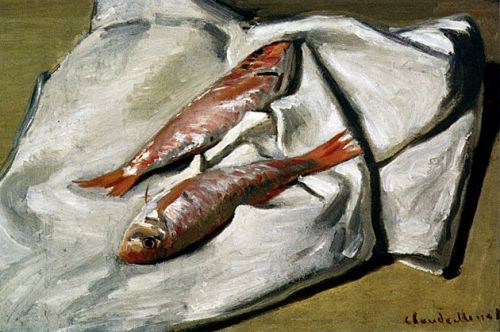
Red mullets as seen by Claude Monet.

Recipe: Pan-Fried Red Mullet with Almond Mint Fregola and Olio Santo

Last night I had another of my torturous dreams where I’m braising some type of meat in the oven, usually lamb or pork, and the thing becomes a whole living creature while cooking, not the shoulder roast or whatever I started out with. And it’s still alive, groggily trying to escape the engulfing heat. I keep trying to push the thing back in, turning up the temperature to try to decrease its suffering, but the animal stays half dead, half alive forever, and my feelings of misery and remorse grow so strong I can’t bear them. Pleasant, isn’t it? Is this the cook’s dilemma?

It’s trendy now in the food world to get to know the meat you cook in an intimate way and to master high-powered butchering. Cookbooks are filled with bloody photos of tattooed chefs burying cleavers into whole hogs, animals the chefs have watched grow up. I could never work on a farm and become friends with goats or lambs and then slaughter them. I’d be terrified of what I’d take back with me to bed at night. Fish, no problem. I’ve gutted and filleted fish that were still wiggling.

Who can sort it all out?

Maybe love of flavor overrides all. I’ve never met a sea creature I didn’t want to eat and wouldn’t mind harpooning, from the shimmering yellow pompano to the hideously appealing octopus. But I have to say that, lately at least, red mullet has been my favorite fish. It’s popular in the South of France, all along the Mediterranean, and down to Greece. The first time I tasted it was not in Europe, but in a Greek restaurant in Astoria, Queens, one of the many places there that serve plain grilled fish, Greek salad, retsina, and that’s about it. I ordered the red mullet because I wanted to be transported to Nice, but mainly because there the fish were, lined up on ice, a beautiful pinkish orange, a color frequently used by the designer Christian Lacroix to accent his amazing gowns. They were too lovely not to devour.

raw-mullet
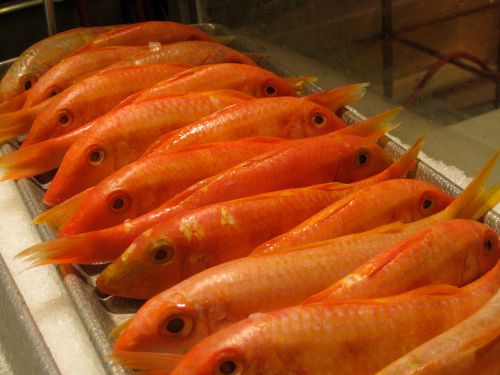
Red mullets for sale at Chelsea Market.

Red mullet looks firm, not floppy, and when you pick one up you’ll see that it doesn’t just look that way. Its texture after cooking is sturdy, not tender, and full of irritating little bones; its taste is shrimp-like and iodiny, a flavor that for me is addictive. After my first experience with red mullet (called rouget in French and triglie in Italian), I thought a lot about the fish. I wanted to taste it again. I wanted to cook it myself, for certain. Years ago I had a hard time finding it in fish shops, but now I see it often, since it’s caught and shipped up from the Gulf Coast of Florida (these fish really get around).

When in Italy I’ve ordered red mullet whenever I could. In Southern Italy it’s usually served simply grilled or fried, with a side of lemon, but I had it once in Venice worked into a pasta sauce. (I’ll see if I can remember that dish more vividly and write up a recipe. It included cherry tomatoes—I remember that distinctly.) In Spain it’s often matched with roasted peppers. For my version, I’ve just done an easy pan fry, pairing the crisp fish with fregola, the Sardinian toasted couscous, and a spiced-up olive oil. I hope you’ll like it.

The oil is not a traditional olio santo, the hot pepper oil used in Southern Italy, where the chilies are steeped in oil and then strained out. Rather I’ve minced everything together to serve more as a spicy relish.

cooked-mullet
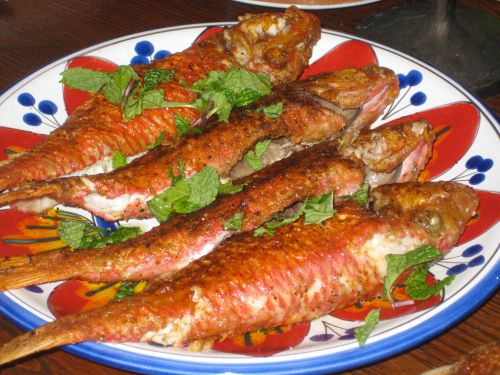
My pan-fried red mullet.

Pan-Fried Red Mullet with Almond Mint Fregola and Olio Santo

(Serves 2)

For the olio santo:

⅓ cup extra-virgin olive oil
2 long, red fresh peperoncini, seeded and roughly chopped
1 garlic clove, chopped
1 tablespoon red wine vinegar
Salt
1 teaspoon  sugar

For the fregola:

1½ cups large fregola (it comes in two sizes, small pellets, more like a traditional couscous, and a larger version; I prefer the texture of the larger kind)
Salt
1 bay leaf
Extra-virgin olive oil
1 tablespoon unsalted butter
1 large shallot, finely chopped
A large handful of whole blanched almonds
A generous pinch of ground cumin
A generous pinch of ground cinnamon
Freshly ground black pepper
A splash of white wine
¼ cup chicken broth
A few large mint sprigs, the leaves lightly chopped, plus a few extra sprigs, left whole, to garnish the fish.
A few large basil sprigs, the leaves lightly chopped

4 whole red mullets (usually 2 per person is about right; if you find bigger ones, 1 may do), cleaned and scaled but with the heads left on
Salt
Freshly ground black pepper
A pinch of ground cumin
A pinch of powdered, lightly smoked chili, such as Pimenton de la Vera
¼ cup all-purpose flour
Extra-virgin olive oil

To make the olio santo: Put all the ingredients into the bowl of a food processor, and pulse until you have a rough but uniform chop. Transfer to a small bowl.

Set up a pot of water, and bring it to a boil. Add a generous amount of salt and the bay leaf. Add the fregola, and cook until tender, about 8 to 10 minutes for the bigger type but check the package for specific cooking instructions. Drain well, and place in a large serving bowl. Drizzle on a little olive oil, and give a quick toss.

In a small skillet, heat a tablespoon of olive oil with the butter over medium heat. Add the shallot and the almonds, and season with the cumin, cinnamon, black pepper, and a little salt. Sauté until the almonds are lightly golden. Add the white wine, and let it boil away. Add the chicken broth, and turn off the heat. Pour this over the fregola, and toss gently. Add the mint and the basil, and toss one more time.

To cook the red mullets: Season the fish with salt, black pepper, cumin, and a touch of smoked chili. Then coat them with flour, shaking off any excess. Pour about an inch of olive oil into a large skillet, and get it hot over medium-high heat. Add the mullets, and sauté them on one side until crisp and browned, about 4 minutes. Flip them, and sauté on the other side about 3 or 4 minutes longer. Removed the fish from the skillet, and place on paper towels for a moment to blot excess oil. Transfer to a serving platter, and garnish with mint sprigs. Serve right away with the fregola, drizzling a little olio santo over the fish.

Read Full Post »

pasta-eaters
A scene from Miseria e Nobiltà, starring the legendary Totò.

Recipe: Casarecci with Asparagus, Ricotta, Anchovy, and Basil

Since making my asparagus and ricotta tart last week, I can’t get its just about perfect flavor combination out of my mind. It reminds me of one of the dishes I used to make at my first apartment, on University Place, several centuries ago, a studio near New York University, where I was supposed to be attending journalism school. It was the time of my blossoming love affair with Italian food, but I didn’t yet really know what I was doing in the kitchen, and I had next to no money. And to make things even more confused, more often than not there were various people, usually some actual friends, who hung around my small place, passed out on the floor, stuffed into my twin bed, rifled through my meager closet looking for something to wear for a night of clubbing. Someone always seemed to have locked themselves in the bathroom, doing God knows what. Well I certainly had to feed them. Pasta was the most reasonable choice.

Penne with frozen peas, cream, and Boar’s Head salami was a standby. Sometimes I’d substitute Boar’s Head prosciutto, if I had a few extra bucks. This dish wasn’t really very good, but it was filling. I did many variations on pasta puttanesca, usually either with canned tomatoes, capers, and anchovies, or with canned tuna, olives, dried oregano, and way too much garlic (it takes practice to develop a nuanced approach to garlic). These improvisations were generally more successful than my cream-based ones, so puttanesca became my signature dish, and it was demanded by my transient group. I’d cook up several pounds at a time, toss the whole thing in a restaurant bus bucket, and serve it trough-style, so anyone who happened to be hanging around could just dig in. I did, I think, own several dishes, but I could never find them when I needed them. Everyone seemed to wind up at my house after a night of doing whatever. They knew I’d have food. It felt like a transgender commune, or the St. Vincent’s triage center, depending on the group. Whatever it was, these people were always hungry.

At some point after I officially dropped out of college I hosted an unruly Italian language class at my apartment, usually about eight people at a time (a friend of mine who spoke decent Italian offered to teach this because she craved attention and loved to boss people around). After class I made pasta. People brought Gallo Hearty Burgundy, Champale (I swear), Harvey’s Bristol Cream, Gorilla brand Anisette (maybe the foulest liqueur ever produced). We’d play Louis Prima and John Cale, and I’d cook up a big bucket of some pasta concoction (I think I may have even gotten plates together by that time). Penne with broccoli rabe and canned sardines was definitely a low point.

As I honed my skills, my pasta dishes became a bit more sophisticated. One dish I started improvising with was pasta with ricotta (something my mother used to make and I always loved), with various add-ons. Pasta with ricotta and asparagus was one of the creations that came out of this time period, and it was heaven. I haven’t made it in a while, but I cooked up a version last night, and I’m glad I did.

Of course now I use homemade (or good Italian shop–made) ricotta and fancy olive oil. Being a snob makes such a difference in the quality of your finished dish. I’ve added lemon zest and a splash of white wine to wake things up. Garlic and anchovy add backbone. I’ve found that lots of freshly ground black pepper is essential to elevate the ricotta base to support a sophisticated whole. This is still, even with all my haughty flourishes, a simple, inexpensive meal, but it’s one with great taste, both creamy and fresh at the same time. It’s the essence of springtime, and it’s still great for an impromptu get-together.

casarecci1

Casarecci with Asparagus, Ricotta, Anchovy, and Basil

I’ve chosen casarecci, a thin, rolled tube-shaped pasta from Puglia, for this recipe. I like the way the ricotta gets caught up in its grooves. Benedetto Cavalieri, an artisanal pastamaker from Puglia, makes an excellent one. You can substitute other short twisted or rolled shapes, such as cavatelli or gemelli, if you like.

(Serves 6 as a first course)

1 large bunch medium thick asparagus (about 2 dozen), peeled and cut on an angle into sections
1 cup whole milk ricotta
¼ cup whole milk, warm if possible
4 anchovy fillets, minced
The grated zest from 1 small lemon zest
⅛ teaspoon grated nutmeg
Salt
Freshly ground black pepper
Grated pecorino Toscana cheese
1 pound casarecci pasta
Extra-virgin olive oil
2 garlic cloves, thinly sliced
¼ cup dry white wine
A handful of basil, cut into chiffonade

Set up a large pot of pasta cooking water, and bring it to a boil. Add the asparagus, and blanch for 2 minutes. Scoop it from the water with a large strainer spoon, and run it under cold water to stop the cooking and set its green color. Drain well.

Choose a large, nice-looking pasta serving bowl, and keep it warm. Add the ricotta, anchovies, milk, lemon zest, nutmeg, salt, freshly ground black pepper, about 3 tablespoons of the grated Pecorino Toscana, and a generous drizzle of olive oil. Mix well.

Bring the pasta water back to a boil, and add a generous amount of salt. Drop in the casarecci.

In a large skillet, heat 2 tablespoons of olive oil over medium heat. Add the garlic, and let it sauté for about 30 seconds. Add the blanched asparagus, season with salt and black pepper, and sauté about a minute or so. Add the white wine, and let it bubble for a few seconds. Don’t bubble it dry, though. You should have some liquid left in the skillet.

When the pasta is al dente, drain it, saving about a cup of the cooking water. Pour the pasta into the serving bowl, and toss well to cover it with the ricotta mixture. Add the asparagus, with all the skillet juices. Scatter on the basil, and toss gently. The texture should be creamy. If it seems too dry, add a little pasta cooking water. Taste for seasoning, and add more salt and black pepper if needed. Serve right away, with more pecorino Toscana brought to the table if desired.

Read Full Post »

« Newer Posts - Older Posts »