
Cauliflower as interpreted by Bartolomeo Bimbi (1648–1730).
Recipe: Risotto with Cauliflower, Saffron, and Chervil
People who insist that they don’t like cauliflower make me sad, and if they stick to this irrational stand for any length of time, they get on my nerves. I don’t want anyone, especially my readers, to miss out, to limit themselves, in the good eating department. So what I always try to do is make it irresistible.
With cauliflower, my approach is to go all-out elegant with the admittedly somewhat dumpy vegetable. That’s where risotto comes in. And when I think of cauliflower risotto, my mind almost always floats toward the idea of saffron. That makes for a beautiful matrimonio di sapore. Saffron is expensive, and that makes some cooks timid. But it’s not particularly mysterious, and luckily you really want to use only a little bit, and heat it just briefly, so it retains its exotic flavor without taking on any bitterness. (In my recipe, I show you the best way to get the most flavor from your saffron.)
Cheese and cauliflower are another win-win combination. I use a sweet aged Piave for this risotto, but you could go with a Parmigiano Reggiano or its little sister, grana Padano. Both have beautiful, rounded flavors with no sharp edges to harsh your risotto mellow (the way a pecorino Romano definitely would).
And do yourself a big favor. Get your cauliflower at a Greenmarket or farm stand. It’s summer. Go for glory. You don’t want to deal with some withered up, miserable supermarket stand-in for the real thing. You can get one of those lovely orange “cheese” cauliflowers, or a green spiral Romanesco, which to me looks like a deep-sea coral, or just a simple standard creamy white one, as I used for this risotto.
Risotto is nothing to be scared of. It’s mostly a matter of good ingredients, like carnarolo rice, which produces a much more suave risotto than arborio, a rice that can make the dish gummy. Chefs scream about perfect technique and convince you that you’ll fail if you don’t do it exactly according to Marcella Hazan or whoever. You’ll see while following my rather freewheeling recipe that that craziness of continuous stirring all in one direction is just what it sounds like—craziness, designed to keep you down. Risotto comes out great even if you don’t make yourself frantic.
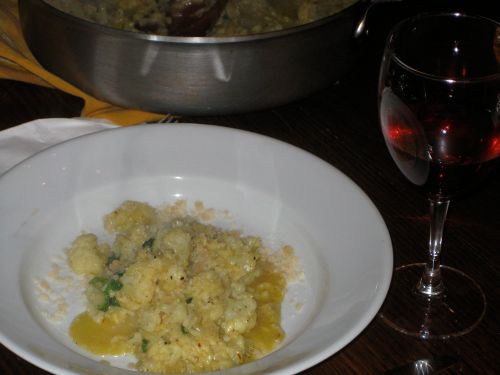
Risotto with Cauliflower, Saffron, and Chervil
(Serves 4 as a main course or 6 as a first course)
A generous pinch of saffron threads (about 10 or so)
2 tablespoons unsalted butter
1 tablespoon extra-virgin olive oil
1 large sweet onion, a fresh summer one or a Vidalia
A small palmful of fennel seeds, ground to a powder
1 small cauliflower cut into very small florets (about 2 cups of ½-inch-size pieces)
½ teaspoon sugar
1½ cups carnarolo rice
Salt
Black pepper
½ cup dry white wine
About 5 cups light chicken broth
A squeeze of fresh lemon juice
A chunk of aged Piave cheese
A handful of fresh chervil, stemmed
If your saffron is moist (and it should be somewhat moist, if it’s fresh), place it in a small pan, and dry it for a few seconds over very low heat. Next place it in a mortar, and give it a gentle grind with a pestle. It should easily break down into a powder. Add about 3 tablespoons of hot water or hot chicken broth to the saffron, so it can release its entire flavor. (If you just throw saffron threads into a dish whole, you’ll lose much of their effect, since they won’t dissolve much; they’ll just float around in your dish without letting off any of their charm.)
Pour the chicken broth into a saucepan, and bring it to a boil. Turn the heat down, and keep it at a simmer.
The best pan for risotto is one that’s wide and has straight, not too high sides (see photo above). That will provide enough room for good evaporation and even cooking. So find a pan something like that, and get it hot over medium heat. Add the butter and a tablespoon of olive oil. When that mixture is hot and frothy, add the onion, and let it soften for a minute or so. Add the fennel seed, the cauliflower, and the sugar, and sauté until the cauliflower is well coated with flavor, about 2 minutes. Add the rice, season it with salt and black pepper, and sauté until it’s shiny, about another minute or so. This step puts a light seal on the rice, ensuring that it cooks up separate and glossy. Add the white wine, and let it boil away almost to nothing.
Add a big ladle of hot chicken broth, and give the rice a few good stirs. You needn’t go crazy stirring risotto constantly, so don’t get nervous about it. The main thing is not to let it stick to the bottom of the pan, so just test it every so often with a few good stirs. When the rice looks almost dry, add more broth, and give it a few more stirs. Keep the broth at a good, constant, lively bubble and you’ll be in good shape. Keep doing this until the rice is just tender but still has a little bite and the consistency has become somewhat creamy (if you run out of broth, just add a little hot water). In my experience this takes about 17 to 18 minutes. Now add the saffron broth and a squeeze of lemon juice, and give everything a few more stirs (in the opposite direction, just to torment Marcella Hazan). The rice should turn light yellow.
Take the risotto off the heat, add about 2 heaping tablespoons of grated Piave, and stir it in. Then add another small ladle of chicken broth, just to be sure it doesn’t get too dry (I like my risotto on the loose side). Give it a few fresh grindings of black pepper and add the chervil (leaving out of few sprigs for garnish). Give everything one final stir.
Ladle the risotto out into warm serving bowls, and top each one with a few sprigs of chervil and an extra little sprinkling of Piave. Serve right away.








 Erica De Mane