Feeds:
Posts
Comments

Archive for the ‘Skinny Guinea’ Category

marcello with bread
Marcello with his own festive yeast creation.

Recipe: Focaccia with Zucchini, Shallots, and Black Olives

At summer’s end, what are we left with at the market that still speaks summer? Bins of dried-out zucchini. But I hold on to the idea of zucchini anyway, that big, sometimes really big, symbol of summer heat and fruitfulness, even as the nights become cool and my once floral basil grows woody and starts to smell like cat pee.

Not only does zucchini accumulate as summer ends; also its taste changes, becoming cottony and aerated.  In summer a bit of olive oil, a scattering of mint, a quick sauté, and you’ve got a regal dish. Now you have to drench it in flavor to bring any life to it. Here I’ve topped a classic focaccia dough, one of the simplest yeast breads of all, with raw marinated zucchini, cut paper thin and tossed with olives, anchovies, lots of thyme, garlic, and good, abundant olive oil. It’s what I would call a transitional dish, working a delicate summer vegetable into a traditionally more hearty format.  A big stretch of  crisp, oily dough warm from the oven really takes on your hunger on a night with a hint of a chill.
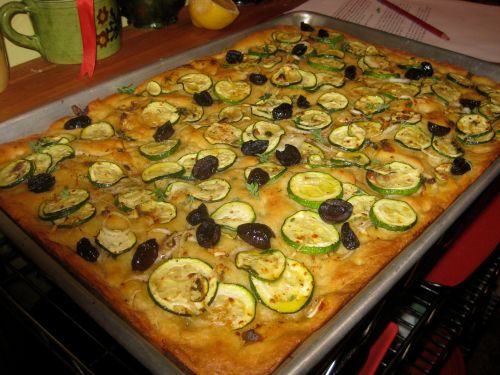
zucchini focaccia

Focaccia with Zucchini, Shallots, and Black Olives

(Serves 8 as an antipasto offering)

For the dough:

1 package active dry yeast
1¼ cups warm water (about 115 degrees)
A pinch of sugar
¼ cup extra-virgin olive oil
3 cups all-purpose flour, plus a little extra
½ teaspoon salt

For the top:

Extra-virgin olive oil
2 shallots, very thinly sliced
3 medium zucchini, very thinly sliced (use a mandolin, if it doesn’t scare you; otherwise a sharp knife will do)
2 garlic cloves, thinly sliced
About 10 large thyme sprigs, the leaves chopped
5 minced anchovies
A handful of wrinkly Moroccan black olives, pitted
Salt
Freshly ground black pepper
A pinch of sugar

Pour the warm water into a large bowl. Sprinkle in the yeast and the sugar, giving them a quick stir to dissolve clumps, and let sit until frothy, about 8 minutes.

Add the olive oil to the yeast mixture. Then add 3 cups of flour and the salt. Stir the mixture until you have a nice soft dough. It will be quite sticky. Turn the dough out onto a floured surface, and knead very briefly, about 4 minutes, adding a minimal amount of extra flour to prevent sticking (mostly flouring your hands).

Oil a large bowl, and place the dough in it, turning it once to coat it all over in oil. Cover with a kitchen towel, and let rise in a warm, draft-free place until doubled in size, about 2 hours.

Coat a 10-by-15-inch sheet pan well with olive oil. Turn the dough out onto the pan, and stretch and pat the dough out, fitting it to the edges of the pan. Give the focaccia a drizzle of olive oil, cover it with plastic wrap, and let it sit again until it’s puffy, about an hour.

Preheat the oven to 450 degrees.

Meanwhile, in a big bowl, combine the zucchini, shallot slices, garlic, thyme, anchovies, and olives. Season with a small amount of salt (remember that the anchovies and olives are salty), a more generous amount of black pepper, and the sugar. Drizzle with about 2 tablespoons of olive oil, and toss everything very well with your hands, making sure the zucchini especially is coated with oil (add more if you think you need to).

Uncover the focaccia, and spread out the zucchini mix over it in one layer as best you can. Bake for 15 minutes. Lower the heat to 375 degrees, and bake for 15 to 20 minutes longer, or until the focaccia is golden brown. Serve warm or at room temperature.

Read Full Post »

459px-Espinosa,_1645,_A_bouquet_of_flowers_in_a_conch_shell,_with_nuts_and_figs,_surrounded_by_a_wreath_of_flowers_and_fruit
A bouquet of flowers in a conch shell, with nuts and figs, by Juan Espinosa, 1645.

Recipe: Fig Tart with Limoncello and Thyme

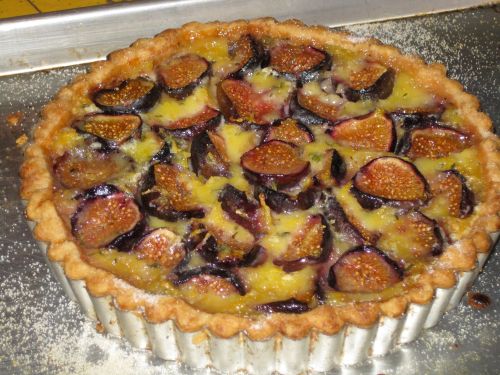
I’m a savory type. I’ve always known this. Even as a kid, I preferred a tin of anchovies to a Ring Ding. But come summer and early fall, I become a lover of fruit tarts. Maybe because they’re so beautiful. When you bake fruit, the colors often become burnished, taking on a half-withered, dripping Caravaggio allure. Also, tarts target their flavor, getting right to the point with concentrated fruit sugars and all the glossy goo that emerges while baking, extending pigment into the crust. You don’t need a precise recipe to create a fruit tart. What you need is a desire to create one, a desire to create beauty. A fruit tart just has to be alluring, and they almost always are, whether made prissy and fluted or free-form.

I picked up three pints of California black figs from my corner fruit guy for the really reasonable price of five bucks. Nobody grows figs in New York, aside from a few old, nurturing Italians in Bay Ridge, who every fall will wrap their tree (usually only one) in burlap, keeping it cozy through the long winter in hopes of having it produce a handful of figs in the spring and fall.

Green figs are what I really love. I usually find that the black ones have slightly musky-tasting skin, but these ones were perfectly plush and pink-fleshed, so I knew they’d make a good tart. Any ripe fig is delicious, but I find the dark-skinned ones especially rich, with little acidity. Because of that richness, I added limoncello and lemon zest into my tart, as well as a fresh herb for added drama. Mint goes wonderfully with figs, and so does basil, but I went with thyme, which is more serious, more savory. I added it to the crust and worked a little bit into the custard.

fig tart

Fig Tart with Limoncello and Thyme

(Serves 6 to 8)

For the crust:

5 tablespoons unsalted butter
2 tablespoons extra-virgin olive oil
4 tablespoons sugar
A pinch of salt
2 tablespoons Limoncello
1¾ cups all-purpose flour
4 thyme sprigs, the leaves lightly chopped

For the custard:

¾ cup non-ultrapasteurized heavy cream
1 large egg
2 tablespoons sugar
1 tablespoon Limoncello
The grated zest from 1 lemon
4 thyme sprigs, the leaves lightly chopped
1 teaspoon finely ground flour, such as Wondra

Plus:

15 or 16 fresh figs, either black or green, cut in half lengthwise
Extra sugar for the top

Preheat the oven to 375 degrees.

In a small saucepan, melt the butter. Add the olive oil to the butter, give it a stir, and then let the butter mixture cool completely. With a pastry brush, use about a tablespoon of the melted butter mixture to coat a 9-inch tart pan with a removable bottom.

To make the crust: In a medium bowl, combine the remaining butter mixture with the sugar, salt, Limoncello, and about a tablespoon of water. Stir to blend. Add the flour and the thyme, and mix briefly until you have a mass of moist, crumbly dough (don’t blend so much that it forms a ball). Tip the dough into the tart pan, and pat it down and out to the edges and all the way up the side to form a thin crust. Bake for about 15 minutes, until lightly colored and slightly puffy.

In a small bowl, combine all the ingredients for the custard, and whisk until they’re well blended.

Place the figs, cut side up, in the crust, in a slightly overlapping circular pattern. Pour the custard evenly over the figs, and sprinkle the top with sugar. Bake until the crust is golden and the custard is set, about 45 minutes. Let sit for about ½ hour before serving.

Read Full Post »

peach cake

Recipe: Peach Cake with Almond and Anise

I’m not sure when this all started, exactly, but for several years now I’ve been making simple Italian-inspired, I guess you would say farmhouse, breakfast cakes for Fred, my husband, as often as I can manage. Usually they’ve got fruit in them; sometimes I’ll add ricotta or yogurt, and often olive oil instead of butter, and never too much sugar. He loves all of them, and they’re really easy to make (generally speaking I only bake when I can get away with imprecise measuring, and these are very forgiving cakes).

I came up with the general idea for these sturdy, relatively healthy cakes from ciambella, a kind of Italian sponge cake that small hotels in Italy offer for breakfast. Often it’s a ring cake, but in Puglia, where I’ve had it most often, it’s more solid, often with sugar on top or drizzled with a thin, sticky icing. It is Puglian agroturismo fare,  a down-on-the-farm touch for the tourists, and a hell of a lot more appealing than the usual cornetti, the shrink-wrapped spiral horns filled with tooth-zinging almond paste you so often get at big city hotels.

I like to bake, but I get easily agitated, occasionally hostile, and even prone to heart palpitations when I have to actually measure something. These ciambelle, once you get the idea, you can really play around with, adding different boozes, spices, jams, nuts, and chunks of fruit. That is is my kind of freewheeling baking experience. I’ve made them using an olive oil base (very light and beautiful and delicious with pears or apples). I’ve used yogurt and olive oil (a big success). Butter always works, giving you a denser texture, more like a pound cake. You can grind nuts and add them to the flour, as I did with this peach cake, or you can stir in jam, for a gooier, wetter cake.

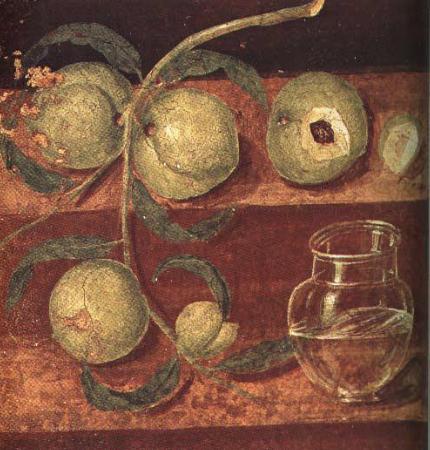
StillLifePeachesHerculaneum
Still life with peaches, from the ruins of Herculaneum.

I notice now, at this moment in my husband’s life, that he appreciates these cakes more than ever. Fred has a few pressures on him lately, some of them job-related, but if he knows there’s one of these cakes waiting for him in the morning, it really, truly lifts his spirit. Isn’t life simple? I have the power to lighten his morning burden, and I don’t even have to use measuring spoons.

Don’t worry. I do give you amounts here, but I tell you, you can wing it a bit with no bad results, and  you might even come up with something better. But this is pretty good.

Peach Cake with Almond and Anise

1 cup all-purpose flour
½ cup sliced almonds, lightly toasted and then ground to a powder
½ a whole star anise, ground to a powder

1 1/2 teaspoons baking powder

A generous pinch of salt
1 stick unsalted butter, softened
¾ cup sugar, plus an extra tablespoon for the top
2 large eggs
1 teaspoon good vanilla extract (Madagascar is wonderful)
1 tablespoon Sambuca or anisette
3 ripe peaches, cut into thin wedges, leaving the skin on

Preheat the oven to 350 degrees.

Butter a 9- or 10-inch springform pan.

In a small bowl, mix together the flour, three quarters of the ground almonds, half the ground star anise, the baking powder, and a generous pinch of salt.

In a bigger bowl, using an electric mixer, beat the butter with the ¾ cup sugar until it’s fluffy. Add the eggs, and beat them in. Add the vanilla and Sambuca or anisette, and beat them in. Add the flour mixture all at once, and, using a low speed, beat until just blended.

Pour the batter into the pan. It will be a bit thick, so you might want to smooth it out with a spatula. Press the peach slices into the batter in a circular fashion.

Now mix together the tablespoon of sugar, the remaining ground almonds, and the rest of the star anise. Scatter the mix over the top of the cake. Bake for about 45 minutes, or until the top is browned and the cake feels firm. Let it cool in the pan for about 15 minutes before removing it.  Serve warm or cool.

Read Full Post »

Negroni Sbagliato

sophia cocktail
Sophia creating her own end-of-the-summer cocktail.

Recipe: Negroni Sbagliato

Many of my readers know that I love a negroni. This drink, equal parts gin, sweet vermouth, and Campari, is considered an aperitivo in Italy, but it’s certainly a powerful one. Two negronis and I’m usually flying.  I have unfortunately given up hard liquor in the last few months, not because I wanted to but just to preserve what’s left of my nerve endings. But this change in diet has happily coincided with my discovery of the Negroni Sbagliato, or “wrong” negroni, a drink invented at Bar Basso in Milano, which substitutes prosecco for the gin. Now, this variation is obviously not as interesting, chemically speaking, as the original, but it is delicious, and it’s more in the spirit of a real aperitivo, a light drink that served to open up your appetite for dinner.

For my Negroni sbagliato I’ve come to feel that instead of equal parts of everything, less Campari and vermouth and more prosecco tastes better to me. It’s lighter, and you can experience the prosecco, which is tinted a pretty light pink. Also, it’s traditionally served on the rocks, but I like mine straight up in a champagne glass.  Maybe it’s a bit of a girlie drink in looks, but its bitterness raises it at least to the level of transvestitehood, if not all-out manhood. It doesn’t go too well with most food, but that’s just as well, since it’s best savored without distraction.

The end of summer is bittersweet. It deserves a special, bittersweet drink.  Here’s a lovely one.

Negroni Sbagliato

Chill your champagne glasses. Chill the Campari and the sweet vermouth, and obviously chill your prosecco. To each glass add about a tablespoon each of Campari and sweet vermouth, then fill it up with prosecco. Garnish with an orange peel.

Read Full Post »

800px-Ischia_Fungo_Lacco_Ameno
Il Fungo (the mushroom), a rock formation just off the island of Ischia.

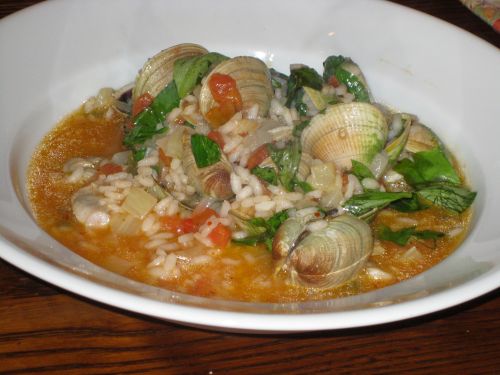
Recipe: Risotto Ischia Style, with Summer Tomatoes, Cockles, and Fennel

Yesterday there was a touch of fall in the air. It scared me, and I had to cook something summery to keep it at bay. I thought of a risotto I ate years ago in Ischia Porto during one of my first self discovery explorations, when I set out on a mission to make myself feel somewhat Italian, something I had oddly lacked despite being brought up in an Italian-American family. Ischia, which was full of pale German and English elders, some gravely ill, some missing limbs, all there to take the farty healing waters, didn’t actually call to my roots, but its food went straight to my soul. I’d eaten it all before, either at my mother’s table or in my dreams.

The risotto I ordered at a little trattoria on the water was a real Southern Italian creation—no butter, no cheese, no meat, no glop, just tomatoes, olive oil, herbs, and a big whiff of the briny sea. I’m so glad I cooked it last night (well, it wasn’t exactly the same dish, but it was very close, and it was good). And, see, today was warm and sunny. Summer returned.

clam risotto

Risotto Ischia Style, with Summer Tomatoes, Cockles, and Fennel

(Serves 4)

Extra-virgin olive oil
1 small fennel bulb, cut into small dice
2 shallots, minced
1 fresh green chili, seeded and minced
2 garlic cloves, very thinly sliced
A small palmful of fennel seeds
2 cups vialone nano rice
Salt
Black pepper
½ cup dry white wine
6 cups light chicken broth, heated
2 pounds cockles, well cleaned
A splash of Pernod or another pastis
2 large, round summer tomatoes, skinned, seeded, and well chopped
A big handful of basil leaves, lightly chopped

Choose a wide, shallow pan that will hold all the cockles when opened.

Heat 3 tablespoons of olive oil over medium heat. Add the fennel, shallot, and green chili, and sauté until everything is soft and fragrant, about 4 minutes. Add the garlic and fennel seeds, and sauté about a minute longer. Add the rice, giving it a little salt and black pepper, and sauté for about a minute or so to coat it well with oil and flavoring. Add the white wine, and start stirring the rice, letting the wine boil away. Add a ladle of hot broth, and stir the rice a few more times, keeping it at a lively bubble.

Throw the cockles into a big pot. Add a tiny splash of Pernod and a small ladle of chicken broth. Turn the heat to high, and cook until the cockles open, about 4 minutes or so. Remove the pot from the stove.

Keep adding ladles of broth to the rice as the pan gets dry, stirring fairly often (contrary to popular belief, you don’t have to do this consistently to achieve a good risotto). After about 10 minutes of adding broth and stirring, add the tomatoes. Keep adding broth until the rice is just tender to the bite and has a lightly creamy texture. This should take about 18 minutes in all.

Now add the cockles with all their cooking liquid to the rice, and give it a stir (cockles are usually pretty clean, but if you see any sand in the cooking liquid, strain it first). The texture should be somewhat loose. Add a little more broth or warm water if you need to. Taste for seasoning, and add the basil, giving it a final stir. Give the risotto a drizzle of your best olive oil, and serve right away.

Read Full Post »

scallops

Recipe: Fried Sea Scallops with Peperoncino Pesto

I arrived on Block Island wanting nothing but to stare at the waves and eat fried seafood. Well, I got my wish. Maybe I overdid it a bit with the fried fish, but I couldn’t help it. Fried seafood of any kind has always been just about my favorite thing to eat anytime, any season, anywhere. I love all the little cruddy fried fish counters at seaside resorts, with their sometimes disgusting but occasionally sublime fried clams, oysters, soft-shell crabs, shrimp, and cod. If they fry it, I’ll eat it. But I think my all-time favorite is fried scallops. And they are a Block Island specialty.

Block Island sea scallops are enormous. They are a perfect seafood to fry, since they have enough heft to remain moist and juicy while taking on a good crisp crust. Sometimes small things like shrimp or clams fry up as all coating, with a dry, anonymously fish-scented center. But scallops, unless the cook goes off for a few sea breezes, should stay beautifully tender. At those fish counters you sometimes get ten or more, plopped on top of a big, pillowy bun to soak up any excess grease (a nice touch, I think). Who could eat that many? When they’re lightly coated and deftly fried they’re so delicious I almost could eat that many. (When I bought an order I offered a few to some raucous seagull friends. I really love seagulls. I find them really cute but also a little scary, since they’re so loud and they get so close and their beaks look like can openers.)

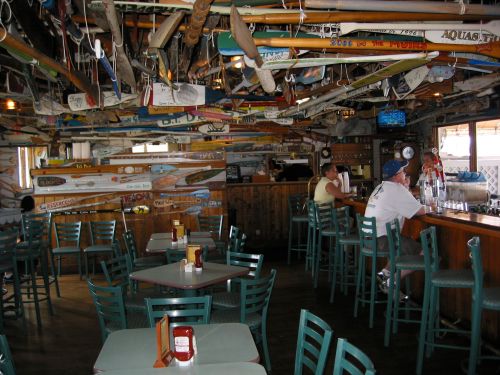
The Orr

The Oar, a good place to eat fried fish on Block Island

I encountered all sorts of batters and coatings for those scallops at places on Block Island. A fancy restaurant we went to served them sheathed in a coat of armor. I couldn’t figure out exactly how they achieved that. Maybe it was just flour and water, but it cracked off in one big shell, exposing a lovely translucent scallop that unfortunately went skidding across the restaurant floor. Then there was the thick spongy batter, usually made with eggs and baking powder. Not a favorite of mine.  I prefer a light coating of either flour or breadcrumbs. What I finally decided I loved best was plain old cornstarch. It gives you lightness and crispness and brownness. God, I ate a lot of fried scallops.

When I got back to stinky and steaming Manhattan, I thought I’d gag if I had to eat another fried anything, but here I am already messing around with a bag of Citarella’s scallops and a pot of dangerously hot oil. I can’t help it. I really want you to try these. What I’ve realized was missing from my Block Island scallop extravaganza was a good homemade chili sauce. Trappey’s was ever-present, but it just doesn’t zero in on my true desire. Now I get the chance to make my own, with a little Calabrian flair.

Fried Sea Scallops with Peperoncino Pesto

(Serves 2)

For the pesto:

1 red bell pepper
2 fresh hot red chilies, such as peperoncini or ripe red jalapeños
1 garlic clove, roughly chopped
1/3 cup lightly toasted sliced almonds
The grated zest from 1 lemon
Salt
2 to 3 tablespoons extra-virgin olive oil

Oil for frying (I like using half olive oil and half vegetable oil)
6 large sea scallops, the side muscles removed
½ cup cornstarch
Salt
½ teaspoon sugar
Black pepper
A small bunch of chicory, frisée, or puntarella, torn into pieces
1 scallion, cut into thin rounds, using some of the tender green part
Several lemon wedges

Place the sweet and hot chilies under a broiler, and let them blister and blacken all around. Let them cool a bit, and then rub off and discard as much charred skin as you can (run them under cool water briefly if you’re having a hard time). Seed them and give them a rough chop.

Place the chilies, garlic, almonds, and lemon zest in the bowl of a food processor. Add some salt and about 2 tablespoons of olive oil. Pulse until you have a rough paste. If it seems too crumbly, add a bit more olive oil. Transfer the pesto to a little bowl.

Place the greens and the scallion in a small salad bowl. Lay out two salad plates.

Get out a wide pot with high sides, and fill it about 3 inches deep with half olive oil and half a neutral vegetable oil. Turn the heat to high. Test the oil. If it sizzles quickly when you add a few drops of water, it’s hot enough.

Place the cornstarch in a shallow bowl, and season it well with salt, the sugar, and the black pepper. Dry off the scallops, and then add them to the cornstarch, coating them well. Shake off any excess.

Dress the greens with a squeeze of lemon juice, a little olive oil, salt, and black pepper, and divide them onto the two plates.

Drop the scallops into the oil. They should all go in at once, since you’re cooking only enough for two. Let them get good and brown on one side, and then give them a flip and let them brown on the other side. Try not to move them more than once. The cooking should take about 2 to 3 minutes total, depending on their size. With a large strainer spoon, lift the scallops from the oil and onto paper towels. Place three scallops on top of each salad. Top with a generous spoonful of the pesto, and garnish with the lemon wedges. Serve right away.

If you have leftover pesto, add it to a tomato sauce for spiciness, or stir it into summer minestrone for a little kick. It’s also nice as a topping for ricotta-slathered bruschetta.

Read Full Post »

sophia boat
My summer vacation.

Recipe: Cantaloupe Salad with Speck, Mozzarella, and Sweet Marsala Vinaigrette

It’s cantaloupe time again in Manhattan. Don’t ignore them. They’re big, but they’re uniquely delicious. Cats even like them. Think salt instead of sweet, and you’re on the right track.

Everybody’s Italian grandfather, including mine, salted his cantaloupe. Peppered it sometimes, too. That brings up its flavor like no sweet thing can, which of course, is why cantaloupe is often paired with prosciutto. With that brilliant pairing in mind, I decided to fashion a composed salad using some of my favorite Italian ingredients.

I chose Speck instead of prosciutto because its more rugged structure and slight smokiness stand up better to a vinaigrette (prosciutto will get soft and flabby while sitting in vinegar). You could also use a soppressata cut into thin matchsticks. Then I added bocconcini mozzarella and grape tomatoes. I melon-balled the cantaloupe in an effort to extend the salad’s round theme . I padded it with frisée lettuce (you could use chicory), some basil (mint or tarragon would also be good), and a few other savories, tossing it all with a Marsala vinaigrette. Black olives might have been nice with this as well, but I didn’t include them, thinking they might tilt the salad into the category of overload (maybe I’ll try using the olives in place of the Speck next time). I think the results are voluptuous. I really hope you’ll like it as much as I do.

cantaloupe

I’ll be on vacation this week, not on the Italian Riviera, where I believe Sophia and Jean-Paul were cruising, but on Rhode Island, which I suppose is a kind of Italian-American Riviera. (I think Rhode Island has the highest percentage of Italians of any state. Or maybe Connecticut does. Actually, I just looked it up. New Jersey ranks first, then Connecticut, then Rhode Island, and then New York.) Well, in any case, there are lots of Italians up there running seaside fish restaurants, and I’m going to make sure I get to a few of them (fried fish is tops on my list for summer dining). I’ll also do some research on Rhode Island oysters and summer produce and come up with a few good recipes for you. See you next week.

Cantaloupe Salad with Speck, Mozzarella, and Sweet Marsala Vinaigrette

(Serves 4 as a first course or a lunch dish)

For the vinaigrette:

¼ cup sweet Marsala
1 tablespoon Spanish sherry vinegar
3 tablespoons extra-virgin olive oil
Salt
Black pepper

For the salad:

1 small cantaloupe, scooped out with a melon baller
1 pint grape tomatoes
About a dozen bocconicini mozzarellas
¼ pound Speck, cut into thin strips
1 large bunch frisée lettuce, ripped into pieces
1 shallot, thinly sliced
A handful of basil leaves

To make the vinaigrette, pour the Marsala into a small saucepan, and boil it over high heat until you have about a tablespoon. Let it cool for a few minutes. Then whisk in the sherry vinegar and the olive oil, and season with salt and black pepper.

Place all the ingredients for the salad in a large salad bowl. Pour on the vinaigrette, and toss gently. Serve right away.

Read Full Post »

corn

Recipe: Corn Sautéed with Green Pepper, Sweet Onion, and Basil

Corn on the cob (or corn on the club, as a friend’s very young son used to call it), is great when it’s dripping with butter, but there’s really nowhere to go with it from there, unless you turn it into a corn dog or a marital aid. If those outcomes hold no appeal, then you need to move ahead, take the kernels off the club, and figure out what to do with them.

I don’t get much inspiration from Italy on this subject, since the corn there is either ground into polenta or hacked up and fed to animals. But I’m an animal, and I love corn, and I’m always looking for ways to serve it with Italian flair. If I’m on my own here, so be it.

frying peppers
Italian frying peppers from the Union Square Greenmarket.

I discovered a very interesting pairing recently while playing around with a counter full of corn kernels (at least, the ones that were left after my cat got finished with them—he loves corn, as I never knew until a few days ago). I sautéed them up with a little green pepper. The pepper’s acidic, almost gasoline flavor works really well to temper corn’s sugar, especially the sugar in some of the hyper-sweet new-fashioned varieties (I don’t like those types at all; I wish they’d go away). I didn’t use a green bell pepper but instead chose the milder, light green, Italian frying pepper of sausage-and-pepper fame. The Spanish Cubanelle is similar in looks and flavor. I pulled the two polar flavors together with sweet onion, a splash of dry white wine, and a scattering of basil. Corn and basil go well together (which reminds me that another good thing to do with corn is to sauté the kernels in a little olive oil  until tender and then toss them with a lump of pesto—really nice).

I served this corn dish with merguez sausage, which is spicy; a mild Italian pork sausage would be great with it, too.

There’s plenty of corn out there now. I hope you’re working it.

Corn Sautéed with Green Pepper, Sweet Onion, and Basil

(Serves 4)

Extra-virgin olive oil
1 fresh summer onion, cut into small dice
1 Italian frying (or Cubanelle) pepper, seeded and cut into small dice
The kernels from 4 uncooked ears of corn
Salt
Black pepper
A pinch of ground nutmeg
A pinch of ground cumin
A pinch of ground cayenne
A splash of dry white wine
A handful of basil leaves, cut into chiffonade

In a large skillet, heat 2 tablespoons of olive oil over medium flame. Add the onion and the pepper, and sauté until everything is soft and fragrant, about 4 minutes. Add the corn, seasoning it with salt, black pepper, the nutmeg, the cumin, and the cayenne. Sauté to coat it well with all the flavors, and let the corn soften for about another 4 minutes. Add the splash of white wine, and let the corn simmer in it until it’s just tender, about a minute or so. Pour the corn into a serving bowl,  give it a drizzle of fresh olive oil and add the basil, giving it a quick toss.

Serve hot.

Read Full Post »

stillife peaches
Still Life with Peaches, Panfilo Nuvolone (1581–1631).

Recipe: Peach Salad with Wild Arugula, Goat Cheese, Almonds, and Basil

It has been a good summer for peaches. Not so great for tomatoes, sadly, but at least we have good peaches. Some years they never seem to ripen, or they’re mealy (that’s the most upsetting of all). This year they seem perfect. And for me, good peaches mean I’ll be soaking them in wine, either red or white, but in true Southern Italian fashion usually red. My father always did that for us in the summer. And it was a regular offering at the Little Italy festivals of my childhood, peaches in wine served in plastic cups, before the booze-and-glamour police took over and decided vendors could only sell refrigerator magnets.

I’m not a religious person, but peaches and wine seems religious to me. After all, the fruit is anointed in the substance that is the usual stand-in for the blood of Christ. You can work the concept a few ways. Just bring peaches to the table and drop slices into your wineglass as an end-of-the-meal cap-off. Or do it up formal, and bring out a big presoaked bowl of peaches. That’s what my father preferred, more often than not.

From my experience, the longer they sit, the better or worse they become, depending on the wine. The peaches can get really bitter if the wine is bad, and we had some bad wine back then, especially the Chianti in a basket that turned my gums black (but turned the peaches a gorgeous shade of burgundy). If the peaches were sweet and the wine was mellow, you could have a most voluptuous summer dessert, especially after it was left to macerate for a time and the peach juice mingled with the wine, creating a kind of puckery sangria effect. My parents often bought a cheap Spanish wine when I was a kid. I can’t remember exactly what it was, but it was sort of rich tasting, not as acidic as most of the cheap Italian stuff they also bought. It was very good with peaches. My father insisted you couldn’t really enjoy peaches in wine without a cigarette. A slurp of wine, a bite of peach, a suck on the cigarette—for him, a beautiful trilogy.

That was my first taste of peaches made savory, and I loved it with a passion. I guess I’ve been fascinated from an early age with nudging the flavor of fruit away from the sweet. I’d rather eat duck breast with vinegary peaches than eat peach pie. Peaches with basil or mint and peaches tossed with olive oil and onion are flavor combinations I daydream about, but those dishes can easily become a reality, if you’re game.

Which brings me to what I view as my favorite dish this summer, the peach salad. Savory peach salads seem to be turning up on restaurant menus all around town. I had a good one at Aurora, on Broome Street, a few weeks ago. It included Parmigiano cheese and hazelnuts. When a trend turns out to be worthwhile, there’s nothing better for an antsy cook to play around with, and I’ve been playing around with it.

I recently had what I consider the best peach salad of the season, at my favorite out-of-town restaurant, Peekamoose, in Big Indian, New York, deep in the not so prosperous Catskills. With places up there closing left and right, this place only gets better and busier, and that’s because it’s excellent (take note, all you mediocre places complaining of no customers). Devin Mills, the chef at Peekamoose, creates food with a delicate touch. His peach salad is a composition of pure beauty, a toss of local peaches, arugula, and red onion, with a scattering of goat cheese and a few pistachios, all held together by a gently vinegared dressing. It is a great mix of bitter, sweet, sour, and salty.

Here’s my take on it.

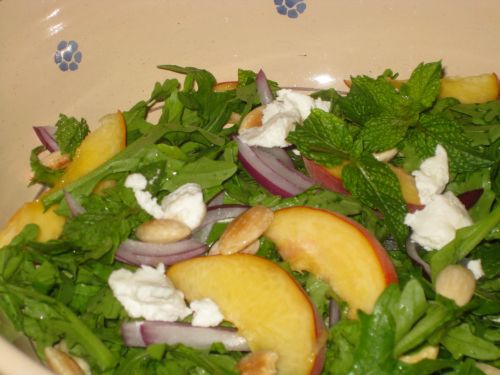
peach salad

Peach Salad with Wild Arugula, Goat Cheese, Almonds, and Basil

(Serves 2)

1 large bunch wild arugula (or use the regular supermarket arugula), stemmed
1 perfectly (not excessively) ripe peach, cut into thin wedges
A handful of blanched whole almonds, lightly toasted
A few very thin slices of red onion
About a half a small log of fresh goat cheese
A dozen basil leaves, left whole
1 teaspoon Spanish sherry vinegar
A few drops of balsamic vinegar
Salt
Black pepper
A pinch of grated nutmeg
2 tablespoons extra-virgin olive oil

Place the arugula in a medium-size salad bowl. Add the peach slices, the almonds, and the red onion. Crumble on the goat cheese, and add the basil leaves.

In a small bowl, whisk together the sherry and balsamic vinegar with the olive oil, and season it with salt, black pepper, and the nutmeg. Pour it over the salad, and toss gently. Serve right away.

Read Full Post »

tenerumi
Tenerumi from the Union Square Greenmarket.

Recipe: Spaghetti with Tenerumi and Pomodoro Crudo

Often when cooking I find that just the look of an ingredient can  inspire me. As a kid, when I first saw cucuzza growing in our  neighbors’, the Cavuotis’, backyard garden, I knew that long, twisted, snaky zucchini type thing, which they called “zucca lunga,” was weird and mysterious and therefore attractive. I never knew what they did with it, and I was maybe a little afraid to ask.

I didn’t think much about zucca lunga for a decade or so after that, until it started showing up at city Greenmarkets. There it was, light green, really long, and just as weird as when I first spotted it taking over Mr. Cavuoti’s garden. I bought one, took it home, chopped it up, and went about cooking it as I would zucchini. Boy, what a disappointment. It was a bore.

cucuzza
Zucca lunga for sale in Sicily.

But as I learned a few years later, while traveling around Sicily for the first time, one of the treatments for zucca lunga is to candy it, just as they do with citron, and use it to decorate cassatas or cannolis. They also turn it into a dull, watery soup. But I also learned that the tendrils—the stems and leaves—are what are really prized. The beautiful, tangled greens the squash produces are a Sicilian summertime treat, usually worked into a soupy pasta dish. And that’s just what I made this week when I found tenerumi tied up in big, wild-looking bunches at the Union Square market. The tenerumi looked both lovely and frightening at the same time. I hate to say it, but to me the stuff almost looks like it’s moving. Its kinky coils resemble skinny worms poking their way out from amid a mass of stems and tender dark green leaves. That was fine with me.

A pretty standard Sicilian pasta consists of tenerumi, garlic, maybe a bit of hot chili, and tomato, all simmered together and finished with a sprinkling of pecorino. That is more or less the recipe I found in Natalia Ravida’s lovely book Seasons of Sicily, among other places. Broken spaghetti is the traditional pasta employed with tenerumi, but I always object to the messy look that produces, and I decided instead to just go with the regular pasta. Otherwise I didn’t stray far from the classic Sicilian rendition. I did, however, decide to keep my summer tomato raw, added only at the last minute, for a fresh burst of contrasting flavor and texture.

Tenerumi has a beautiful taste. Somehow I’d expect something so dramatic-looking to be bitter, but it’s actually very delicate. I’m not sure why, but its flavor reminds me of Chinese dishes that incorporate wilted greens, possibly because the taste is somewhat like pea shoots. But it’s much more subtle. Pea shoots taste like peas; tenerumi doesn’t really taste like the squash, and to me, in fact, the squash tastes like almost nothing.

I’m not sure what a good substitute for tenerumi would be. You could make a similar pasta with Swiss chard, I suppose, but this stuff really has a unique flavor and texture. I would say, if you find a bunch of tenerumi at your farmer’s market, pick it up and try this pasta.

tenerumi pasta

Spaghetti with Tenerumi and Pomodoro Crudo

(Serves 2)

2 medium-size ripe summer tomatoes, seeded and cut into very small dice
Salt
Extra-virgin olive oil
1 big bunch tenerumi, the tough stems trimmed
½  pound spaghetti
About ¼ cup small diced pancetta
3 summer garlic cloves, thinly sliced
1 fresh hot chili (such as a jalapeño or a peperoncino) minced (remove the seeds if you like less heat)
A splash of dry Marsala
A handful of basil leaves, lightly chopped
A chunk of mild pecorino cheese

Place the diced tomato in a colander, sprinkle it with a little salt, and give it a toss. Let it drain over a bowl for about 30 minutes, and save the drained tomato water. Pour the tomatoes into a small bowl, and drizzle them with olive oil, giving them a toss.

Set up a big pot of pasta cooking water, and bring it to a boil. Add a generous amount of salt.

Cut the tenerumi into approximately 1- inch lengths, discarding some of the coily parts and any really thick stems that are still attached. Throw the tenerumi into the water, and blanch for about 3 minutes. Scoop it from the water into a colander with a large strainer spoon. Run cold water over it to bring up its green color. Squeeze as much water as you can from it. Bring the cooking water back to a boil.

Drop the spaghetti into the water.

In a large skillet, heat about 2 tablespoons of olive oil over medium heat. Add the pancetta, and let it get nice and crisp. Add the garlic and the fresh chili, and sauté until everything softens and gives off a good aroma. Add the tenerumi, seasoning it with salt. Sauté until the greens are well coated with oil and everything is fragrant, about 4 minutes. Add the Marsala, and let it boil away. Add any tomato water you’ve collected from draining the tomatoes.

When the spaghetti is al dente, drain it, saving about ½ cup of the cooking water. Pour the spaghetti into a large serving bowl, and drizzle it with a generous amount of fresh olive oil. Add the basil, and grate on about a tablespoon or so of pecorino. Give it a toss. Now add the tenerumi sauce and enough of the pasta cooking water to moisten everything well (the dish should be a little loose). Toss well. Serve hot with extra pecorino brought to the table for grating.

Read Full Post »

« Newer Posts - Older Posts »