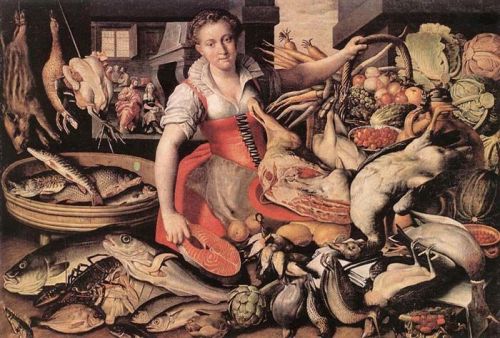
A lady with a nice looking salmon steak, by Vincenzo Campi (1536-1591).
Archive for the ‘2009’ Category
Women with Fish
Posted in Women with Fish on July 27, 2009| Leave a Comment »
String Beans with Pancetta and Lemon Breadcrumbs
Posted in Skinny Guinea on July 22, 2009| 4 Comments »

Recipe: String Beans with Pancetta and Lemon Breadcrumbs
Have you ever noticed how awful supermarket string beans are? What kind of question is that, you’re probably asking yourself, since they’re usually so obviously dry, bitter, woody, faded, and starched over? But somehow I got used to them. That’s really sad. I needed the Greenmarket to refresh my memory, reminding me how lovely these vegetables can be in July, when they’re fresh picked and piled up high, dark green, crisp, moist, and gorgeous. They’re an entirely different creature. Unbelievable. With all the boring and now somewhat embarrassing talk from food types about eating seasonally and locally, this is one time it’s so apparent the difference is startling. The vegetable isn’t dreary. It’s exciting and inspiring. I rushed a big bagful home yesterday and invited my sister, Liti, over for dinner.
I knew I needed a quick-cooking approach to preserve their green, moist beauty. I tried to recall how my mother usually prepared my father’s summer garden string beans, but I couldn’t remember ever eating them. I must have. We had tons of them. I guess it was with garlic and olive oil, but how could I not remember? They must have been good. Maybe she overcooked them so they tasted like the supermarket version, even though my father obsessively tended to them in our back yard. That’s not fair of me, and in any case it was my grandmother’s job to hammer vegetables to death. I pride myself on remembering just about everything I ever ate, going back years. Maybe my mother just boiled them.
I might put that dish out of my mind. I do remember her making string beans simmered in tomato sauce, sometimes with potatoes, but not in the summer (that was a dish, and a good one, that was definitely done only with the supermarket supply). Oh,well. Let me think about it. I’m sure it will eventually come back to me.
In the meantime I decided to go with my original instinct and employ olive oil—but really good olive oil—and garlic. Then I thought about breadcrumbs and lemon and giving the results a gentle toss with my fingers instead of a spoon (it seemed quick and easy, maybe a little scalding, but I’m used to that, and enjoy it, even). Maybe this is how I ate summer string beans when I was a kid. Doubt it though. I think I would have remembered it. These are really delicious.
String Beans with Pancetta and Lemon Breadcrumbs
(Serves 4 as a first course or a side dish)
For the breadcrumbs:
½ cup homemade breadcrumbs, not too finely ground
1 tablespoon extra-virgin olive oil
1 tablespoon unsalted butter
The grated zest from 1 lemon
½ teaspoon sugar
Salt1 pound string beans, trimmed
Salt
Extra-virgin olive oil
½ cup small diced pancetta
1 shallot, minced
2 summer garlic cloves, thinly sliced
Black pepper
A squeeze of lemon juice
In a small sauté pan, heat a tablespoon of olive oil with a tablespoon of butter. Add the breadcrumbs, and sauté for a minute or so, just until they start to get crisp and golden. Add the lemon zest, the sugar, and salt, and sauté a few seconds longer, just to season them uniformly.
Set up a medium pot of water, and bring it to a boil. Add a little salt, and throw in the string beans. Blanch until tender-firm, about 2 minutes. Drain the beans into a colander, and then run cold water over them to stop the cooking and bring up their green color. Drain well.
In a large skillet, heat 2 tablespoons of olive oil over medium heat. Add the pancetta, and sauté until crisp. Add the shallots, garlic, and string beans, and sauté quickly, just until the shallots and garlic give off flavor and the string beans are well coated with flavor. Season with salt and black pepper and a squeeze of lemon juice.
Pour the string beans into a large serving platter, scatter on a heaping tablespoon of the breadcrumbs, and toss gently. Top with the remaining breadcrumbs and a generous drizzle of fresh olive oil. Serve hot.
Summer Potatoes, Octopus, and Flowering Thyme
Posted in Skinny Guinea on July 19, 2009| 1 Comment »

Recipe: Warm Potato Salad with Grilled Octopus and Flowering Thyme
Sometimes on an oppressively hot Manhattan evening there’s nothing I like better than closing all the windows, jacking up the AC, throwing on a Chinatown bathrobe and lighting a cigarette (if I’m feeling tawdry), opening a bottle of red wine (a fresh, unoaked Barbera Castello del Poggio, for instance), and getting myself into the kitchen to cook up a big pot of something that bubbles and steams and smells rich but ultimately produces a dish of lightness. There’s where the octopus comes into play.
I’m not into those baby octopuses you find at restaurants these days. To me they look like waterbugs. I know they’re quick to sear up, but for flavor and texture I prefer the big ones. They need a long, slow simmer, something that couldn’t be simpler or more sultry. After that first step, you can move on to grilling or sautéing to create a summer masterpiece.
Get yourself a good-size octopus, about two pounds. Fresh and frozen are both fine. I’ve been finding fresh at my fish seller lately. Have it cleaned (which means excavating the head section), but otherwise leave it whole. Then all you need to do is lower it into a pot a liquid.
I know you’re wondering about the cork trick, right? Supposedly placing a wine cork in the pot helps tenderize the octopus—something about the cork’s enzymes. Many chefs and home cooks swear by this. I really don’t understand it. I’ve tried it several times, and I couldn’t discern any difference. I’d rather cook the thing in the wine itself. At least that gives it good flavor.
Warm Potato Salad with Grilled Octopus and Flowering Thyme
(Serves 4)
To simmer the octopus:
1 approximately 2-pound octopus, cleaned, and thawed if frozen
1 bay leaf
Salt
1 cup dry white wine
A few thyme sprigs
2 garlic cloves, lightly crushedFor the salad:
Extra-virgin olive oil
A generous pinch of hot paprika
A pinch of sugar for the octopus, plus another little pinch for the vinaigrette
Freshly ground black pepper
Salt
A dozen small red new potatoes
2 tablespoons dry white wine
1 red shallot, thinly sliced
A palmful of capers
About 8 large thyme sprigs, with blossoms if available, the leaves chopped
1½ tablespoons Spanish sherry vinegar
A generous pinch of ground allspice
Freshly ground black pepper
A handful of flat-leaf parsley leaves, lightly chopped
Put the octopus in a large pot, and add the bay leaf, salt, 1 cup of white wine, the thyme sprigs, and the garlic cloves. Add cold water to cover the octopus, and bring it to a boil. Reduce the heat to low, and simmer, partially covered, until the octopus is tender, about 1 to 1½ hours, depending on its size. Start testing after about an hour; you can overcook octopus, making it dry. It’s done when a skinny knife goes easily into the thick part of the tentacle. When the octopus is tender, turn off the heat and let it sit in the water for about 20 minutes (I find this helps tenderize it further). Then lift it from the water, and let it cool until you can handle it.
Cut the tentacles from the body of the octopus, dry them well, and then toss them with a little olive oil. Season with the hot paprika, pinch of sugar, salt, and black pepper.
Place the potatoes in a medium saucepan. Cover them with cool water, and season well with salt. Boil until just tender, and then drain well. Cut the potatoes in half, and place them in a large serving bowl. Mix the white wine with a tablespoon of olive oil and a little salt, and pour it over the hot potatoes. Toss gently with your hands, letting the wine mixture soak into the potatoes. Scatter on the red shallot and the capers.
In a small bowl, add the thyme and blossoms, vinegar, sugar, allspice, and about 3 tablespoons of olive oil. Season well with salt and black pepper, and whisk everything together.
Set up a grill pan over a high flame (or you can do this on an outdoor grill, if you feel like leaving the house). When the grill is nice and hot, add the octopus and grill it, turning it once or twice until it’s well grilled all around (but not charred, if you can help it). Pull the octopus from the grill, and cut it into 1-inch pieces.
Add the octopus to the potatoes. Pour on the vinaigrette, and toss gently. Garnish with the parsley. Serve right away.
La Cucina Povera and Stuffed Zucchini
Posted in Skinny Guinea on July 15, 2009| 10 Comments »

Castelfranco in Miscano, home of my grandparents, a classic cucina povera town (note the taralli strung around the base of the Virgin).
Recipe: Round Zucchini Stuffed with Farro, Garlic Sausage, and Savory, Served with a Cherry Tomato Sauce
My taste in food tends toward la cucina povera, the traditional cooking of Italy’s less well-heeled. This is not because I’m dirt poor, nor is it a strict philosophy. I love this cooking for its taste (I guess I’m a peasant through and through). I’ve always been attracted to grains (any starch really), all vegetables, oily fish like sardines and anchovies, and little bits of fatty meat mixed with lots of filler. I really admire breadcrumbs.
Big slabs of relatively cheap meat were what my and everybody else’s grandmother found in urban grocery stores in the 1910s and ’20s, when they arrived in this country. What a pleasant shock it must have been, but, in a way, what a shame, since it corrupted many of their classic cucina povera dishes. In my opinion the meatball was ruined by Italian-Americans’ newfound ability to procure endless supplies of chopped meat. In their excitement over their good fortune, they cut back on, or abandoned altogether, the soft, wine- or milk-moistened bread that had provided the light texture for the homeland meatball, only to create heavy, dull, big, ugly meatballs that were nothing to be proud of. Exactly how my grandmother’s cooking changed when her family moved from miserable old Castelfranco, on the Puglia boarder, to Port Chester, on Long Island Sound, I can only surmise, but she served steaks and big roasts much more often than tough cuts like braciole that were traditionally stuffed with stale bread and hard cheese to make a little go a long way. The few times I’ve eaten with relatives in Castelfranco, we’ve had macaroni with tomato sauce, often baked and flavored with a little pork fat, or once with slivers of sweet peppers. The side attractions have included vinegared vegetables, really terrible homemade wine, a solid chunk of pecorino, and rock-hard taralli. Nothing too fancy, but it’s had its glamor.
I suppose it was inevitable that la cucina povera cooking would become hot in Manhattan restaurants. Why serve expensive meat when you can charge $34 for bucatini cacio e pepe (pasta with pecorino and black pepper)? However, if chefs were working within the true confines of la cucina povera, they’d be tossing their bucatini with breadcrumbs and dried red chili—as I’m sure some of them are. I’m guilty of corrupting the spirit of cucina povera myself, but I do feel that at times it just can’t be helped. I mean, imports are expensive. If I want to make pasta cacio e pepe at home and want it to taste the best it can, I’ll use my $40-a-bottle Sicilian olive oil, $24-a-pound pecorino, $8 box of Latini spaghetti, and the fancy Tellicherry peppercorns I pick up at Kalustyan’s. What a shame. Thank god I don’t have kids to feed. I suppose what I really feel about cucina povera is, don’t worry about the hypocrisy, just go for the taste.
One of my favorite kinds of cucina povera dishes is stuffed vegetables. I always find myself making them at times during the summer, at my first sight of local mini-eggplants, for instance. I love them for their improvisational design, for their compact beauty, and, above all, for their taste. Any vegetable that’s small and scoopable is great for stuffing.
To my mind, a stuffed vegetable should highlight the vegetable that’s stuffed. I always use some of its scooped-out insides in my stuffing. Then I move on to a starch filler of my choice. Lately I’ve been trying to get away from rice and dried bread. They’re both good and classic, but they’ve been done to death. So I’ve turned toward whole grains. I love farro and wheat berries. You can use either in this recipe. Once I pick my filler, everything else, especially any meat I might add, I use in minuscule amounts. In true cucina povera fashion, I find I can stretch the expensive ingredient almost to nonexistence. In this structure lies the beauty—a delicate flavor that doesn’t overpower but in fact highlights the vegetable itself.

I’ve been finding round zucchini at the Union Square Greenmarket. Yuno Farms calls it avocado squash, and its inside does resemble a firm avocado. This cute, light green zucchini seems to have no seeds (not possible really, though—they must be in there somewhere), and it has much less water than the usual long zucchini. It’s lovely and smooth, and it just beckons to be stuffed.

Round Zucchini Stuffed with Farro, Garlic Sausage, and Savory, Served with a Cherry Tomato Sauce
(Serves 6 as a lunch, a light supper, or a first course)
6 small, round zucchini
Salt
Freshly ground black pepper
Extra-virgin olive oil
1½ cups farro
1 2-inch piece of garlic sausage, cut into tiny cubes
1 small fresh onion, cut into small dice, using some of the tender, green part of the stem
1 small inner celery stalk, cut into small dice, plus a handful of celery leaves, lightly chopped
A few sprigs of summer savory, the leaves chopped
A splash of dry vermouth, plus a little extra for baking
A good-size chunk of pecorino Toscano cheeseFor the tomato sauce:
2 pints cherry tomatoes, quartered
Salt
Extra-virgin olive oil
1 fresh summer garlic clove, minced
2 scallions, cut into thin rounds, using some of the tender green part
Freshly ground black pepper
A small handful of flat-leaf parsley leaves, lightly chopped
Preheat the oven to 400 degrees.
Cut the tops off the zucchini about a quarter of the way down. Scoop out the insides of the round part with a melon baller, saving the insides. Cut a thin slice from the bottom of each zucchini, so it will sit upright. Place the zucchini, cut side up, in a baking dish that will hold it fairly snuggly. Drizzle the zucchini lightly with olive oil inside and out, and season with salt and black pepper. Bake for about 30 minutes, or just until it starts to soften but is still firm and holding its shape. Take it from the oven, and let it cool off a bit.
While the zucchini is baking, set up a medium pot of water, and bring it to a boil. Add a generous amount of salt, and add the farro. Cook at a lively bubble until the farro is just tender, about 18 minutes. Drain well.
Chop finely about half of the zucchini insides (avoid the food processor, as it can make them watery). You’ll want about a cup or so of chopped zucchini. In a medium skillet, heat about 2 tablespoons of olive oil over medium flame. Add the garlic sausage, the onion, the chopped celery, and the savory, and sauté about two minutes, just to soften the onion and release the flavors of the sausage and savory. Add the chopped zucchini, and sauté a few minutes longer. Add the dry vermouth, and let it bubble for a few seconds, leaving some liquid in the skillet. Add the farro, and mix well, seasoning with salt and black pepper. Add the celery leaves and a generous drizzle of fresh olive oil. Let cool for a few minutes, and then grate in about three tablespoons of pecorino Toscano.
Fill the zucchini rounds with the farro mixture, trying not to pack it down too firmly (save any leftover filling for a side dish, or for your lunch). Drizzle the tops with a little dry vermouth and then with a little more olive oil. Sprinkle a bit of grated pecorino over the zucchini. Now place the zucchini tops, flat part down, on a small, lightly oiled sheet pan. Drizzle the tops with a little more olive oil, and season them slightly with salt and black pepper. Bake both the stuffed zucchini and the tops until tender and lightly browned, about 45 minutes or so for the stuffed part, about half an hour for the tops.
While the zucchini is baking, mix all the ingredients for the tomato sauce together in a small bowl. If your cherry tomatoes are very juicy, you might need to salt and drain them for a bit before assembling your sauce.
Take the zucchini from the oven and place the tops on them. Serve warm or hot, accompanied by the cool tomato sauce.
Women with Fish
Posted in Women with Fish on July 13, 2009| 3 Comments »

Women drying fish in India.
Chicken Salad with Radicchio, Pine Nuts, and Caper Berries
Posted in Skinny Guinea on July 7, 2009| 1 Comment »

Recipe: Chicken Salad with Radicchio, Pine Nuts, and Caper Berries
When I’m stuck in the city on a summer weekend, I want to cook food that’s appropriate for an outdoor barbecue or a picnic, just to feel a semblance of summer freedom and fun. Sometimes it works, sometimes it doesn’t, depending on how much I manage to sweat up the apartment. We have only one small air conditioner, and it’s in the bedroom, but often it does the trick, cooling off the entire place. It was, however, not up to the task last night, when I decide to make cookout-inspired barbecued chicken on a stove-top grill plate. Within the confines of my little kitchen, the entire project was out of control—too much oil, smoke everywhere, sweat pouring down my neck, my eyeballs red and burning. Luckily we ripped the smoke detector thingy out of the wall years ago. Wow, what a mess. The walls were covered with a thin grease slick. After all that, I had no appetite for the chicken. All I wanted was a cold glass of vodka.
So today I have a ton of charred chicken in my refrigerator, but at least I don’t have to cook tonight and burn the place up again. Tonight we’ll have a nice summer picnic instead of a barbecue. Tonight we’ll have chicken salad. I’ve ripped into that chicken and discovered it was tender, moist, and delicious under all that char. I decided I wanted to have my picnic in the Sicilian countryside, maybe in the shade of Mount Etna, so the salad got caper berries, pine nuts, lots of excellent Sicilian olive oil (Ravida, of course), and a great bitter edge from a ruffly, loose ball of radicchio I had just picked up at the Greenmarket. It was a fine picnic in a cool apartment.
Note: I use caper berries in this salad. You may be more familiar with capers, which are the flower buds from the Mediterranean caper, a shrub. Caper berries are the mature fruit of the plant. About the size of grapes, they’re preserved in brine or salt the same way capers are, and they taste quite like capers, maybe a bit gentler, but with a very different texture. When you bite into one, you discover that it’s filled with little seeds and is very crunchy. The best ones I’ve found in this country are Sicilian, produced by Agostino Recca. They’re packaged in white wine vinegar. Just give them a gentle rinse before using.

Chicken Salad with Radicchio, Pine Nuts, and Caper Berries
(Serves 4)
1 small roasted or barbecued chicken, cooked until just tender, warm or at room temperature
A handful of caper berries, rinsed
A handful of pine nuts, lightly toasted
2 celery stalks, thinly sliced, plus a handful of celery leaves
½ small red onion, thinly sliced
1 small head radicchio, cut into chiffonade, leaving 4 leaves whole to use as a salad bed
A handful of basil leaves, cut into chiffonade
The juice and grated zest from 1 small lemon
1 garlic clove, lightly crushed
A teaspoon of Dijon mustard
½ teaspoon sugar
Extra-virgin olive oil
Salt
Freshly ground black pepper
Pull all the meat off of the chicken. You can leave some of the skin on if it’s not too charred. Slice the meat thinly, and place it in a large salad bowl. Add the caper berries, pine nuts, celery and celery leaves, red onion, sliced radicchio, and basil.
In a small bowl, whisk together the lemon juice and zest, garlic, Dijon mustard, sugar, and about 3 tablespoons of olive oil, possibly a bit more, seasoning the dressing well with salt and black pepper. Pour the dressing over the salad, and toss well. Taste for seasoning (you may want more salt or black pepper or something, depending on how much seasoning your chicken had to begin with; I had marinated mine in olive oil, lemon, marjoram, garlic, and a bit of hot chili, so it provided a flavorful base).
Set out four salad plates, and line each one with a radicchio leaf. Pile the salad on top. Serve right away.
Fettuccine with Fresh Peas, Lemon, and Mint
Posted in Skinny Guinea on July 1, 2009| 3 Comments »

John Keats, with a pretty cat friend, at the Protestant cemetery in Rome.
Recipe: Fettuccine with Fresh Peas, Lemon, and Mint
A friend’s 16-year old-daughter is soon leaving for a six-week art history program in Rome. This has gotten me thinking about a lot of things, mainly when the hell am I going to get a summer vacation, but also all the warm-weather Roman food this kid is going to be eating and loving without me. One of my favorite Roman dishes is pasta with fresh peas. You can make it simply, with just sautéed onion, or you can add guanciale or pancetta or prosciutto. You can assemble a carbonara-type dish, with eggs, adding a handful of peas, or you might include cream (my least favorite version). Basil shows up often in this dish. I like mine with pancetta, lemon, mint, and some type of gentle grating cheese such as grana Padano. You can use fettuccine or spaghetti or something chunkier like penne. I’ve had several versions in Rome. They were all memorable.
It has been a while since I visited Rome, but in the past I’ve always stayed in the Testaccio neighborhood, the old meat slaughter area, which also encompasses the unexpected Piramide, Volpetti’s meticulous cheese shop, the big Testaccio food market, Cestia, an inexpensive little trattoria where many patrons look like Salvador Dali and where I first ate pasta con piselli in Rome, and, very important, the Protestant cemetery, which I love for its well-fed cats and ornate, mostly non-Italian graves. I’ve always had a morbid romantic attachment to graveyards. They’re beautiful and soothing, but as I discovered a long time ago, they can also sometimes be as haunting as they have every right to be.
When I was a kid, I planned a picnic at a flower-filled little graveyard in Glen Cove, Long Island, with my morose friend Scott. A fun summer outing. We got very sophisticated, packing a basket with brie and baguettes and cornichons, and a turquoise beach towel. What a lovely time we were having among all the gray stones, sweating in the sun and getting bit by huge flies, when, toward the end of our lunch, I sank my teeth into one of the juicy summer peaches I had packed, and the sensation of the fuzzy skin on my tongue reminded me of something human but somewhere between alive and dead, or specifically more dead than alive. The sudden, overwhelming thought of all the rotting flesh and bones underneath our beach towel creeped me out so thoroughly that I threw up on some poor departed soul named Mancuso. The smell of wilting roses in the blazing sun may have contributed. In any case, I can’t eat in cemeteries anymore, not that it has ever been encouraged by any cemetery staff I’ve run into anyway.
I’ve watched the cats at the Protestant cemetery in Rome being fed huge pots of pasta and ragù by the resident priests, who call to them and they all come running, jumping off the graves of Keats and Shelley, the American Beat poet Gregory Corso, the old Italian Communist Antonio Gramsci, and various English, German, and American poets and artists who came to Rome for its magic and ultimately for its peace. I like watching the cats congregate and eat. I’ve never seen them get fed fettuccine con piselli, but I’ll bet they get it once in a while. Just like me. I love making it a few times every June and early July, when I find sweet shell peas at the New York Greenmarkets. It’s a great dish, but I’m not going to eat it in any graveyard any time soon.
Fettuccine with Fresh Peas, Lemon, and Mint
(Serves 2)
Salt
Extra-virgin olive oil
¼ cup small diced pancetta
1 tablespoon butter
1 small fresh summer onion, cut into small dice
1 cup freshly shucked green peas (about ¾ pound before shucking)
Coarsely ground black pepper
A generous pinch of ground allspice
A splash of dry white wine
½ cup chicken broth, possibly a little more
½ pound fresh fettuccine
The grated zest from 1 lemon
A handful of mint leaves, lightly chopped
A small chunk of grana Padano chese
Set up a pot of pasta cooking water, and bring it to a boil. Add a generous amount of salt.
In a large skillet, heat a tablespoon of olive oil over medium heat. Add the pancetta, and sauté until crisp. Add the butter and the onion, and sauté until softened, about 2 minutes. Add the peas, season with salt, black pepper, and the allspice, and sauté a minute to coat them with flavor. Add the white wine, and let it boil away. Add the chicken broth, and simmer until the peas are just tender, about 5 minutes. Add more broth or a little warm water if the skillet gets dry.
Drop the fettuccine into the water, and cook until just tender. Drain the pasta well, saving a little of the cooking water, and tip it into a large serving bowl. Add the pea sauce and the lemon zest. Add a drizzle of fresh olive oil, a few big grindings of coarse black pepper, and a bit of the pasta cooking water for moisture, if needed. Toss gently. Add the mint leaves, and grate in a heaping tablespoon of grana Padano. Toss again gently. Taste for seasoning, adjusting the salt if needed. Serve right away, with the rest of the cheese brought to the table.
Warm Chickpea Salad with Mortadella and Broccoli Rabe
Posted in Skinny Guinea on June 24, 2009| 3 Comments »

A poster for La Mortadella, the 1971 film directed by Carlo Ponti and, by the way, written by Ring Lardner, Jr.
Recipe: Warm Chickpea Salad with Mortadella and Broccoli Rabe
Summer is cranking into gear at the New York Greenmarkets, with lots of big, scary, leafy greens on display, things that look dark and indestructible. What to do? Take them home and play with them is what I say.
Collards, mustard greens, beet tops, Swiss chard, kale—too healthy for you? I know what you mean. But I’ve also been finding big bunches of broccoli rabe, something close to every Southern Italian’s heart. The bunches I’ve seen from Migliorelli, a Greenmarket farmer based in New York State’s Hudson Valley, look almost unrecognizable alongside the stuff I find at the supermarket. They have fewer buds, more big, leafy greens, and thinner, longer stems. They are beautiful stuff that cooks up tender but with that alluring bitter and sweet taste that goes so well with any number of pork products.
Lucky for me, I’ve also happened to have on hand a chunk of mortadella, one of the few Italian pork specialties, besides prosciutto, that are legally allowed into this country. Many people don’t know you can buy real Bologna mortadella here, and it’s much better than most American brands, with smooth texture and subtle spicing, studded with little bits of fat and pistachios. What a lovely thing, and what a great match for broccoli rabe. No wonder Sophia Loren went ballistic when customs inspectors snatched the giant mortadella she tried to smuggle in through New York’s JFK Airport in the summer of 1971 (this was not real life, but a scene in the Carlo Ponti film called, fittingly enough, La Mortadella). I have to admit to sneaking many Italian sausages through airport customs myself and getting caught only once, with a beautiful soppressata from Lecce, Puglia. It broke my heart having it taken away, especially when I knew those nasty boys would only bring it into some secret back room, pop open a few bottles of confiscated Brunello, and wolf the whole thing down.
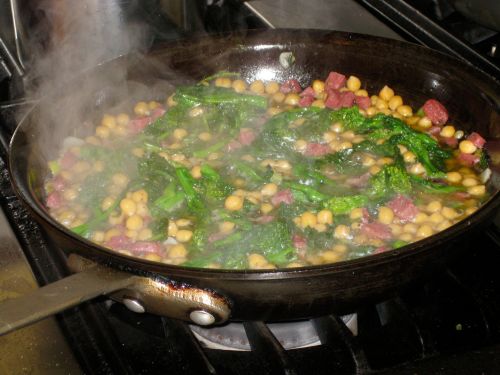
Warm Chickpea Salad with Mortadella and Broccoli Rabe
(Serves 5 as a side dish or a light supper)
2 cups dried chickpeas, soaked overnight in cool water to cover
1 bay leaf, fresh if possible
Extra-virgin olive oil
Salt
1 big bunch broccoli rabe, the tough stems trimmed
1 small onion, cut into small dice
¼ pound mortadella, cut into small cubes
2 garlic cloves, thinly sliced
1 small, fresh, red peperoncino pepper, minced
A few sprigs of rosemary, the leaves chopped
A splash of dry white wine
A tiny drizzle of red wine vinegar
A chunk of pecorino Toscano cheese
To cook the chickpeas, drain them, and place them in a large pot. Cover them with cool water by at least 3 inches. Add the bay leaf, and turn the heat to high. When the water comes to a boil, lower the heat, and let them simmer gently, partially covered, until tender, about 1½ hours, but it really depends on how hard your chickpeas are. Some can take much longer, but start testing them after about 1½ hours. Add more warm water if needed to keep the chickpeas covered. When they’re tender, season them with salt and a generous drizzle of olive oil, and turn off the heat. Let them sit in their warm cooking water for about a half hour (this will help tenderize them).
Drain the chick peas, saving all their cooking liquid.
Set up a large pot of water, and bring it to a boil. Drop in the broccoli rabe, and blanch for about 2 minutes. Drain it into a colander, and run cold water over it to stop the cooking and to set its green color. Squeeze as much water as you can from the broccoli rabe, and then chop it roughly.
In a large skillet, heat 3 tablespoons of olive oil over medium heat. Add the onion, and sauté until softened, about 4 minutes. Add the mortadella, the peperoncino, the rosemary, and the garlic, and sauté a minute longer, just to release their fragrances. Add the broccoli rabe, season with salt, and sauté for a minute or so longer. Add the chickpeas and another drizzle of olive oil, and let them warm through. Add the splash of white wine, and let it boil way. Add a cup of the chickpea cooking water, and let everything simmer for about 4 or 5 minutes, just to blend all the flavors. You should have a little liquid left in the pot (if not, add a bit more of the chickpea cooking broth). Add a few drops of red wine vinegar and a drizzle of fresh olive oil. Taste for seasoning, adding more salt if needed. Serve in bowls, with thin slices of pecorino shaved over the top. You can eat this hot or at room temperature.
Go to Cacio e Vino for Good Sicilian Food
Posted in Restaurant and Product Reviews on June 19, 2009| Leave a Comment »

Maria Grammatico in her pastry shop, in Erice, Sicily.
In all of Italy, Sicily, for me, has the best food. It just makes sense to me all around—the ingredients, the palate, the preparation. I suppose being part Sicilian myself, I’m predisposed to favor Sicilian flavor, and maybe also to be infatuated with Louis Prima. But who really knows why we like what we like? Familiarity no doubt has something to do with fondness, but not everything. Sometimes you just fall in love. For instance, I love the flavor of aqvavit, the strong, caraway-flavored Norwegian booze, although I haven’t got a drop of Norwegian blood in me—and though, by the way, it tastes absolutely terrible with tomato sauce.
Sicilian food is for me a mix of the exotic and the familiar. I love its lows and its highs, from its plain grilled swordfish with lemon, or its raw sea urchins eaten straight from the boat, to its opulent timballi of meats and cheeses encased in sweet pastry, a legacy of an abusive aristocracy with French-trained chefs. I love its Arab touches—cinnamon, saffron, pomegranates, couscous. I love its citrus and anchovies, and capers. I’m crazy about all its ultrasweet desserts made with honey and pistachios, and especially its works of art made with almond paste, molded into sacrificial lambs or eels or bunches of grapes, as fashioned by Maria Grammatico at her pastry shop in Erice (see the photo above, and if you’d like to know her story, a journey that takes her from convent kid to Sicilian pastry queen, pick up Bitter Almonds, a great little book by Mary Taylor Simeti and her, published in 2003).
New York hasn’t had many Sicilian restaurants that I can remember. I used to love Briscola, at Fourth Avenue and 9th Street, named after a Sicilian card game. They made great pasta con le sarde and a delicious escarole torta. I had several rambunctious, nero d’avola and cassata-soaked birthday parties at that place. They made the most superior ricotta gelato I have ever tasted, something I often craved at strange hours, occasionally making my way over to the restaurant just for it. Briscola repeatedly opened, closed, and reopened in slightly different forms for about ten years, finally packing up for good around 2000. I really miss its ricotta gelato

Braised octopus at Cacio e Vino, in the East Village.
Over the last few months I’ve been stopping into Cacio e Vino, one of the zillion little Italian places in the East Village with more or less indistinguishable décor that rely on rows of wine bottles to try to set a mood. This one is different. It’s Sicilian, with a real Sicilian menu and Sicilian owners. And they have a wood-burning oven. I first wandered into the place months ago because its doorway was filled with the aroma of good, smoky pizza. I soon discovered that everything that comes out of its wood-burning oven is really good.
I wanted pizza, but I noticed on the menu that they offered other dough-based things too. There’s schiacciate, a flat bread sandwich that can be filled with all sorts of stuff. I decided on a cunzato, filled with anchovies, primo sale (a young pecorino), and oregano. It was beautiful, with thin, crisp, wood-scented bread and oozing cheese. My friend had a Norma, with eggplant, tomato, and aged pecorino. As good as the schiacciate sandwiches are, nothing is quite as impressive as the farciti, a Sicilian version of calzone. Cacio e Vino makes one that looks like a big crab or a gigantic croissant.
On another visit to the little restaurant I ordered a farcito with potatoes, onions, and sausage, and my sister had the mozzarella, anchovy, and onion version. These are not at all like the usual overstuffed Neapolitan-type calzones that can be so densely packed with ricotta and mozzarella that one or two bites and you’re defeated. The farciti are not solid. They have air inside. They look huge but in fact are quite delicate.
The pastas at Cacio e Vino cover just about all the Sicilian favorites. I’ve tried spaghetti cacio e piselli, with pecorino, black pepper, and green peas. It was simple but flavor-packed, despite its few ingredients. Anelletti, the Sicilian ring pasta, tossed with a beef and eggplant ragù, came closed up in pastry and baked in the pizza oven, very Il Gattopardo. Gnocchi al baccala, with salt cod, was salty but enticing, with its mix of strong fish and very light, fluffy gnocchi. Busiate, a kind of thick spaghetti, tossed with a traditional Trapanese pesto made from almonds, basil and tomatoes, was really lovely and is hard to find in New York. The only pasta I wasn’t completely crazy about was their version of bucatini con le sarde. All the flavors were in place—the sardines, the saffron, the fennel, the raisins and pine nuts—but the sauce was heavy with wet, mushy breadcrumbs. I’ve had it made that way in Sicily, so I suppose it’s a traditional rendition, but I prefer a chunkier texture.
First-course standouts include a rather sweet but very appealing caponata, the agro dolce eggplant appetizer, with a side of panelle, Sicily’s version of socca, the Niçoise chickpea-flour pancake. Braised octopus with a marinara sauce comes with garlic bruschetta. This simple dish has good, direct flavor. The sarde a beccafico, stuffed sardines, a real Sicilian classic, could have been fresher the night I ordered it. I think restaurants in general need to keep a more trained nose on their sardines, which go off quickly. Arancini, those Sicilian saffron-flavored, ragù-stuffed, fried rice balls, are on the menu. I love those things when they’re good. I have yet to try Cacio e Vino’s version, but I’ll be back for it soon I’m sure.
It just occurred to me, I’ve been to Cacio e Vino about half a dozen times so far, and I have yet to order a main course. I can’t seem to get my head out of their pizza oven. Maybe next time I’ll order their baccala with lemon risotto cake. Sounds promising.
I did try the homemade cassata, a cassatina really, since it was thin and not elaborately decorated the way full-blown cakes tend to be. All the flavors were there, the green-tinted almond pasta, the ricotta cream, the fresh little sponge cake. I was very happy to find it house-made and made well.
The wine list is mostly Sicilian, small but good. I love the house rosato, a rosé wine made from Sicily’s famous red wine grape Nero d’Avola. It’s wonderful with the grilled octopus, fennel and orange salad. Check it out.
Cacio e Vino
80 Second Avenue (between 4th and 5th Streets)
New York, N.Y.
(212) 228-3269
Spaghetti with Magda Zucchini
Posted in Skinny Guinea on June 14, 2009| 2 Comments »

Still Life with Zucchini, Giacomo Ceruti, 1700-1768.
Recipe: Spaghetti with Zucchini, Anchovy, and Garlic Toasted Almonds
Finally it’s zucchini time at the New York City Greenmarkets. Big deal, you say? Well, I know what you mean. Zucchini is not exactly the most exciting vegetable. But since it’s the first of the real summer stuff to come into season, I’m always incredibly happy to see it. It is, for me, the great marker, the one dependable thing that tells me summer has officially begun. (It actually hasn’t officially begun on the calendar, but it certainly has culinarily.)
The best thing about buying zucchini and other produce at the Greenmarket, aside from the fact that it’s local and just picked, is that you get to try so many varieties. Every year the New York farmers seem to come up with something new and wacky-looking. This week I saw the usual long, dark green zucchini, and also the deep yellow variation (which I don’t think has much taste, although the things are so beautiful I buy them anyway). There were also little piles of the Italian Costata Romanesco variety, with their raised ribbing. When you cut them into rounds they resemble a snowflake design. I also noticed Magda zucchini, a Middle Eastern variety that look like small, light green torpedoes. So cute, so chubby. Those are my favorites. They have a thick, softer skin and a rich, dense inside that doesn’t fall apart as easily as do the more common dark green ones. I bought a big bag of them and took them home, itching to make something good and summery.
Zucchini, it goes without saying, needs some help. Everyone who’s ever cooked it knows this. And since offering help is what I’m all about, I’ll tell you that I almost always go for garlic, especially since fresh summer garlic becomes available at the same time zucchini makes the scene around here. Leafy herbs like basil, mint, or parsley, and a touch (not too much) of hot chili are nice too. Zucchini isn’t boring. It’s just shy and needs a little push to bring it out.
Another thing anyone who’s ever cooked zucchini knows is that it sometimes gives off a bit of water, which is why it can take on an insipid boiled taste. What you want to do is brown it so it gets a slight, crispy caramelization. To accomplish that, I always cook zucchini slices in a large pan, so they spread out, making steaming less likely. I also add a sprinkling of sugar to help the browning along. And I remember to add salt only at the end, so as not to coax out even more liquid from them.
Here I turn to my all-time favorite pasta, spaghetti, to make a simple but richly embellished zucchini-based sauce. I bring out the big guns, choosing garlic, anchovy, and hot chili—one of the grand Southern Italian flavor trilogies. It’s a freewheeling version of an Italian classic that I hope will open the door to summer for you.
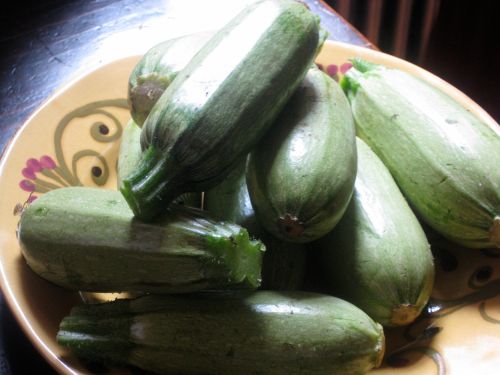
Magda zucchini from the Union Square Greenmarket.
Spaghetti with Zucchini, Anchovy, and Garlic Toasted Almonds
Extra-virgin olive oil
½ cup slivered almonds, lightly chopped
3 cloves summer garlic, thinly sliced
Salt
1 pound spaghetti
6 or 7 Magda zucchini (or small regular green zucchini), cut into half moon shapes
4 scallions, cut into thin rounds, using much of the tender green part
1 medium-hot long green chili, seeded and chopped
A generous pinch of sugar
4 anchovy fillets, minced
A splash of dry vermouth
½ cup light, homemade or good quality store-bought chicken broth, or possibly a little more
The juice from ½ a lemon
A big handful of fresh mint and basil leaves, very lightly chopped
2 tablespoons grated pecorino Toscano cheese
In a small sauté pan, heat a tablespoon of olive oil over medium heat. Add the almonds, and heat until they just start to color. Add one of the sliced garlic cloves, season with a pinch of salt, and turn off the heat, stirring the almonds around so the garlic can flavor them without browning. Set aside.
Set up a large pot of pasta cooking water, and bring it to a boil. Add a generous amount of salt, and drop in the spaghetti.
In a large skillet, heat about 2 tablespoons of olive oil over medium heat. Add the zucchini, scallions, and green chili, all at the same time. Sprinkle on the sugar, and sauté until the zucchini starts to gets golden at the edges and everything is fragrant, about 4 minutes. Add the anchovy and a little salt, and sauté a minute longer. Add the vermouth, and let it boil away. Turn off the heat, and add the chicken broth and the lemon juice, mixing everything around so it will loosen up any caramelized stuff in the pan.
When the spaghetti is al dente, drain it, and pour it into a large serving bowl. Add the basil and mint, a generous drizzle of fresh olive oil, and the pecorino Toscano, giving everything a gentle toss. Add the zucchini sauce, and toss again, tasting for salt. Add a little extra chicken broth if it seems dry. Sprinkle the almonds over the top. Serve right away.
-
Welcome to Ericademane.com

I am a chef, food writer, and herb lover who specializes in improvisational Italian cooking. I am the author of The Flavors of Southern Italy and Pasta Improvvisata, as well as Williams-Sonoma Pasta, which is available at Williams-Sonoma stores. A member of the Association of Culinary Professionals, The New York Women's Culinary Alliance, The New York Culinary Historians, The Herb Society of America, and the Italian-based International Slow Food Movement, I live in New York City.
For more about me, see About Erica De Mane.

Buy a copy of The Flavors of Southern Italy.

Buy a copy of Pasta Improvvisata.

Buy a copy of Williams-Sonoma Pasta.Buy a copy of my ebook, Pasta Improv

 Erica De Mane