Feeds:
Posts
Comments

Archive for the ‘Skinny Guinea’ Category


Nasturtiums at the Union Square Greenmarket in Manhattan.

And if you’d like to eat flowers, try some of these. They’re gorgeous and delicious. Here’s a recipe:

Arugula Salad with Nasturtium Blossoms, Spring Onion, and Black Olives

(Serves 2)

1 large bunch arugula, stemmed
1 small spring onion, very thinly sliced, using some of the tender green part
1 1/2 tablespoons extra-virgin olive oil
1 teaspoon Spanish sherry vinegar
A few scrapings of fresh nutmeg
A pinch of salt
Freshly ground black pepper
A small handful of black Niçoise olives
About a dozen nasturtium blossoms

Put the arugula and onion in a salad bowl. Whisk the olive oil with the vinegar, and season it with the nutmeg, salt, and black pepper. Pour the dressing over the salad and toss gently. Scatter and olives and nasturtium blossoms on top. Serve right away.

Read Full Post »


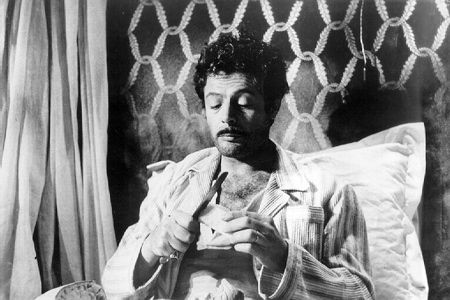
Marcello snacking in bed? How un-Italian of him.

This is a problem. I never was much of a dessert person, but if I ate early and had time to kill, hanging around reading or watching TV, I’d start craving another glass of wine—totally bloating and unnecessary. And after finishing off the dregs of the bottle, I’d sometimes go back for round two and finish off that last piece of lasagne, or stuff in a few more meatballs. It’s just the same for you who crave sweets. The more time you’ve got to digest your food before bed, the more attractive that tub of gelato, hunk of salami, or extra vino is. Solution: Eat late. As late as you can. When you eat at six o’clock, unless you’re a farmer who has to rise before dawn, what are you going to do all night? Watch TV and raid the refrigerator is probably the answer. So drag it out, eat at nine, as they do in Italy and Spain. I love stuffing myself and then lying down with a book—usually a cookbook, wouldn’t you know it—and a couple of cats on my chest. All of a sudden it’s midnight, and I’m still full from dinner and ready for sleep (and I sometimes even wake up in the morning feeling full).

I’ve always heard that you shouldn’t go to bed on a full stomach. It’s bad for acid reflux, and calories eaten before bed are somehow super calories, harder to burn off and quickly turning to fat. The calorie part is simply not true, according to recent studies, including one from Oregon Health & Science University. Our bodies don’t stop working and burning calories when we sleep, so there’s no special time when we store fat. The same meal eaten at six or at nine will cost the same number of calories and be processed by our bodies the same way. The problem, insofar as there is one, is that late evening is a notorious time for binge eating. But that’s why a healthy, low-calorie late-evening dinner, with no snacking, has worked for me (and if you go out to eat, it’s easier to get a reservation at a late hour).

Now that I know calories are calories whenever consumed, any trick that stops me from squeezing in an extra little meal is worth it. When I was a kid my family would often have those huge Italian Sunday suppers at five or six, with the “big” sauce loaded with meatballs, sausage, braciole, and hunks of pork. I’d feel stupefied afterward, but then around ten or ten-thirty, my father and I would be hovering around the refrigerator digging for leftover meatballs and sausages to make huge hero sandwiches with. We’d have dinner all over again. Even as a kid, I felt that there was something wrong here, and as I watched my father’s gut expand to beach-ball dimensions, I became convinced of it. No one over the age of two needs four meals a day. So get a grip. Dispense of your American or Italian-American eating habits. Eat like a real Italian. I’m sure Marcello would have never eaten in bed; this was just for the movies.

Read Full Post »


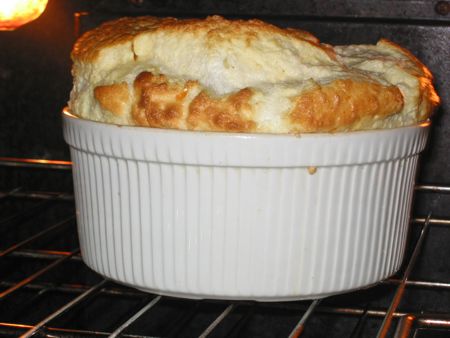
My light-as-air soufflé, just about ready to pull from the oven.

Recipes:
Fontina and Piave Cheese Souffle
Baby Spinach Salad with Radishes and Chive Vinaigrette

A soufflé is for me the ultimate diet food. You might find that strange, but think about it. It’s light and fluffy, gorgeous, romantic, and smells amazing while cooking. Okay, it’s full of eggs, but mostly the whites. It’s low-carb, so it fits into my diet philosophy nicely. And I serve it as a main course, not a side. But is a soufflé Italian? The word, which comes from the French verb souffler, meaning to blow, obviously isn’t. The technique, as far as I can determine, is traditionally French, but the true lineage of many French and Italian dishes can be a sore subject, since many Italians believe that everything culinarily worthwhile was originally Italian. Italians certainly use the term on menus, and chefs there make some fine soufflés using, for instance, porcini, Parmigiano, ricotta, and zucca. How beautiful is the idea of a soufflé made with Italian flavors?

Sformato is a word you’ll find on Italian menus as well. It means a delicate, eggy, baked mold, firmer than a traditional soufflé, more a custard than a puff. A sformato is always set with eggs, but it may or may not have beaten egg whites folded in at the end. I love a sformata, but it’s not particularly diet-friendly. I make one with cauliflower that has the texture of a tender custard. I’ve also made a chicken liver sformata that’s firm, with a rich flavor heightened by sage and Parmigiano. Neither is meant to rise very much, and both contain cream, making them dense and rich, packing a lot of calories into a very small lump of food (and they’re generally thought of as first courses, so they’re just the start of the meal). (more…)

Read Full Post »

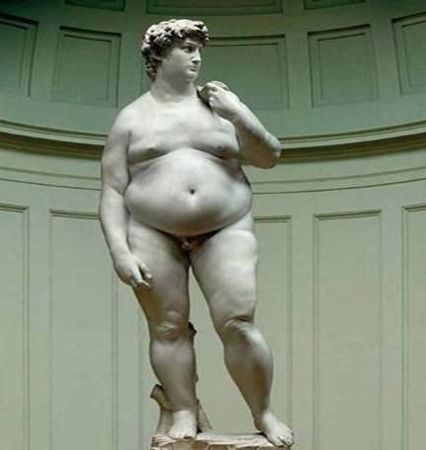
Don’t let this happen to you.

Read Full Post »


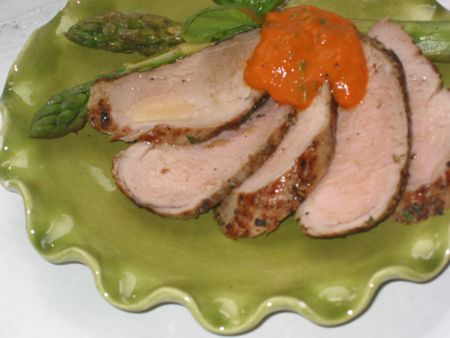
A dieter’s delight.

Recipe: Pork Tenderloin with Roasted Pepper and Fennel Sauce

Pork tenderloin is a dieter’s delight. It’s got just about no fat—which is why I almost completely avoided it for years. Not only was I skeptical of fatless pork, but the few times I prepared the cut, it was dry and boring. In retrospect I think that was because I was still under the influence of the old-fashioned hammered-to-death pork cookery of my childhood. Now I’m enlightened. I’ve cooked up a few tenderloins lately, and I’ve discovered that they cook amazingly quickly. You should leave them pink at the center. That makes them a most delicious cut of pork, not as porky maybe as a big fatty, bone-in chop, but elegant, simple to slice, and open to all sorts of flavorings. So you can get really creative. I’ve chosen to emphasize fennel here. Pork with fennel is a classic Italian combination. I marinate the tenderloin for about an hour in fennel seed and a splash of pastis, among other things, and also include a touch of fennel in my roasted sweet pepper sauce.

One of the best ways to cook a whole pork tenderloin (a cut of meat that looks remarkably like a horse’s thingy, I must say), is by browning it well on the stove and then putting it in the oven to finish cooking (grilling is my second favorite method, and I’ll provide a recipe for that as we head into summer). You just want to get the meat’s temperature up to 140 degrees. That will make for a touch of pink and a lot of juiciness. Many books, even recently published ones, tell you to cook pork tenderloin to 150 to 155 degrees, and they claim that that will give you pink. Don’t do it. The result will be dry and gray. This small, tender cut, much like a chicken breast, keeps cooking after you take it out of the oven, more than does any larger, fattier cut, so if anything, you want to take it out a little sooner. The last one I made, I pulled at 138 degrees, and after I let it rest for about 5 minutes, it sliced into gentle pinky-beige perfection. It’s what I made for my mother on Mother’s Day. She loved it, and she’s not even on a diet. (more…)

Read Full Post »


Just don’t do it: A scene from La Grande Bouffe.

Eating between meals? Try to get the very thought out of your head. What I’ve learned is that if I eat between meals, I won’t lose weight, period. I just don’t do it anymore. It was difficult at first. I didn’t miss the out-and-out crap so much, the midafternoon doughnuts or Fritos, but I did crave the good stuff—sfogliatelles (my absolute favorite Italian pastry), thick slices of buffalo mozzarella drizzled with great olive oil, a hunk of baguette stuffed with sopressata (the most satisfying 4 p.m. pick-me-up). I cut all that out of my life. It’s weird how disciplined I’ve become. Am I now a regimented killjoy with no spontaneity? Well, maybe a little. But as I see it there’s no joy in blubber or in diabetes. So I decided to try to stop spontaneously throwing stuff into my mouth, at least if I could. To my astonishment I discovered I could (most of the time).

I used various head-trip techniques to accomplish the feat. First I tried talking myself into enjoying feeling hungry. I know that sounds perverse, but it worked, on occasion. At the same time I noticed that when I wanted to eat between meals, sometimes it was from actual hunger, but mostly it was just plain boredom or anxiety, or a delightful mix of both. My supposed between-meal craving began to reveal itself for what it really usually was, just a gnawing emptiness that had nothing to do with my stomach. I tried replacing it with activities like sending comical but vaguely irritating e-mails to friends.

I came to realize that what I really needed was to understand that the only food worth eating is wonderful food enjoyed with friends and family while sitting at a real table. So the more creative my cooking becomes, and the more friends I can gather round, the more exciting my dinners are, and I can wait for them with anticipation, without picking. If all I had to look forward to after a long day of work was an impersonal frozen diet dinner thrown in the microwave, I’d never make it through the day without two pounds of greasy salami and a gallon of pistachio gelato.

Some diet books suggest eating five or six small meals a day, to keep your blood sugar on an even keel. That is the world’s worst advice. I don’t know anyone who has ever succeeded at that. Either you wind up eating five not-so-small meals a day and ingesting tons of calories, or you pick up any old crap and throw it in your mouth when you have a minute free. Not only do I know no one over the age of two who has the luxury of adopting such an eating schedule, and grabbing food and shoving it into their mouth like an astronaut, but it’s utterly un-Italian in spirit anyway. It’s a way to eat for people who really don’t enjoy food—the kind of people who eat “power bars.”

So for real dieting success and tranquility of spirit, the point ultimately is to do what Italians usually do; Sit down with family and friends and eat a great meal.

Read Full Post »


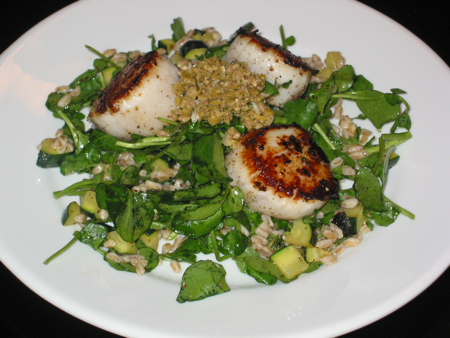
Scallops seared on only one side, so they’re crisp but meltingly tender throughout.

Recipes:

Watercress Salad with Sautéed Apples, Pine Nuts, and Bra Dura Cheese
Seared Sea Scallops with Watercress, Farro, and Green Olivata

I’ve been fascinated with watercress ever since I was introduced to a wild patch growing in a little stream in the Catskills near where we from time to time rent a cabin. I knew watercress had to exist up there, with all the shallow roadside trickles of water. I could sense its presence, but for years, even with all my searching in spots that seemed promising, it eluded me.

That part of the Catskills is a place where in the 1950s and ’60s many French food professionals settled and opened restaurants, mostly people from Brittany. Most of the restaurants have now closed, but many of the people are still scattered around. One French lady, a former pastry chef and somewhat morbid type who I often noticed taking her constitutionals near our cabin, had for years been keeping the location of a big watercress patch to herself. She’d occasionally show up at the cabins with little bags full, as a gift to the proprietress, but she wouldn’t let anyone know where the spot was, and frankly I think I’m the only one who really cared. She knew I was a cook, and she’d occasionally brag to me about some leek gratin or plum tart she had just cooked up. Finally one day, for no apparent reason, she told me where the patch was (she still won’t divulge her spots for morels and ramps, and I’m not gonna push that).

I could barely contain my excitement when I first laid eyes on the watercress. It’s a prolific patch, sprouting up in April and getting bigger and lusher into the summer. The watercress is peppery, deep green, and absolutely delicious in that gentle bitter way that I and most Italians (and apparently French) love. The thick stems near the roots are hollow, and they seem very delicately hinged to the watery earth. I have to be careful about pulling them up, since the plant is easy to uproot, so I usually bring scissors and clip the tender, leafy stems. Around late summer the watercress starts blossoming with little white flowers, and at that time it turns a little too bitter, but I still love it, using it more in soups and sautés than in salads.

Here are two recent watercress creations of mine that came out especially well. They were made not with my own foraged watercress but with $6-a-bunch wild watercress from the Union Square Greenmarket (which may very well have come from a patch near my special Catskills spot). (more…)

Read Full Post »


A springtime treat: soft-shell crabs, crisp and juicy, on a warm escarole salad.

Recipes:

Soft-Shell Crabs with Warm Escarole, Potato, and Lemon Salad
Whole Wheat Penne with Asparagus, Pancetta, and Green Jalapeño

My new goal is to try to replace about 75 percent of the refined carbohydrates in my diet (white rice, white bread, white spaghetti, white ziti, cannolis, and so on) with green vegetables, mostly of the leafy variety, either cooked or in salads. When I really stick to this I lose weight and feel good, since I not only cut down on my sugar intake but load up on Omega-3 fatty acids from all the greens. I feel pretty good about all those vegetables—except when I think about the cannolis and ziti I could be eating.

Working more vegetables into my life has really not been hard at all, especially since I grew up on leafy greens, bitter and otherwise but almost always prepared in a way that made them delicious. It’s the Southern Italian way, whether you live in Basilicata or in Greenwich, Connecticut. My grandmother picked dandelions, watercress, mystery weeds she insisted were edible, and all sorts of sprouting stuff from golf courses and neighbors’ backyards in Westchester County. It was humiliating for the family, but she couldn’t be stopped, she said. Her health would be in jeopardy, although her health was probably actually in more jeopardy from all the weed killer and bug spray and dog pee she ingested along with her greens. But she lived to be 99, so I guess she was doing something right. Maybe the gallons of fizzy purple Riunite Lambrusco she drank along with all the weeds canceled out all the bug spray.

Whole grains, green vegetables, small amounts of meat and fish: That’s a great diet. And wine, of course. Not Riunite if you can help it; drink really good wine with your vegetables. It’ll make you forget about all the cannolis and fettuccine Alfredo you’re missing. A good Southern Italian white for both these dishes is the Fiano di Avellino made by the great producer Mastroberardino, in Campania. It’s light and incredibly refreshing but has a slight honey taste that gives it richness and unique Southern Italian character (Fiano is an ancient Southern Italian grape).

In my continuing effort to provide you with the most delicious, slimming recipes, loaded with the Italian flavors you crave, here are two more good ones to keep you sleek and elegant and also very healthy. (more…)

Read Full Post »


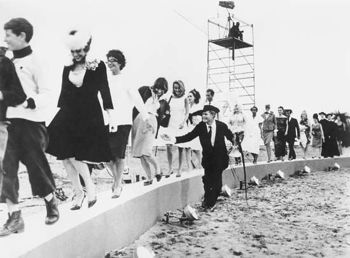
Purposeful exercise, Italian-style.

I haven’t lost much weight from exercise, at least not from the type of routine I’ve fallen into lately, twenty minutes once of week on one of those hamster wheels. I think to really make a dent in your load you need to exercise a lot, every day, running in circles or cycling in one place for hours. But I find that kind of exercise soul-deadening. Maybe if I had a stronger sense of self, I wouldn’t let it get to me.

When I was in my twenties I spent most nights dancing at clubs. That was an amazing freedom, certainly nothing I ever viewed as exercise but rather movement driven by a mysterious purpose, something most people would label as purely sexual, but I didn’t think of it that way, since it was done mostly at gay clubs with no potential dates in sight. It was purely artistic expression.

A few years ago, with the memory of my old club days in mind, I decided I once again needed to exercise with a purpose other than slimming my thighs. Flamenco was what I settled on, for no particular reason other than that I liked the outfits, especially the Mary Jane–style shoes with the nails in them. This is an intense solitary dance, quite regimented even though in performance it looks freewheeling. I quickly got caught up in a Moorish fantasy, but it burned itself out after about 8 months, because ultimately it wasn’t me, plus my left heel got inflamed from all the pounding, so I could barely walk. I called it quits. I then went on to ballet, something I had studied as a child and thought must be imbedded in my brain, like an early language. But when you’re twelve it’s one thing. Ballet in middle age with obviously no intention of becoming a ballet dancer is one of the most miserable, pointless, and painful pursuits imaginable. I felt like a Zelda Fitzgerald in the making, and it scared me.

After some soul search I finally decided on something closer to my Southern Italian ancient heritage. The tarantella would be my next pursuit. This is a fantasy for most Southern Italian girls at some point in their lives (isn’t it?), with all its out-of-control screaming and jumping. But I discovered that there are two tarantellas, one a graceful Neapolitan courtship dance, something I was definitely not interested in, and the other, from Puglia, the highly agitated dance supposedly performed by a victim of tarantula bite, the dance I had in mind. That’s a convulsive fit that could engulf an Southern Italian neighborhood in dancing mania, with its music working its way from hysterical to soothing and finally, after hours of shaking and screaming, to harmony in the town and a cure. This was my kind of dance, but to my astonishment there seemed to be no lessons for it available in Manhattan.

As much as I could relate spiritually to the tarantella, I think I actually get most of my true, quality exercise from lugging heavy grocery bags around town. That seems, as much as I hate to admit it, an exercise most dear to my heart. It’s the most honorable exercise for a cook. It has the highest purpose.

Read Full Post »


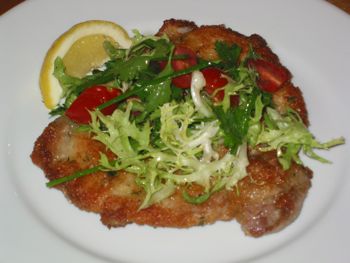
A perfect dish; hot, crispy, cool, and refreshing.

Recipe: Pork Scallopine with Parsley and Grape Tomato Salad

Whenever I go to an Italian restaurant and crave something luxurious but still want to stick to my low-carb, vegetable-heavy diet, I order scallopine topped with salad. Many restaurants in New York serve versions of it, especially places that like to think of themselves as Tuscan. I’ve had the dish made with a deluxe, bone-in veal chop pounded so thin it’s wider than the plate and then crisp-sautéed and topped with a tangle of raw shaved zucchini; I’ve also had a much humbler version made with a hammered-out chicken breast topped with a little mesclun. The most common version is boneless veal scallopine, breaded and crisp-sautéed and then covered with an arugula and cherry tomato salad. To me just about any variation is alluring. The mix of hot, crispy scallopine with the vinegary sparkle of a cool salad makes for an extremely satisfying dinner.

The dish is very easy to turn out at home too. I like making mine with pork, just for a change, since it stays very juicy when quick-cooked. I leave a tiny amount of fat around the edges, which crisps up nicely. I vary the salad part, depending on my mood. Here I use a big handful of flat-leaf Italian parsley, which I love, and whose flavor I feel is underrated. (more…)

Read Full Post »

« Newer Posts - Older Posts »