Feeds:
Posts
Comments

Archive for the ‘Skinny Guinea’ Category

San Gennaro and Chickpeas


The San Gennaro festival procession in Naples.

Recipe: Roasted Chickpeas with Garlic and Rosemary

I think we have to face a fact: The San Gennaro feast in Little Italy is a crashing bore. When Johnny Boy proclaimed in Mean Streets, ”I hate this feast with a passion,” I could feel his pain. I’m sure at some point, maybe back in 1966 when it first started, the feast was fun (unless, of course, you lived upstairs from it). Even back when I first attended, in the 1970s, we could at least win the “basket of cheer,” full of cheap Chianti and lupini beans—and they didn’t mind if teenagers opened the straw-basket bottles and drank on the streets. Those were the days. And then the neighborhood holy men, all boozed up, would drag out the metallic San Gennaro statue, green-face from wear, and start their dinky procession, accompanied by a four-piece Little Italy band that sounded like it was playing kazoos and tin cans when in fact it was holding real instruments like trumpets and drums. This was mesmerizing. There was the arancini lady, who set up a folding chair and sold rice balls, at the corner of Hester and Mulberry. I even saw Frankie Valli perform there once, perched up on a little wooden platform, right next to the arancini lady. All this is certainly better than the generic New York street fair the feast has morphed into. I understand that not many Italians still live in the neighborhood, and they say that’s the main reason the charm has drained away. It’s sad really. It makes me long for old Napoli, where the feast has its Catholic origins.

San Gennaro (Saint Januarius in English) is the patron saint of Naples, and the city celebrates his feast day on September 19 (and just on that one day, not on the eleven frigging days they drag it out over here). There are elaborate religious processions through the streets, but the real focus, as far as I’m concerned, is the celebration of the city’s beautiful street food. Not great diet food (and we always have to consider these things, here at Skinny Guinea), but fabulous nontheless.

If you like things fried, as I do, Naples does them better than anywhere else. At the feast you can get batter-fried zucchini flowers, calamari, artichokes, eggplant, even fried cow’s brains. Or a slice of Naples’s famous pizza margherita. Or you might require calzone stuffed with escarole or ricotta, or pizza fritta (basically a deep-fried calzone), crocche (potato croquettes), zeppole, or a sweet, flaky sfogliatelle. While the kids eat spumoni, the old men walk the streets munching on roasted chickpeas from little bags and drinking red wine out of plastic cups. That ritual seems very austere compared with everything else going on at the feast, which makes it very appealing and romantic. You can still get roasted chickpeas at the Little Italy feast in New York, but they are as hard as pebbles and, in my opinion, almost too dangerous to eat. Like most things, if you really want them right you’ve got to make them yourself. So here is my recipe for roasted chickpeas. They’re crisp and brown outside, but with a creamy center. Not only are they delicious and crunchy, but they’re almost fat-free, and they’re a great carb choice, low on the glycemic index. With all the red wine you’ll need to ease them down, they are a health meal made in Naples. For the wine, try a glass of Campanian red, such as a Lacryma Christi Del Vesuvio. Terredora is a good producer.

Roasted Chickpeas with Rosemary and Garlic

2 cups home-cooked chickpeas, drained (use good-quality canned ones if you prefer, but rinse them)
2 tablespoons extra-virgin olive oil
5 garlic cloves, unskinned and crushed with the side of a knife
Sea salt
A generous pinch of ground hot red pepper
A pinch of sugar
3 sprigs rosemary, the leaves well chopped

Preheat the oven to 450 degrees. Lay the chickpeas out on a sheet pan. Drizzle them with the olive oil. Scatter on the garlic cloves, and season everything with salt and the ground hot pepper. Toss the chickpeas with your fingers so they’re well coated with the seasoning. Spread them out again in one layer.

Roast the chickpeas until they’re fragrant and starting to brown, about 20 minutes. Pull the sheet pan from the oven, and scatter on the rosemary, and sprinkle on the pinch of sugar. Toss quickly, and put back in the oven for another 5 minutes or until the chickpeas are browned and crunchy-skinned but still have soft centers. Let them cool on the sheet pan. Serve warm or at room temperature.

Read Full Post »


Murray’s cheese cave, built into the sidewalk on Bleecker Street.

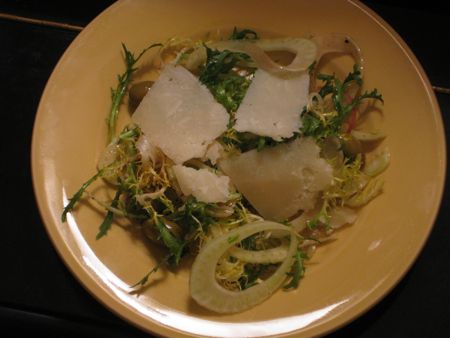
Recipe: Frisée Salad with Capra Sarda Cheese, Fennel, and Green Olives

About once a month I walk over to Murray’s cheese shop on Bleecker Street to check out any new Italian cheeses they may have gotten in. When they first moved across to the other side of Bleecker a few years back, expanding and gaining lots of attention, I was disappointed that their interest in Italian cheeses seemed to take a back seat to French and artisanal American ones, which hadn’t happened at the old store. They were doing such a good business with all the other cheeses, I got the feeling they thought Italian cheeses, especially ones from the South, weren’t cool enough to bother with in their new, upscale shop. This is changing, but their selection is still puny. Where’s my Ragusano, my Piacentino, my Canestrato Pugliese? I guess I’ll have to make my way down to DiPalo for those.

On my most recent trip to Murray’s I was happy to see a few new offerings. I noticed something called Capra Sarda, a Sardinian goat’s milk cheese. Sardinia is known for its sheep’s milk cheeses, so this intrigued me. It turns out Fratelli Pinna, one of Sardinia’s biggest sheep’s milk cheese producers, was approached by a few of Sardinia’s goat’s farmers with the idea of making an aged goat’s milk cheese. Pinna took them up on it. What they came up with is interesting, a goat’s milk cheese made in the style of a pecorino.

The cheese is firm and golden, not white like most goat’s cheeses. It has a goaty taste, but not overly so, and an appealing horse-poop-and-hay aroma in the rind. Yet once you cut into a piece and take a bite, the flavor is surprisingly sweet, with something of the browned-butter taste that you get with an aged Gouda. The aroma of Capra Sarda makes you think the taste will knock you out, but though it is an assertive cheese, it’s low-salt, and its sweetness tempers it, which is exactly why when I incorporated it into a salad I added green olives for balance. All this richness needed a juicy juxtaposition too, so I decided on fennel, which also supplies a bitter edge.

From a diet or health point of view (which is what we here at Skinny Guinea specialize in), Capra Sarda is a good cheese to shave over salad. Since it has a fairly assertive taste, you can get away with using very little but still make a statement. And it can stand up to vinegar. I like it a lot, but so far I actually prefer it in a salad rather than by itself. I’m not sure exactly why, but maybe because of how it really takes to good olive oil. This feeling may change. I’m going to try eating it with various fruits and see how that works out.

Here is a simple salad, just three contrasting tastes, but when I put them together I found that they added up to one unique flavor that really made me happy.

If you can’t find Capra Sarda, another aged goat cheese should do, but I’ve never seen one with quite the texture of this cheese. I’d instead go with an aged Tuscan pecorino, many of which are actually made in Sardinia anyway.

(Murray’s Cheese Shop is at 254 Bleecker Street, between Sixth and Seventh Avenues. Its phone number is (212) 243-3289.)

Frisée Salad with Capra Sarda Cheese, Fennel, and Green Olives

(Serves 2)

½ teaspoon Spanish sherry vinegar (or a little more to taste)
A few drops of pastis (I used Pernod)
Salt
A pinch of sugar
1 garlic clove, peeled and lightly crushed
2 tablespoons extra-virgin olive oil
A small head of frisée lettuce, torn into smallish pieces
½ a small fennel bulb, very thinly sliced
A few large sprigs of tarragon, lightly chopped
A handful of green olives (I used Picholines)
Freshly ground black pepper
A small chunk of Capra Sarda cheese

In a small bowl, combine the vinegar and a few drops of pastis. Add the garlic clove, smashing it a little with a fork so it releases its flavor. Add a little salt and a tiny pinch of sugar. Give it all a stir. Add the olive oil, and stir to blend.

Put the frisée in a salad bowl. Add the fennel, tarragon, and olives. Grind on a good amount of black pepper, and pour on the dressing. Give it a toss. Divide the salad up onto two plates, and shave three big sheets of the Capra Sarda onto each salad. Serve right away.

Read Full Post »

Eggplant Is Your Friend


Gorgeous eggplants at the Hanover Farms 24-hour vegetable stand, in Mount Tremper, New York.

Recipe: Eggplant Gratin with Ragusano Cheese and Filetti di Pomodoro

Are you scared of eggplants? A lot of my friends are. Fear of the unknown can be mesmerizing. If you didn’t grow up in an Italian or Middle Eastern household, you probably weren’t witness to the peeling, salting, weighting, dredging, frying, and tinkering that are all part of traditional eggplant preparation. Yet you still might have known that a slice of eggplant will soak up as much oil as you let it. That makes people uncomfortable, too. And the fact that eggplants are so beautiful makes them still more intimidating. Who wants to cut into perfect, shiny, black skin?

One of the most famous Italian eggplant dishes, eggplant parmigiano, originally from Naples but now made all over the world, is truly complicated, with all its breading, egging, frying, layering of cheeses, and baking. It is, however, exceptionally delicious and, when done to perfection, extremely fattening. What I offer you today is not an eggplant parmigiano, but a completely different thing. It’s much easier, much less bloating, yet it’s in no way a compromise, and best of all it’s fear-free eggplant cooking.

You bake the eggplant, so you don’t have to set up bowls of flour, egg, and breadcrumbs and a big pan full of scary boiling oil and then lay paper towels all over your kitchen to soak up the hot grease. You don’t even have to cook a tomato sauce. You stir together a simple pomodoro crudo.

Caciocavallo cheese replaces mozzarella in this gratin. Actually caciocavallo is a kind of mozzarella, just salted and aged and so firmer and tangier. The beauty is that its stronger flavor allows you to use less cheese but still produce a big effect. My favorite caciocavallo is Ragusano, a raw cow’s milk DOC cheese from in and around Ragusa, Sicily. Ragusano has an unusual large brick shape when whole, and a reddish rind. The kind I find at Citarella is semi-hard, so it’s easier to slice or crumble than to grate. It’s less salty and strident than most other caciocavallos I’ve found in this country, and definitely more nuanced than provolone, another mozzarella-type aged cheese and something I wouldn’t suggest for this recipe since it would overpower every other flavor.

The final touch is a layer of hard-boiled egg slices and a hit of fresh sage, an idea I lifted from my mother’s eggplant parmigiano. The eggs and sage add amazing richness, and they seem to warm and temper the sharp edges of the tomatoes and the cheese, nudging the dish, made with all summer vegetables, into the realm of early fall.


Eggplant gratin made using the eggplants in the top photograph.

Eggplant Gratin with Ragusano Cheese and Filetti di Pomodoro

Note: Filetti di Pomodoro is what Italians call fresh tomatoes that have been skinned, seeded, and cut into thin strips or dice. They’re often used as a base for a sauce.

(Serves 4 as a main course)

8 fresh plum tomatoes, peeled, seeded, and diced
Salt
2 tablespoons extra-virgin olive oil
5 thyme sprigs, the leaves chopped
1 large garlic clove, minced
A few big scrapings of fresh nutmeg
Freshly ground black pepper

2 medium eggplants (I used long, dark purplish-black ones)
Extra-virgin olive oil
Salt
Freshly ground black pepper
3 hard-boiled eggs, sliced
½ pound Ragusano Caciocavallo cheese, crumbled or roughly grated
5 sage leaves, plus a big handful of Italian flat-leaf parsley leaves, all lightly chopped and mixed together

To make the sauce, place the tomatoes in a colander over a bowl, and sprinkle them with a little salt. Let drain for about half an hour. Meanwhile, in a small bowl, mix the drained tomatoes with the olive oil, thyme, garlic, nutmeg, and some black pepper. Give it all a stir, and let it sit, unrefrigerated, while you prepare the eggplant.

Cut the tops and tips off the eggplants. Stripe-peel them, so you’re making alternating lengthwise peels and leaving long strips with the skin intact. This way they’ll stay together and cook better than when completely peeled, but you won’t get a big piece of hard peel in your mouth when you bite into them, and they’ll be easier to cut. Cut into ½-inch-thick slices. I don’t bother to salt and weight eggplant, especially when I’m going to bake it. Salting does draw out some water, but it doesn’t, as some believe, remove bitterness. To assure against bitterness, buy firm summer eggplants from a farmers’ market.

Preheat the oven to 450 degrees. Coat two baking sheets with olive oil. Lay the eggplant slices out on the baking sheets, brush the top of each slice with olive oil, and then sprinkle them with salt and black pepper. Roast without turning until tender and browned, about 15 minutes. Switch the sheet pans’ place in your oven once during baking so the bottom one doesn’t get too dark.

Get out an approximately 12-by-8-inch, fairly shallow baking dish. Put in it a layer of the tomato sauce, then one of the eggplant. Sprinkle on a little Ragusano cheese and then some of the parsley-sage mixture. Spoon on another layer of sauce, then make a layer of egg slices, using all the eggs. Now add another eggplant layer, more Ragusano, and the rest of the parsley-sage mix. Do a top layer of eggplant, spoon on the remaining sauce, and sprinkle with a little more Ragusano. Bake quickly, uncovered, at high heat (keeping the oven at 450) until browned and bubbling, about 20 minutes. Let rest 10 minutes. Serve hot or warm.

Read Full Post »

Recipe: Fried Zucchini Blossoms Filled with Mozzarella, Marjoram, and Sun-Dried Tomatoes

This still from Fellini’s Amarcord reminds me of the end of summer, or what the end of summer should ideally feel like, a peaceful, breezy transition to a cooler place. My end-of-summer transition usually takes place in the kitchen, not on the Adriatic coast, but one of my tricks for a smooth passage is to hold on to summer as long as possible. I guess you’d call that denial. Finding zucchini blossoms at the Greenmarket in early September helps considerably. So here’s an ode-to-the-end-of-summer recipe for you, fried zucchini blossoms filled with mozzarella, marjoram, and tomato. One or two of these won’t blow your diet, if you eat them before a light meal of fish and salad, and they’re all good, healthy stuff. Make sure to fry them in extra-virgin olive oil for the best taste.

Fried Zucchini Blossoms Filled with Mozzarella, Marjoram, and Sun-Dried Tomatoes

(Serves 5 as an appetizer)

1/2 pound mozzarella, cut into medium dice
20 fresh zucchini blossoms
8 oil-packed sun-dried tomatoes, cut into strips
The leaves from 5 marjoram sprigs

For the batter:

1 cup all-purpose flour
1/8 teaspoon baking powder
A generous pinch of salt
A few scrapings of fresh nutmeg
3/4 cup cold water

Extra-virgin olive oil for frying

Gently open each blossom and pinch off the stamen, checking while you do for any dirt (or bugs) that might be trapped inside. Wipe the blossoms gently inside and out with damp paper towels (do this only if they look dirty; the zucchini blossoms I’ve been buying lately at farmers’ markets seem to be completely dirt free, but check them out and give them a very gentle wipe if needed).

Place a piece or two of mozzarella in each blossom. Add a few slices of sun-dried tomato and maybe four marjoram leaves. Twist the tops of the blossoms to close them up. You can fry them now or refrigerate them for a few hours.

To make the batter: In a medium mixing bowl, combine the flour, baking powder, salt, and nutmeg. Stir well to blend. Add the cold water, and whisk until the batter is smooth. It should be a little thicker than heavy cream.

Fill a large sauté pan with about 2 inches of olive oil. Heat over medium-high flame until the oil starts to shimmer, but not until it’s smoking. You can test by flicking a few drops of batter into the pan. If they bubble and turn golden, the oil is ready.

Dip the blossoms in the batter, letting the excess drip off. Fry them in batches, about five at a time. Turn them when they look golden and crisp, about 2 minutes on each side. Using tongs, lift the blossoms from the oil onto paper towels to drain for a moment. Transfer to a serving platter. Sprinkle them with salt and black pepper. Serve hot.

Read Full Post »

Summer Tomato Sauce


Keeping it fresh.

Recipe: Summer Tomato Sauce with Thyme and Marjoram

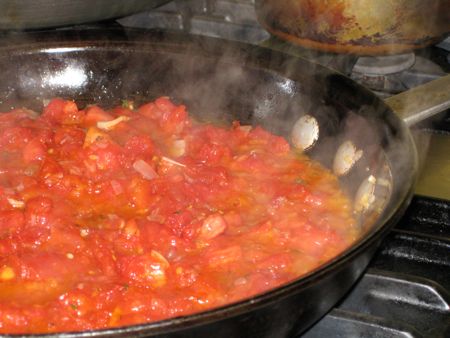
Your goal here is to cook up a sauce of summer tomatoes that fully captures their incredible fresh taste. Believe it or not, it’s easy (chef’s always say that—doesn’t it infuriate you?). In this case it’s actually true, but first you should know a few things. You’ll want a wide skillet, and you’ll want to use high heat. The more surface area you’ve got for your tomatoes to spread out over, and the quicker you can get them heating, the sooner you’ll be able to boil away excess liquid. High heat and fast cooking will help the tomatoes retain their bright red color and true tomato flavor. That’s the trick. It’s not a trick exactly, but just something really good to know.

Plum tomatoes are a very good choice for a fresh sauce, since they give off little liquid and have concentrated flavor. That is a true Southern Italian–style sauce. But many people tell me they have trouble finding fresh plums, so I’ve devised a method for using big, juicy round tomatoes. They produce a different kind of sauce, one with lightness, bright red color, and a refreshing pure-summer flavor. You just have to coax some of the liquid out of them before you start cooking.

A blend of thyme and marjoram is my current favorite herb mix for a fresh tomato sauce. Basil, of course, is a classic, and you can go with that if you prefer, but thyme and marjoram have a depth of flavor that makes this sauce better for accompanying things you throw on the grill—eggplant, salmon, chicken, lamb—and since it has that elusive herbal mystery, it even works well with whole wheat pasta.

You can use this sauce as is on pasta or spooned over stuffed summer vegetables (I really love that), but any embellishments you’d like to include, such as capers, anchovies, bits of prosciutto, parsley, pine nuts, or basil, are easy enough. I like adding chopped black olives, fresh hot chili, a few drops of vinegar, and a handful of chopped celery leaves, and serving it cold, alongside grilled mackerel, for instance. I also love it spooned onto a hamburger.

Summer Tomato Sauce with Thyme and Marjoram

(Makes about 2 1/2 cups of sauce)

6 medium-size round summer tomatoes
Salt
Extra-virgin olive oil (the best you’ve got)
1 large shallot, minced
2 fresh summer garlic cloves, thinly sliced
10 thyme sprigs, the leaves chopped
5 marjoram sprigs, the leaves chopped
Freshly ground black pepper

Set up a large pot of water, and bring it to a boil. Drop in the tomatoes, and blanch them until you see their skins just starting to crack, about 3 minutes. Lift the tomatoes from the water with a large strainer, and run cold water over them. Now you can easily slip their skins off.

Cut the tomatoes in half and squeeze out the seeds. Chop them into small dice. Place the diced tomatoes in a colander over a bowl, and sprinkle them lightly with salt. Let them drain for about an hour (this is important, since these round tomatoes give off lots of juice that would dilute your sauce). Save the juice, though, just in case you want to loosen the sauce at some point. (It is possible to drain or cook off too much liquid, so a little extra is nice to have, and it’s a good way to add a little bit of purely raw tomato taste back to the sauce.)

Choose a wide skillet. This is important too. You want a lot of surface area so the liquid evaporates quickly, leaving the tomatoes thickened but not overly cooked down. Place the skillet over medium heat, and when the surface is hot add 2 tablespoons of olive oil. Add the shallot, and sauté until softened, about 3 minutes. Add the garlic and the thyme, and sauté a minute longer, just to release their fragrances (you don’t want the garlic to darken, though). Turn the heat to high, and add the tomatoes, spread them out, and cook over a lively bubble, uncovered, for about 6 or 7 minutes, stirring occasionally (stirring constantly is not necessary and might make your sauce watery by lowering the skillet temperature). When the sauce has some body and is still a bright red, it’s done. Turn off the heat. Add the marjoram, the black pepper, and about a tablespoon of fresh olive oil. Give it a stir. The sauce will be chunky (if you’d like a smoother sauce, pulse it in the food processor a few times). Taste to see if it needs salt.

You can use the sauce right away, or you can refrigerate it and hold it for up to about 4 days. Reheat it quickly, over high heat so it doesn’t lose too much freshness. And if you’re lucky enough to actually grow tomatoes and have them taking over your kitchen, double or triple the recipe and freeze it.

Read Full Post »

Recipe: Tomato and Cantaloupe Salad with Purslane

At summer’s end I find myself a bit frantic, trying to buy and cook as much produce as possible, often combining lots of things in one dish, just to get to taste them all once more. Occasionally I create an incongruous mess, but most often things come out fine. Here’s one that came out really fine.

Purslane is a summer succulent with a mild sour taste. It’s best used raw, where its juicy crunch can be appreciated (it goes limp when cooked). It’s also excellent when paired with something sweet, like the cantaloupe I’ve chosen here.

Tomato and Cantaloupe Salad with Purslane

(Serves 4 as a first course or a light lunch)

4 heirloom tomatoes (a mix of green, red, and yellow varieties, if possible), cut into wedges
Salt
½ a small cantaloupe, cut into chunks
A big handful of purslane
3 scallions, sliced, using some of the tender green part
About a dozen small basil leaves
About a dozen mint leaves
2 tablespoons extra-virgin olive oil
1 teaspoon champagne vinegar
Freshly ground black pepper

Place the tomatoes in a colander, and sprinkle lightly with salt. Let drain for about half an hour. Now put the tomatoes, cantaloupe, and purslane in a pretty salad bowl. Add the scallions, the basil, and the mint leaves. Add the olive oil, and toss gently. Season with a bit more salt and a generous amount of black pepper, and drizzle on the vinegar. Toss again. Serve right away.

Read Full Post »


Pier Paolo Pasolini and Maria Callas celebrate the completion of Medea.

Recipe: Fragolimone

I can tell a lot about my general sense of well-being by the way I react to the end of summer. If I look at it as offering a new start, then everything is relatively good. But if I view it with dread, than I know anxiety is lurking, and I need to do something to make things more right. This year dread is coming out on top. I’m not sure why, exactly, but instead of trying to analyze why I’m anxious and vaguely miserable, I’ve decided the way to start making things right is by inventing a new cocktail.

Another problem with summer’s end, one I have no control over, is that it’s the end of beautiful fresh, local fruits and vegetables. There’s no dire need for fruit anxiety just yet, since there’s still plenty of good stuff around, including the little Tristar variety of strawberries, a day-neutral type cultivated from a wild variety, which keeps producing late into the summer. I’m grateful for it.

Fruit juice and booze can be a beautiful combination, as long as it’s not too sweet. Prosecco, glamorous and affordable, is a wonderful bubbly base for mixing with fruit. Not that I’m the first one to think of this; the Bellini certainly is famous enough, and I love it, but right now I really wanted to do something with the candy-fragrant pint of little day-neutral strawberries I just picked up at the Union Square market.

There are all kinds of prosecco around, and even when I’m mixing it with fruit I want to start out with something good. The towns of Valdobbiadene and Conegliano, north of Treviso, make up the primary prosecco district, so I always look for one of those names, or both of them, on the label (prosecco, by the way, is the name of the grape as well as of the beverage). Prosecco produced outside this main region, in the flat lands, tends to be a little boring. Mionetto is an accomplished Prosecco producer that makes various types, some gently bubbly, some sparklier, and with varying degrees of dryness (there’s even a still prosecco). I really like Mionetto’s prosecco brut, with its ample bubbles, lack of sweetness, and subtle mineral taste.

I started designing my cocktail with fresh strawberry puree mixed with Mionetto prosecco brut. That was good, but it just missed being exciting. Did it need sweetness? A touch of sour? More heft? I wasn’t sure, but I decided on adding a splash of limoncello, and I’m happy to tell you that pulled it all together. So here’s my new cocktail, an aperitivo, really. I call it the fragolimone. It has kind of a girly taste and look, but it’s not sweet, and the added booze hit from the limoncello is welcome (maybe that was the ultimate fix). I don’t know if my fragolimone will sooth my transition into fall, but it certainly improved an evening.

Fragolimone

(Serves 5)

1 pint Tristar strawberries (or another late-summer variety), hulled, plus 5 nice looking strawberries left whole for garnish
About a tablespoon sugar, if needed
5 teaspoons Limoncello (or a little more to taste), chilled
1 bottle Mionetto prosecco brut, chilled

Put the hulled strawberries in a food processor along with about 1/2 cup of cold water. Purée until very smooth, and pour through a fine-mesh strainer. Taste the purée. If you’d like it sweeter, add a little sugar. Chill for at least 2 hours.

Chill five champagne flutes. Add 1½ tablespoons of strawberry purée to each glass. Add a teaspoon (or a little more to taste) of limoncello to each one, and then fill the glass with the prosecco. Garnish each drink with a strawberry. Serve right away.

Read Full Post »

Recipe: Chilled Peach Soup with Basil and Peperoncino Pesto

Once, when I was in high school, a friend’s mother invited a bunch of kids over for her son’s birthday, and instead of the usual summer barbecue/food fight/pothead afternoon, it turned out to be a formal sit-down luncheon. We were very uncomfortable. She was Austrian, and she seemed so out of place in Glen Head, Long Island, dressed in a long, gray-blue skirt that just may have been fashioned from burlap, and long, flat, brown stylishly orthopedic looking shoes . We all nervously took our seats around the table, and she brought out a first course. A first course. God, now we were really nervous. It was a cold blueberry soup, with sour cream or something white and sour on top (crème fraîche?). I had never heard of such a thing, soup made from fruit, and it wasn’t even dessert. It made a big impression on me. It was sour, dark purple, and startlingly delicious. It was glamorous. I can’t remember much else about the meal, except that it went on for hours without much let up in tension, but I do recall my friend’s father, sitting off in the corner through the entire ordeal, playing Carl Orff records on a decrepit child’s turntable, and every once in a while yelling something in his German accent, such as “Here, you see, here is where it says anus.” Carl Orff, I believe, is known for his modern though medieval-inspired sexual Nazi sound. This really seemed to appeal to my friend’s father, a former Jew turned Episcopalian turned Unitarian. At the end of the afternoon I wanted to run out of there so fast, back to the ring-a-ding Dean Martin comfort of my own home. But that soup made a lasting impression.

Since then I’ve been served and I’ve prepared myself fruit soups, and they’ve always had a fancy-dining feeling about them. They’re a wonderful thing to serve guests, because their colors can be brilliant (cobalt blue, day-glo pink, flaming orange, crimson), and their flavors—half sweet, half savory—are unexpected. For obvious reasons I always think about fruit soups in the summer, so when I recently picked up a little box of fragrant yellow peaches at the Union Square market, I knew they needed to become soup, but soup with Italian flair, more savory than sweet, and with no cream to muddy it up.

Peaches with basil has for a long time been a familiar flavor combination for me. In warm weather, my father would throw together big bowls of sliced peaches in red or white wine, and he’d often add a few basil or mint leaves from his garden. This too was glamorous. So, with these flavor memories as my guide, I went ahead chopping up my peaches, adding shallot sautéed in olive oil, and white wine. I topped this acid-sweet purée with basil pesto, replacing the cheese, which I thought would make the peach taste a little pukey, with fresh chili. The mix of fruit, herbs, and a touch of spice emerged as something really appealing. I served my peach soup and then a dish of pork chops braised with gently vinegared bell peppers (I have a recipe here), another good late summer dish, since peppers are at their best right now. If you follow up with a simple green salad, you’ve got it made, and the meal might not even scare teenagers. As long as you forgo the Carl Orff accompaniment.

Chilled Peach Soup with Basil and Peperoncino Pesto

(Serves 4 as a first course)

6 large, very ripe yellow summer peaches
1 tablespoon extra-virgin olive oil
1 small shallot, minced
1 tablespoon sugar
½ cup dry white wine
A pinch of salt
Freshly ground black pepper
A squeeze of lemon juice

For the pesto:

1 cup basil leaves
1 garlic clove
1 fresh green peperoncino chili (or use 1/2 a serrano or jalapeno), roughly chopped
¼ cup pine nuts, plus a handful of toasted pine nuts for garnish
Extra-virgin olive oil
Salt

Blanch the peaches in boiling water for about 4 minutes. Lift them from the water with a slotted spoon, and slip off the skins. Cut the peaches in half, and remove the pits. Crush them with your fingers over a shallow bowl, catching all the juice.

In a medium soup pot, heat a tablespoon of olive oil over medium flame. Add the shallot, and sauté until softened, about 3 minutes. Add the peaches and the sugar, and cook for about a minute. Add the white wine, and let it bubble for another minute. Pour in 1½ cups of water, a generous pinch of salt, and some black pepper. Bring to a boil, and then turn off the heat and cover the pot, letting it sit for about 5 minutes so the peaches can gently soften. Purée the peach mixture in a food processor until very smooth, adding more hot water if needed to get a thick but pourable consistency (about like heavy cream). Add a squeeze of lemon juice to bring up the flavors, and chill for several hours or overnight.

To make the pesto: Bring a small pot of water to a boil, and add the basil leaves, blanching them for about 30 seconds. Drain the basil, and run it under cold water to set its color. Drain well. Place the garlic, peperoncino, and pine nuts in a food processor, and pulse until you have a rough chop. Add the blanched basil, ¼ cup of olive oil, and a little salt. Pulse until you have a fairly smooth paste. Transfer the pesto to a little bowl.

To serve: Ladle the soup into shallow bowls. Spoon a dollop of the pesto onto the middle of each, and garnish with the toasted pine nuts.

Read Full Post »


A view of the Spanish Steps in Rome from Keats’s day room.

Recipe: Spaghetti with Anchovies, Summer Tomatoes, and Walnuts

When John Keats lay fading away on his day bed in the end throes of tuberculosis, wanly staring out at the Spanish steps, his doctor decided on a diet of one anchovy a day—instead of the laudanum Keats really wanted. Hard to say why the doctor focused on the lowly anchovy (and only one), but this peculiar diet not only caused the poet to lose even more weight, but the wrenching starvation elevated his pain and soon pushed him over the edge mentally. This was a romantic decision made in the Romantic period by a desperate doctor. That’s one way to lose weight. I love anchovies, but I prefer using them as an accent point, to enhance food and enhance life, not as a sole means of sustenance (even when not at death’s door).

Lately I’ve wanted a lot of anchovies. I’ve been thinking about ways to work them into dishes I never would have thought of in the past. For instance I don’t often add them to a raw summer tomato sauce, preferring the fleeting perfection of summer tomatoes unencumbered. But recently I chopped up a few anchovies and added them to a batch of pomodoro crudo, throwing in a handful of toasted walnuts too. I really liked the result. This easy sauce is sweet, sour, salty, and surprisingly rich. It’s nice tossed with spaghetti.

I’m picky about my anchovies. I think everyone should be. (I have no idea if Keats’s doctor was. I know he wasn’t Italian, so I have my doubts.) When it comes to preserved anchovies, you can get either salt-packed or oil-packed ones. When I’m going to heat anchovies, I prefer the salt-packed kind. After soaking, they’re transformed almost back to the consistency of fresh fish, and they can take a gentle simmer. Oil-packed are sturdier and chewier and have an altered, more thoroughly preserved taste that I really like. A good oil-packed brand like Flott from Sicily has great flavor, and its rugged texture is more appealing in an uncooked sauce than the tender and quite fishy salt-packed kind. You can purchase Flott anchovies (they make both oil- and salt-packed, and both are excellent) from buonitalia.com.

So here’s another summer pasta for you. I view it as a first-course pasta, not a meal in a bowl, since it doesn’t contain much protein and its intense flavor is better enjoyed in small portions. Remember to keep the spaghetti very al dente, which improves its glycemic index. I’d serve this pasta before some type of grilled fish (sardines?) served over a green salad. And for dessert try a bowl of sliced summer peaches soaked in red wine. That will make a healthy summer dinner to help keep the doctor away.


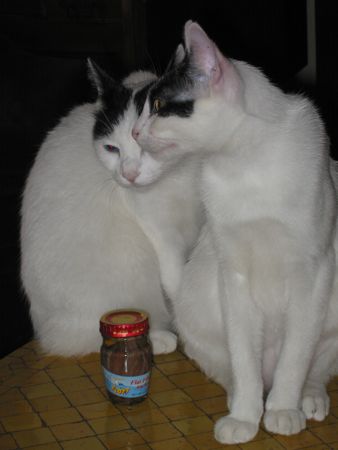
Buddy and Fumio guard my jar of Flott oil-packed anchovies.

Spaghetti with Anchovies, Summer Tomatoes, and Walnuts

(Serves 6 as a first course)

3 large, round summer tomatoes, peeled, seeded, and cut into small dice (you’ll want at least 2 cups)
Salt
5 oil-packed anchovies, minced
1 large summer garlic clove, minced
1 cup shelled walnuts, lightly toasted and roughly chopped
A large handful of flat-leaf parsley, the leaves lightly chopped
A few thyme sprigs, the leaves chopped
Freshly ground black pepper
Extra-virgin olive oil
¾ cup dry breadcrumbs
½ a hot fresh chili, minced
A generous pinch of sugar
1 pound spaghetti

Place the chopped tomatoes in a colander, and sprinkle them with a little salt. Let them drain for about an hour. Pour the tomatoes into a bowl (you might mix the drained-out tomato juice with a splash of vodka and drink it down—a little gift for the cook). Add the anchovies, garlic, walnuts, parsley, thyme, black pepper, and about 1/3 cup of olive oil. Add a little extra salt. Give it all a good mix, and let it sit for about ½ hour to develop flavor.

In a small skillet, heat about a tablespoon of olive oil over medium flame. Add the breadcrumbs and the minced fresh chili, and sauté until the breadcrumbs are crisp and golden, about 2 minutes. Add the sugar and a generous pinch of salt. Transfer this to a small bowl.

Cook the spaghetti al dente, and drain well. Pour it into a large serving bowl, and pour on the tomato sauce. Add a tablespoon of the toasted breadcrumbs, and toss. Serve right away, sprinkling some of the remaining breadcrumbs over each serving.

Read Full Post »


My pomodoro crudo, with Pantelleria capers and rosemary.

Recipe: Crisp Catfish and Pomodoro Crudo with Sicilian Capers and Rosemary

Capers have an astonishing affinity for tomatoes. But not any tomatoes, and not any old capers. I’ve got to have warm, juicy, New York–vicinity tomatoes right now, and for my capers my mind travels far, to the Sicilian island of Pantelleria. Truman Capote, who spent some time on Pantelleria in the l950s, described the island as “a freezing beauty, or an ice queen” (“una bellezza congeladora, una bellezza agghiaccianta”). Why, I’m not sure, since Pantelleria is basically off the coast of Tunisia, but it is white, austere, and harsh, with white-hot, rocky ground, perfect for caper bushes.

From the air the island would look different now from when Capote was there. It has big white compounds erected by Giorgio Armani and Isabella Rosellini. But its ruggedness still prevails for the leather-faced locals who spend long hours hunched over low, bristly bushes picking caper buds, catching them young and tight, before they blossom into lovely white and violet tipped flowers. I’ve never picked capers, even though I’ve probably got the genes for it. It does sound like back-breaking work, but lucky for me, my family escaped from Southern Italy a couple of generations ago, and I can now purchase little bags of salt-packed Pantelleria capers not far from my funky little apartment in New York City. These capers are packed in Sicilian sea salt, not drowned in vinegar, which makes a big difference for their deliciousness. Vinegar or even a harsh brine can make capers acrid, even the naturally sweet, superior Sicilian ones. Sea salt brings out their floral essence.

So here’s a quick raw sauce, blending New York tomatoes, Sicilian capers. olive oil, rosemary, garlic, and a hit of spiciness. The result is good. The sauce is versatile. My recipe here pairs it with catfish, but the sky’s the limit, I think.

Pantelleria capers are available online from Gustiamo.

Crisp Catfish and Pomodoro Crudo with Sicilian Capers and Rosemary

(Serves 4)

For the salsa:

2 round summer tomatoes, peeled, seeded, and cut into small dice
Salt
¼ cup salt packed capers, preferably Sicilian, soaked for 20 minutes in several changes of cool water and then rinsed
4 sprigs rosemary, the leaves well chopped
1 large summer garlic clove, minced
½ teaspoon Dijon mustard
½ a fresh red peperoncino, minced
A squeeze of lemon juice
½ teaspoon sugar
¼ cup extra-virgin olive oil, preferably a Sicilian oil such as Ravidà

For the catfish:

4 catfish fillets
1 tablespoon crème fraîche
1 tablespoon Dijon mustard
Extra-virgin olive oil
A branch of fresh thyme, the leaves chopped
Salt
Freshly ground black pepper
¼ cup fine corn meal
¼ cup all-purpose white flour

Place the tomatoes in a strainer, and sprinkle with a little salt. Set the strainer over a bowl, and let the tomatoes drain for about an hour (summer tomatoes are very juicy, and unless you drain them they’ll water down your sauce).

In a bowl, add the tomatoes and all the other ingredients for the salsa. Give it a stir, and let it sit for about half an hour to develop flavor. Taste for salt after it sits, since some residual salt from the capers will be released. You may or may not need to add more.

While the salsa is sitting, lay out the catfish fillets in a ceramic or glass dish. In a small bowl, mix together the crème fraîche, mustard, a tablespoon of olive oil, and the thyme, seasoning it all with salt and black pepper. Smear this all over the catfish fillets, and refrigerate for about half an hour.

In a heavy-bottomed skillet, heat about ½ inch of olive oil over medium-high heat.

Mix the corn meal and flour together on a plate, and season it well with salt and black pepper. Dredge the catfish fillets in the flour mixture on both sides.

When the oil is hot but not smoking, add the catfish, and sauté until nicely browned on one side, about 4 minutes. Give the fillets a flip, and brown the other side, about another 3 minutes. Lift from the skillet with a slotted spatula, and drain briefly on paper towels. Plate the catfish, and spoon a generous amount of the salsa over or next to it. Serve hot.

Read Full Post »

« Newer Posts - Older Posts »