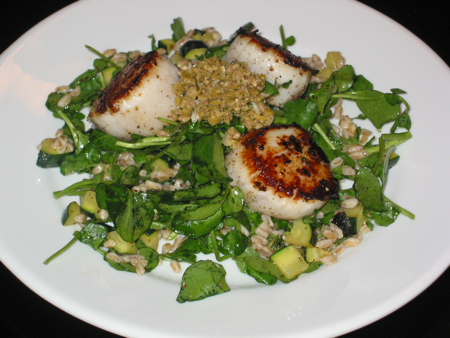
Scallops seared on only one side, so they’re crisp but meltingly tender throughout.
Recipes:
Watercress Salad with Sautéed Apples, Pine Nuts, and Bra Dura Cheese
Seared Sea Scallops with Watercress, Farro, and Green Olivata
I’ve been fascinated with watercress ever since I was introduced to a wild patch growing in a little stream in the Catskills near where we from time to time rent a cabin. I knew watercress had to exist up there, with all the shallow roadside trickles of water. I could sense its presence, but for years, even with all my searching in spots that seemed promising, it eluded me.
That part of the Catskills is a place where in the 1950s and ’60s many French food professionals settled and opened restaurants, mostly people from Brittany. Most of the restaurants have now closed, but many of the people are still scattered around. One French lady, a former pastry chef and somewhat morbid type who I often noticed taking her constitutionals near our cabin, had for years been keeping the location of a big watercress patch to herself. She’d occasionally show up at the cabins with little bags full, as a gift to the proprietress, but she wouldn’t let anyone know where the spot was, and frankly I think I’m the only one who really cared. She knew I was a cook, and she’d occasionally brag to me about some leek gratin or plum tart she had just cooked up. Finally one day, for no apparent reason, she told me where the patch was (she still won’t divulge her spots for morels and ramps, and I’m not gonna push that).
I could barely contain my excitement when I first laid eyes on the watercress. It’s a prolific patch, sprouting up in April and getting bigger and lusher into the summer. The watercress is peppery, deep green, and absolutely delicious in that gentle bitter way that I and most Italians (and apparently French) love. The thick stems near the roots are hollow, and they seem very delicately hinged to the watery earth. I have to be careful about pulling them up, since the plant is easy to uproot, so I usually bring scissors and clip the tender, leafy stems. Around late summer the watercress starts blossoming with little white flowers, and at that time it turns a little too bitter, but I still love it, using it more in soups and sautés than in salads.
Here are two recent watercress creations of mine that came out especially well. They were made not with my own foraged watercress but with $6-a-bunch wild watercress from the Union Square Greenmarket (which may very well have come from a patch near my special Catskills spot). (more…)








 Erica De Mane