Feeds:
Posts
Comments

Archive for the ‘2008’ Category


My pomodoro crudo, with Pantelleria capers and rosemary.

Recipe: Crisp Catfish and Pomodoro Crudo with Sicilian Capers and Rosemary

Capers have an astonishing affinity for tomatoes. But not any tomatoes, and not any old capers. I’ve got to have warm, juicy, New York–vicinity tomatoes right now, and for my capers my mind travels far, to the Sicilian island of Pantelleria. Truman Capote, who spent some time on Pantelleria in the l950s, described the island as “a freezing beauty, or an ice queen” (“una bellezza congeladora, una bellezza agghiaccianta”). Why, I’m not sure, since Pantelleria is basically off the coast of Tunisia, but it is white, austere, and harsh, with white-hot, rocky ground, perfect for caper bushes.

From the air the island would look different now from when Capote was there. It has big white compounds erected by Giorgio Armani and Isabella Rosellini. But its ruggedness still prevails for the leather-faced locals who spend long hours hunched over low, bristly bushes picking caper buds, catching them young and tight, before they blossom into lovely white and violet tipped flowers. I’ve never picked capers, even though I’ve probably got the genes for it. It does sound like back-breaking work, but lucky for me, my family escaped from Southern Italy a couple of generations ago, and I can now purchase little bags of salt-packed Pantelleria capers not far from my funky little apartment in New York City. These capers are packed in Sicilian sea salt, not drowned in vinegar, which makes a big difference for their deliciousness. Vinegar or even a harsh brine can make capers acrid, even the naturally sweet, superior Sicilian ones. Sea salt brings out their floral essence.

So here’s a quick raw sauce, blending New York tomatoes, Sicilian capers. olive oil, rosemary, garlic, and a hit of spiciness. The result is good. The sauce is versatile. My recipe here pairs it with catfish, but the sky’s the limit, I think.

Pantelleria capers are available online from Gustiamo.

Crisp Catfish and Pomodoro Crudo with Sicilian Capers and Rosemary

(Serves 4)

For the salsa:

2 round summer tomatoes, peeled, seeded, and cut into small dice
Salt
¼ cup salt packed capers, preferably Sicilian, soaked for 20 minutes in several changes of cool water and then rinsed
4 sprigs rosemary, the leaves well chopped
1 large summer garlic clove, minced
½ teaspoon Dijon mustard
½ a fresh red peperoncino, minced
A squeeze of lemon juice
½ teaspoon sugar
¼ cup extra-virgin olive oil, preferably a Sicilian oil such as Ravidà

For the catfish:

4 catfish fillets
1 tablespoon crème fraîche
1 tablespoon Dijon mustard
Extra-virgin olive oil
A branch of fresh thyme, the leaves chopped
Salt
Freshly ground black pepper
¼ cup fine corn meal
¼ cup all-purpose white flour

Place the tomatoes in a strainer, and sprinkle with a little salt. Set the strainer over a bowl, and let the tomatoes drain for about an hour (summer tomatoes are very juicy, and unless you drain them they’ll water down your sauce).

In a bowl, add the tomatoes and all the other ingredients for the salsa. Give it a stir, and let it sit for about half an hour to develop flavor. Taste for salt after it sits, since some residual salt from the capers will be released. You may or may not need to add more.

While the salsa is sitting, lay out the catfish fillets in a ceramic or glass dish. In a small bowl, mix together the crème fraîche, mustard, a tablespoon of olive oil, and the thyme, seasoning it all with salt and black pepper. Smear this all over the catfish fillets, and refrigerate for about half an hour.

In a heavy-bottomed skillet, heat about ½ inch of olive oil over medium-high heat.

Mix the corn meal and flour together on a plate, and season it well with salt and black pepper. Dredge the catfish fillets in the flour mixture on both sides.

When the oil is hot but not smoking, add the catfish, and sauté until nicely browned on one side, about 4 minutes. Give the fillets a flip, and brown the other side, about another 3 minutes. Lift from the skillet with a slotted spatula, and drain briefly on paper towels. Plate the catfish, and spoon a generous amount of the salsa over or next to it. Serve hot.

Read Full Post »

Recipe: Plum Salad with Almonds, Fennel, and Arugula

I’ve found that an excellent way to work more fresh fruit into my diet is by including it in a green salad, better even than churning up a batch of glorious cholesterol-elevating peach ice cream and shoving it all down. A salad is never going to be ice cream, but it can be a beautiful eating experience, if you crack open your best olive oil, gather good greens and dripping summer fruit, and go about it with a freewheeling but informed culinary spirit. As long as I stay away from dried hippie chunks like desiccated pineapples or cranberries, or birdseed, I can usually turn out something elegant.

You might not think of stone fruit—plums, peaches, or apricots—as making a good partner for lettuce, but actually those sweet, tart flavors go exceptionally well with bitter greens such as chicory, frisée, dandelion, or arugula. I bought small round red-pink sugar plums at the Greenmarket. Their color is stunning, a Matisse red (a flattering lipstick shade for Southern Italian girls like me, by the way), and they have the gentle sourness that I was looking for. I also like dusky, purple-black, pointy Italian plums, although they’re lower in acid than the ones I used. Depending on your plums, you may need to adjust the dressing, possibly leaving out the sugar or upping the vinegar. You don’t want it too sweet. What you do want is a tongue-tingling sweet, sour, bitter, salty, savory flavor experience. And the great thing about adding fruit to a salad is that it curbs your desire for desert. I swear it really does. When I was thinking up this salad, I immediately thought of pork for the first course, so I marinated a few thick pork chops in some spicy stuff and grilled them up. Nice summer meal, don’t you think?

Plum Salad with Almonds, Fennel, and Arugula

(Serves 2)

5 small summer plums
Salt
A generous pinch of sugar
1 large bunch arugula, well stemmed
1 small fennel bulb, thinly sliced
A handful of whole, blanched almonds, lightly toasted
2 scallions, thinly sliced, using the tender green part
A handful of basil leaves, left whole
1 teaspoon Spanish sherry vinegar
½ teaspoon Dijon mustard
A few scrapings of nutmeg
Freshly ground black pepper
1½ tablespoons extra-virgin olive oil

Halve and pit the plums, placing them in a small bowl, and add a tiny pinch of salt and a bigger pinch of sugar. Let them sit for a few minutes, so any juices can run out.

In a salad bowl, combine the arugula, fennel, almonds, scallions, and basil. Add the plums, leaving the juice in the bowl.

Add the vinegar and mustard to the plum juice. Add the nutmeg, salt, and a generous amount of black pepper. Add the olive oil, and give it all a quick whisk. Pour the dressing over the salad, and toss it gently. Serve right away.

Read Full Post »


Sophia with a nice catch.

Recipe: Sarde in Saor Venetian Style

I love fresh sardines. I know many people in this country don’t, but I can’t imagine why. Too strong? Too bony? Too puny? So silly. I think everyone needs to get over this. Possibly you’ve had them none too fresh. Freshness is key with high-oil fish. And it’s the wonderful oils, the essential fatty acids, so good for us, that give off their enticing aroma when you grill sardines on an open fire, for instance. That creates one of the most comforting but also riveting sea smells, riveting in its pure, glorious intensity. And when you take a bite, the flesh under the crisp skin is all sweetness.

I can buy local, Long Island sardines—Atlantic herring, actually—from my Greenmarket fish man, but only at the coldest times of the year. In the summer I rely on wild-caught Portuguese sardines, true Western European sardines, which I find at the fancier grocery stores in Manhattan. I ask when they’ll arrive, and I pick them up that day, so they’re rigidly fresh. And since sardines are at the bottom of the food chain, they’re better for the seas and for you than big over-fished creatures like tuna and swordfish, which are full of mercury and toxins, things I used to try to avoid thinking about but now I just try to avoid.

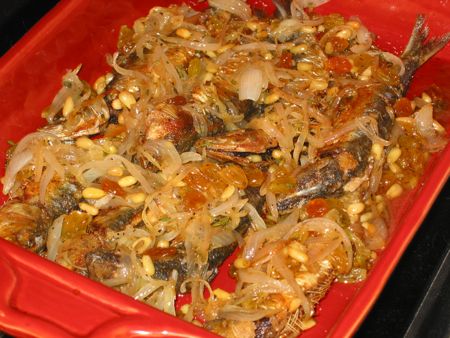
Sarde in Saor is a classic Venetian dish offered at many of Venice’s wine bars. Served at room temperature, It’s richly flavored, gently marinated, sweet and sour, with abundant sweet sautéed onions for much of its depth of flavor. It gets a bath in wine, vinegar, and a little sugar and is accented with the classic Moorish pine nut and raisin combination that I can never resist.  Think you don’t like fresh sardines? Try this.


My sardine dish.

Sarde in Saor Venetian Style

(Serves 4 as a first course)

½ cup golden raisins
½ cup dry white wine
Extra-virgin olive oil
A dozen sardines, gutted and scaled
½ cup all-purpose flour
Salt
A generous pinch of Aleppo pepper (or another spicy paprika)
2 large Vidalia onions, thinly sliced
Freshly ground black pepper
1 teaspoon sugar
4 large thyme sprigs, the leaves lightly chopped
3 tablespoons white wine vinegar
½ cup pine nuts, lightly toasted

In a small bowl, soak the raisins in the white wine.

In a high-sided skillet, heat about 2 inches of olive oil over medium heat.

Pat the sardines dry. Pour the flour out onto a plate, and season it well with salt and Aleppo pepper. Dredge the sardines in the flour.

When the olive oil is hot but not smoking, add the sardines (you’ll probably want to do them in two batches). Fry until crisp and browned on one side, about 2 minutes, and then give them a flip, and brown the other side, about 2 minutes longer. Drain the sardines on paper towels, and lay them out, slightly overlapping, in a rectangular serving dish (one with low sides).

In a large skillet, heat 2 tablespoons of olive oil over medium heat. Add the onions, seasoning them with salt and black pepper. Sauté until the onions are soft and lightly golden, about 10 minutes. Add the sugar and the thyme, and sauté a minute longer. Add the raisins in their soaking wine, and let the wine boil until almost evaporated (you want a little liquid in the pan, though, so don’t boil it dry). Add the white wine vinegar, and let it bubble for about a minute. Add the pine nuts.

Pour the onion mixture over the sardines, making sure they’re well covered. Give it a little drizzle of fresh olive oil, cover tightly, and refrigerate for a day, so the flavor can develop. Bring back to room temperature before serving. It will last about four days refrigerated.

Read Full Post »


Happy customers at Aroma’s bar.

Aroma is a fine bar and intimate caffé with a name that doesn’t sound as good in English as it does in Italian, even though it’s the same word. I suppose they could have done worse. They could have called it Smell, or Stink. Luckily the aroma when you walk through the door is a good one, all basil and sweet sea broth and pecorino and salumi and red wine. This is just what I’d be hoping for from the Southern Italian couple that opened this lovely little place in 2005.

The first thing I noticed the last time I took my seat at the bar was that everyone seemed to be regulars. That is a wonderful thing and exactly what I long for in a restaurant. So few places in New York have any neighborhood feeling to them these days, but at Aroma the customers know the bartender and the hostess. I heard a waitress say to two guys who were eating at the bar, “What did you do with yourselves last week when we were on vacation?” “Oh we got by, somehow.” That’s a nice thing to hear.

I love a place where I feel comfortable ordering a salad and a glass of wine at the bar, and Aroma, at first glance, looks like all bar. There are a few pretty tables at the doorway, under a big crystal chandelier, and a group of cozy tables in the back. But down a narrow, East Village stairway is what they call the Farmhouse room, a long communal table where you can hide away with a bowl of orecchietti with broccoli rabe pesto or a plate of their arancini, the Sicilian rice balls (not great diet food, but once in awhile you’ve gotta have them).

If you’d prefer to stick to your diet, there are plenty of healthy, good carb dishes here. I tried the calamari stuffed with shrimp and capers and fennel, which was tender and highly flavored. I also very much enjoyed the little warm stacked beet salad layered with gorgonzola. These are small dishes; you’d need two to make a meal, which is what I usually do at Aroma. They make a very good Caesar that includes a poached egg and a hefty hit of anchovy; it can be a full meal if you’re not starving. If you are starving, you might be happier with the monkfish and shrimp spiedini that comes with fregola, the Sardinian couscous-like pasta, and summer vegetables.

This is a place where care is put into every dish and the chef loves to cook (you’d think this would be automatic for someone who chooses cooking as a profession, but strangly, it’s not always the case). For instance, a black linguine with shrimp and calamari, something you might find on the menu at any number of Italian restaurants in New York, was fussed over, the pasta infused with a delicate fish broth laced with tomato, and the shrimp and calamari both cooked perfectly. This was not the rubbery, careless dish I’m more used to encountering. Aroma has a seasonal, always changing menu, another reason for me to keep going back. And if you’re not really hungry at all but just want to hang out with a glass of good Montepulciano d’Abruzzo and a bowl of olives, Aroma is a wonderful place to stop and chill.

Aroma
36 East 4th Street (near Bowery)
New York. N.Y.
(212) 375-0100

Read Full Post »


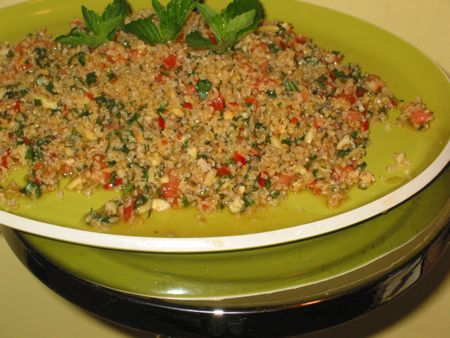
Almonds, mint, basil, garlic, and tomatoes—beautiful Sicilian flavors all in one healthful dish.

Recipe: Bulgur with Trapanese Pesto

In my continuing effort to educate myself on the evils of refined carbohydrates, I have been heartbroken to learn that potatoes rank very high on the glycemic index. They’re right up there with refined white flour. I never thought of potatoes as particularly refined. Summer potato salad is bad? What am I supposed to eat with my grilled lemon chicken? What about potato salad made with wonderful olive oil and fresh herbs? It’s better for your health than with bottled mayonnaise, but still not great. On the glycemic index—a number that indicates how quickly a food makes our blood sugar spike—a baked potato weighs in at about 80 out of a possible 100. That’s high. How depressing.

Maybe not so depressing when I think it through, though. Lately I’ve been trying to come up with delicious substitutes for my beloved summer potato salads. Whole grain is ideally what we should be aiming for, but I want my food to be pretty, not looking like a lump of brown mushy garbage, which is what whole grain dishes often resemble. I picked up a bag of bulgur at the musty health food store on my block. Bulgur is the cracked wheat used in many Middle Eastern dishes like tabbouleh. I like tabbouleh, but how could I make the stuff look appealing and, more important, taste Italian?

Whole wheat needs strong flavors. I immediately thought about Sicilian-style pesto, something I really love for both its forte and its freshness. Sicilian pestos are very different from the better-known Genoese type. This one, generally considered Trapanese in origin, contains almonds, mint, basil, garlic, and tomatoes but no cheese. I haven’t puréed it to a paste; rather I’ve left it rough, since that way the chunks look brighter after being mixed with the cracked grains. You can play around with the proportions. I like it light on the tomatoes, heavier on the mint and basil, which all blends effortlessly with the bulgur. And try it as a bed for grilled sardines or lamb chops. I served it with whole porgies that I picked up at the Union Square Greenmarket and pan-fried. It tasted lively, healthy. and very Sicilian—just what I wanted in the hot weather.

Bulgur with Trapanese Pesto

(Serves 4 as a side dish)

1 large summer garlic clove
1 fresh red peperoncino, roughly chopped
½ cup whole, skinned almonds, lightly toasted
½ cup mint leaves, plus a few whole sprigs for garnish
1 cup basil leaves
¼ cup extra-virgin olive oil (preferably a Sicilian estate oil such as Ravida)
Salt
1½ cups medium or coarse bulgur
1 3/4 cups chicken broth or water

Place the garlic, peperoncino, almonds, mint, and basil leaves in the bowl of a food processor, and pulse about 3 or 4 times, or until you have a large, uniform looking chop. Transfer to a small bowl, and add the tomatoes, olive oil, and some salt, stirring everything well.

Place the bulgur in a serving bowl, and sprinkle it with a little salt. Bring the chicken broth or water to a hard boil, and pour it over the bulgur, giving it a quick stir. Cover the bowl with aluminum foil, and let it sit for about 30 minutes, or until the bulgur is tender and all the liquid is absorbed. Add the pesto, and toss gently. Garnish with mint sprigs.

Serve warm or at room temperature.

Read Full Post »


Fireworks at an Italian festival in New Orleans last year.

Have a great holiday weekend. And do yourself a favor: Forget the diet for a few days. Have a blast. Eat what you love. Drink to your heart’s content. Celebrate in true American style. I plan on stuffing myself with Taleggio, grilled steaks, and Chianti.

Read Full Post »


Looks like fun. I want that hat.

Recipe: Spaghetti with Red Mullet and Haricots Verts, Da Fiore Style

One thing wrong with this country is our lack of respect for vacation time. Compared with Italy and France, we are pathetic, overworked Puritans. It’s tragic that we feel guilty and broke at the thought of taking two weeks in a row, a luxury here for most people. In Italy two weeks is a joke; you don’t even start to unwind before at least three. I haven’t taken two weeks in several years, and I’m so used to it that I forget how badly I need those two weeks. The occasional summer weekend getaway, much of it stuck in traffic, can be fun and will do in a pinch, but it’s no substitute for the real thing. I always seem to return from these weekends feeling tired, and nervous about facing Monday and all the stuff I tried not to think about over those two days. Less pay, more work, chintzy vacation: It’s the American way. This cannot be good for our waistlines. Stress and overeating, as we all know but somehow fail to take seriously, are a classic combination that can result in nervous fat build-up. You not only look bad but you feel bad too. Why do we let this happen? I think because we’re all so beaten down we don’t think we deserve a real vacation. Maybe I’m only speaking for myself, but I think it may be an American epidemic. (more…)

Read Full Post »


Dino holding a bottle of his signature vino (has anybody ever tasted it?).

Recipe: Cherries in Red Wine Vanilla Syrup

So now we all know what my grandmother always knew: Red wine is a medicine, albeit a really delicious, intoxicating one. When my father was a kid, she’d administer it to him by the tablespoon like cod liver oil. When I was young, my sister and I got handed little glasses of red wine mixed with 7Up to drink with dinner, “to aid digestion.” And my grandmother used it herself to chase away her demons, not always with the best results, but her mental state aside, she lived to be 99, and I do believe red wine must have had something to do with it. (And she still had very smooth olive skin.)

The secret health ingredient in red wine turns out to be something called resveratrol, a substance found in all wine but in much higher concentrations in most reds. Many serious studies seem to indicate that resveratrol could be a key to longevity. I’ve even read some studies that have found that resveratrol might have the power to hinder fat storage and reduce the number of fat cells in your body. Now, that just seems too good to be true, and we’ll have to wait for a definitive answer on it, but science is moving to declare resveratrol a possible life-extending elixir. Unbelievable. Seems it may be able to accomplish this amazing feat by switching the body’s resources from fertility to tissue maintenance. This improved tissue maintenance is thought to extend life by cutting down on the degenerative diseases of aging. Can you believe it?

Red wines that get prolonged grape skin contact in the winemaking process have especially high levels of resveratrol, and reds from areas with relatively high humidity tend to be loaded with it. Pinot Noir has a very high level. I wanted to know the amounts of this wonder ingredient in Southern Italian reds, and I found a study conducted at the University of Foggia in Puglia that tested a handful of Southern Italian monovarietal wines. The report is a bit confusing, since it’s written in high scientific language in addition to being translated from Italian rather ineptly, but I could figure out that the study’s purpose was to compare resveratrol levels in Aglianico, Piedirosso, and Nerello Mascalese grapes, all native Southern Italian red wine grape varietals. What the test showed was that the resveratrol level in the Aglianico and Piedirosso, although starting out relatively high, declined after a time in maceration, while the level in the Nerello Mascalese grapes kept increasing with prolonged maceration. Curious. (more…)

Read Full Post »


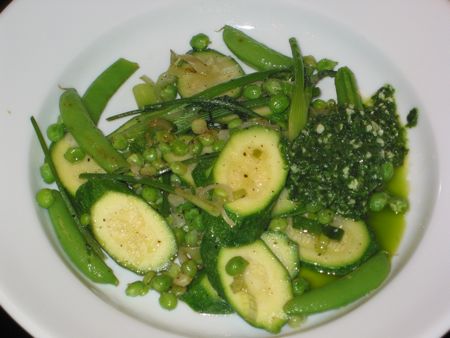
You can serve this pretty spring dish either hot or at room temperature.

Recipe: Spring Vegetables with Mixed Herb Pesto

The more you crowd your plate with beautiful vegetables, the less room you have for bad fats and refined carbs. A little bad fat and carb is desirable, but I’ve found that an excellent way to avoid overdoing it is by learning to be a fabulous vegetable cook. That’s not so hard, especially this time of year, when good things are bursting forth from our still somewhat productive earth, beckoning to be cooked and eaten.

I like going to the market and simply selecting vegetables by color, and then coming up with a way to present them, all together, in a palate of visual and savory pleasure. This week I picked up snap peas, shell peas, little baby fennel, and first-of-the-season zucchini, all in varying shades of green that really caught my eye. And I grabbed basil, parsley, and tarragon because there they were there. I decided to do a little sauté of pretty green things and make a pesto of green to go with it. Now I had a plan. (more…)

Read Full Post »


Gelato in brioche, a bad Sicilian idea of breakfast.

Recipe: Uova in Purgatorio (Eggs in Purgatory)

Every diet I’ve ever heard of instructs you to eat a good breakfast. It will supposedly set you up for the day. I for one am not hungry in the morning. Am I supposed to eat anyway just to get set up? What I’ve always wanted in the morning is nothing but coffee, a big cappuccino. Maybe if I started getting shaky and deranged, a sign of a blood sugar dip, I’d want breakfast, but I never feel that way, unless I overdo it with the coffee.

If I’m coerced into eating breakfast, I get just as hungry for lunch, and at the same time as if I hadn’t eaten breakfast at all. Eating in the morning jump starts my eating cycle, depriving me of several peaceful hours where I feel no need to stuff my face. As I see it, there’s very little point in ignoring the individual quirks of your own body and mind, no matter what the diet experts say.

I’ve been reading a book called Eat, Drink, and Weigh Less, drawn to it initially because it had the word drink in the title. This book, written by Mollie Katzen, of Moosewood Cookbook fame, and Walter Willett, M.D., a nutritionist, is in many ways a fine, reasonable book, aside from some very unreasonable, non-Italian, health-foodie recipes, heavy on the tempeh and cumin. What this book says about breakfast makes perfect sense: “When it comes to smoothing out the peaks and troughs of hunger all day long, a good breakfast starts things off on exactly the right track. Skip breakfast . . . and it’s easy to set off a chain of overeating that lasts till bedtime.”

Every diet book says this, so it must be true, but it’s not true for me. Eating breakfast makes me gain weight. Eating breakfast just adds another meal when I don’t even want it. This book emphasizes setting your blood sugar at a good level by eating whole grains and some protein. That sounds perfectly and scientifically sensible, but don’t let it scare you into eating when you don’t feel like it. After reading tons of diet books and blogs, you’re led to believe skipping breakfast turns you into a savage, food-starved beast, grabbing at any edible thing in your path and stuffing your face endlessly until you finally pass out at night in a bloated haze. For me, I’ve found the opposite to be true. Do you still have to eat breakfast? Dr. De Mane says no, unless you want to. (more…)

Read Full Post »

« Newer Posts - Older Posts »