Feeds:
Posts
Comments

Archive for October, 2008

Recipes:

Farfalle with Burst Tomatoes, Sweet Vermouth, Rosemary, and Goat Cheese
Broiled Chicken Breast with Walnuts, Garlic, and Parsley, Served on Bibb Lettuce

Can a boneless chicken breast be delicious?

Boneless, skinless chicken breast has long been one of my most hated foods. It’s almost always dry, boring, stiff, and lifeless. I completely ignored it in my grocery store until recently when, trying to fashion a make-ahead second course to serve after pasta, I decided to cook some up. Eating pasta as a first course is something I used to frown on, not only because I preferred to eat disgustingly huge loads of pasta, as a real American, but also because I didn’t want to have to get up after the meal began to prepare another course, as a cook. That was annoying. I really don’t know how Italians do it. Maybe they all have maids, or maybe the women are all still slaves, or maybe, just maybe, they make things ahead. What a concept.

I decided that chicken breasts might be an easy thing to prepare and serve after a small dish of pasta. But I knew I would have to do some major rethinking before I could love them. First off I de-dieted them a tad by—horrors—leaving the skin on. The truth is, a little chicken skin isn’t going to hurt anybody, and it makes all the difference, since the skin protects the delicate white meat by enveloping it in its fat of choice, its own. Not only that, but you can stuff deliciousness under the skin, adding garlic, leeks, herbs, pesto, or cheese, creating a personalized chicken breast with amazing taste. Cook it quick over high heat and you wind up with tender, juicy (moist, in fact, I kid you not) Italian-seasoned chicken encased in deliciously crisp skin. That’s about as good as a chicken breast gets. I chose a walnut pesto, which makes this easy dish taste really rich, as if you had put a lot of time into it. You hadn’t. You had only put a lot of flavor in it. And it all gets made ahead and served just warm, after you’ve eaten your pasta, so all you need to do is bring it to the table. I like first-course pastas that are simple and clean. Try this one flavored with tomato, goat cheese, and rosemary. It cooks in about ten minutes.

Farfalle with Burst Tomatoes, Sweet Vermouth, Rosemary, and Goat Cheese

(Serves 3 as a first course)

½ pound farfalle pasta
Salt
Extra-virgin olive oil
1 pint grape tomatoes
2 garlic cloves, thinly sliced
1 large sprig rosemary, the leaves chopped
Freshly ground black pepper
A generous splash of sweet red vermouth
2 tablespoons soft, unaged goat cheese, at room temperature
A small handful of flat-leaf parsley, the leaves lightly chopped
A small chunk of Grana Padano cheese for grating

Put up a pot of pasta cooking water and bring it to a boil. Add a generous amount of salt. Drop in the farfalle.

In a large skillet, heat 2 tablespoons of olive oil over medium-high heat. When hot, add the grape tomatoes, and sauté, shaking them around for about a minute. Now add the garlic and rosemary, and season with salt and black pepper. Continue shaking the skillet until the tomatoes start to burst and give off juice, about another 4 minutes. Add the vermouth, and let it bubble for a few moments.

When the farfalle is al dente, drain it, saving about half a cup of the cooking water, and add the farfalle to the skillet, tossing quickly to coat it well. Transfer the pasta to a warmed serving bowl. Add the goat cheese, the parsley, a few more turns of black pepper, and a drizzle of fresh olive oil, and toss well, adding a few splashes of pasta cooking water if needed to loosen the sauce. Serve hot with a little Grana Padano grated over each bowl.

Broiled Chicken Breast with Walnuts, Garlic, and Parsley, Served on Bibb Lettuce

(Serves 3 as a second course)

Game plan: If you prepare the chicken about an hour ahead, you’ll deepen its flavor. Throw the chicken in the broiler when you start boiling the pasta, and they’ll both be ready at about them same time. Then your chicken can rest, getting tender and perfectly cooked while you enjoy your pasta.

2 large chicken breasts, boned but with the skin left on
½ cup fresh walnuts, lightly toasted, plus a handful for the salad
1 large garlic clove
2 anchovy fillets
Extra-virgin olive oil
1 tablespoon softened unsalted butter
Salt
Freshly ground black pepper
A handful of flat-leaf parsley leaves
2 small heads bibb lettuce, separated into individual leaves
2 teaspoons fresh lemon juice

In a small food processor, combine the walnuts, garlic, anchovies, 1 tablespoon of olive oil, the butter, a little salt, and a more generous amount of pepper. Pulse until you have a rough paste. Add the parsley, and pulse once or twice more, just until the parsley is roughly chopped. Lift the chicken skin up with your fingers, and work as much of the walnut mixture as you can under the skin of both breasts. Season the chicken breasts well on both sides with salt and black pepper, and place them on a baking sheet. Drizzle them with a little olive oil.

When you’re ready to cook the chicken, turn on your broiler and place the chicken about 6 inches from the heat source (if it’s too close, the skin may burn before the chicken is cooked through). Broil about 8 to 12 minutes, checking after 8 minutes. The skin should be well browned, and the meat should feel firm but with a little give at the center, indicating that there is still a touch of pink inside. If you’re unsure, cut into one and take a peek. Take the chicken from the oven, and let it sit. It will continue cooking gently.

Now enjoy your pasta.

When you’re ready to serve the chicken, lay out a large serving platter, and scatter on the bibb lettuce and the reserved walnuts (do this ahead if you like). Whisk the lemon juice together with 2 tablespoons of olive oil, and season it with salt and black pepper. Use about three quarters of it to dress the lettuce. Slice the chicken widthwise on an angle in thick slices, and arrange them over the salad. Drizzle the remaining vinaigrette over the chicken. Serve right away.

Read Full Post »


Orange cauliflowers at the Union Square Greenmarket.

Recipe: Orecchiette with Orange Cauliflower, Raisins, Pine Nuts, and Saffron

I stand in my kitchen holding an orange cauliflower, and I think, this has to be one of the most beautiful vegetables I’ve seen in a long time. It looks like a cauliflower drenched in creamy cheddar cheese. In fact it is sometimes called cheddar cauliflower. I was told by the upstate farmer I purchased it from that the orange color remains after cooking. I was skeptical, since I’ve cooked up bright green and deep purple cauliflowers, and they both faded to pale beige-gray when blanched.

I knew this cauliflower was destined for a pasta sauce. I love cauliflower with pasta, especially when I prepare it in Sicilian fashion, with noble additions such as pine nuts, almonds or pistachios, raisins, saffron, bay leaf, and sometimes wild fennel or anchovies, sometimes capers. I thought about all these opulent Sicilian possibilities and picked quite a few for this dish. And, more important, I can report that the orange color remained after cooking, even becoming more orange. The taste is about the same as that of the more standard white varieties, but when the little orange florets are tossed with pasta, they don’t blend into one big bowl of off-white the way traditional cauliflower does. The orange prettily pops out at you. It’s a happy look. We get a little free beauty in our bowl, which is fine with me. I’ll take beauty wherever I can get it.

Cauliflower with pasta is a very delicious and very healthy dish, as anyone who reads this blog knows, but too much pasta is still too much pasta. I’m really trying to get into the habit of eating pasta as a first course, in true Italian fashion. The Italians have got the thing worked out, and they know that pasta won’t make you fat if you do as they say: Make every pasta dish beautiful and delicious, and savor every bite. Then take it away and move on to something lean and something green. I’ve come up with a few excellent dishes, mostly meat or fish preparations, that I put together while I’m preparing a pasta and serve just warm or at room temperature, along with a green salad. A small bowl of perfect pasta, a small protein course, and a gorgeous green salad—that’s my idea of a great meal, and one that won’t have you running back and forth into the kitchen all night when you should be relaxing and enjoying your dinner with friends or family. I’ll be posting recipes for some of these post-pasta dishes soon. In the meantime, enjoy your pasta.

Orecchiette with Orange Cauliflower, Raisins, Pine Nuts, and Saffron

(Serves 6 as a first course)

1 small orange cauliflower or ½ a larger one (or use a white, green, or purple one), cut into small florets
Extra-virgin olive oil
1 large Vidalia onion, thinly sliced
4 anchovy fillets, chopped
1 fresh bay leaf
Salt
Freshly ground black pepper
1 pound orecchiette
½ cup pine nuts, lightly toasted
½ cup black raisins, soaked in ¼ cup dry white wine
A generous pinch of saffron threads, dried, ground to a powder, and soaked in a few tablespoons of warm water
6 large thyme sprigs, the leaves chopped
A handful of Italian parsley leaves, lightly chopped
A chunk of Moliterno or another aged pecorino cheese for grating

Set up a big pot of pasta cooking water, and bring it to a boil. Season generously with salt, and drop in the cauliflower. Blanch for about 3 minutes. Scoop the cauliflower from the pot into a colander with a large strainer spoon. Run cold water over it to stop the cooking and to set its beautiful orange color. Let it drain.

Choose a large skillet, and get it hot over medium flame. Add two tablespoons of olive oil and the onion, the anchovy, and the bay leaf.

Bring the water back to a boil, and drop in the orecchiette.

Sauté the onion until it’s soft and fragrant, about 5 or 6 minutes. Add the cauliflower, and season with salt and black pepper. Sauté until the cauliflower is just tender, about 3 or 4 minutes longer. Add the raisins and wine, the pine nuts, the saffron water, and the thyme, and let everything simmer for a minute or so.

When the orecchiette is al dente, drain well, saving about a cup of the pasta cooking water. Pour the pasta into a large, warmed serving bowl. Add the parsley, a few more turns of black pepper, and a generous drizzle of fresh olive oil, and give it a toss. Pour on the cauliflower sauce, and toss again, adding a little of the pasta cooking water if needed to loosen the sauce. Serve hot.

Read Full Post »

Peperonata at Its Best

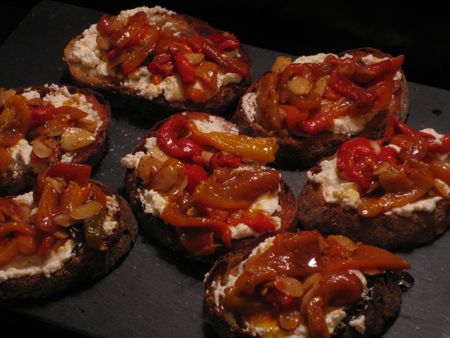
Recipe: Peperonata with Almonds, Thyme, and Pimentón, Served on Ricotta Bruschetta

Peperonata, the roasted sweet pepper dish so popular throughout Southern Italy, is one of my favorite things to eat, and early fall is the best time to make it, when the sweet peppers are warm and ripe and piled high at the Greenmarket. So of course here I am making it now, as every year at this time. Like most dishes I cook a lot, it has evolved through the years to reflect my ever-changing culinary outlook.

When I first started making peperonata I used a lot of sharp and salty flavors, such as capers, anchovies, and olives. That was how I’d often had it served to me in Southern Italy, and it was how my family usually cooked up a batch. Over the years I’ve found I prefer mellower and richer ingredients in it. The peppers themselves provide enough sharpness. In my newest incarnation, I include toasted almonds, fresh thyme, and just a hint of the smoked Spanish chili called pimentón, which adds sweetness and smoke but not much heat. Pimentón comes in both sweet and hot versions. Use the sweet one for this.

Peperonata makes a lovely pasta sauce—I sometimes add it to a simple tomato sauce and toss it with spaghetti—but my favorite way to eat it is on grilled bread, with a  smear of ricotta serving as a gentle, luscious base, a flavor juxtaposition that for me encapsulates Southern Italy’s culinary style at its most brilliant.

Try these bruschetta with a glass of Cerasuolo di Vittoria, a bright red, pleasantly acidic wine made from a mix of Sicily’s frappato and Nero d’Avola grapes. Valle dell’Acate is a very good producer to look for.

Peperonata with Almonds, Thyme, and Pimentón, Served on Ricotta Bruschetta

(Serves 6 as an appetizer)

5 bell peppers (a mix of red, orange, and yellow will look pretty, but all red will give you the deepest flavor)
Extra-virgin olive oil
A handful of sliced almonds
1 garlic clove, thinly sliced
Salt
A pinch of sugar
A larger pinch of Spanish pimentón de la Vera, preferably the sweet variety
A few drops of Spanish sherry vinegar
5 large sprigs of thyme, the leaves chopped

Plus:

1 1/2 cups ricotta (for link to my homemade ricotta recipe, clicca qui)
12 thin bread slices from a long Italian loaf

Preheat the broiler. Place the peppers on a sheet pan, and broil them about 4 inches from the heat source, turning them as they blacken until they’re well charred all around. Let the peppers cool for a few minutes, and then peel and seed them and cut them into slices.

In a medium skillet, heat a tablespoon of olive oil over medium heat. When hot, add the pepper slices, almonds, garlic, sugar, and pimentón, and season with salt. Sauté until everything is fragrant and the almonds are lightly golden, about 4 minutes. Turn off the heat. Add a few drops of the vinegar, the thyme, and a drizzle of fresh olive oil, stirring it all to blend well. Transfer the peperonata to a small bowl. Serve it warm or at room temperature. It’ll keep about 3 days refrigerated, but bring it back to room temperature before serving.

To make the bruschetta:

Toast or grill the bread slices on both sides. Spoon on a heaping spoonful of the ricotta, and top with a spoonful of the peperonata. Serve right away.

Read Full Post »


Italian olive oil for sale in Manhattan around 1930.

I just read an article that says that the good fat found in olive oil may provide one of the keys to appetite control and weight loss. Could it be true, fattening old olive oil?

Could be. It seems that oleic acid, a kind of monosaturated fat that olive oil has in abundance, suppresses hunger pangs and so can help prevent snacking between meals, according to researchers at the University of California, Irvine.

In a study involving lab mice (who else?), the researchers found that when oleic acid reaches the small intestine, it’s converted into a hormone called oleoylethanolamide. The hormone sends hunger-dampening signals to the brain, which means you feel full sooner and can go longer without eating. The findings were published in a journal called Cell Metabolism.

Truly? Somehow it feels true. Just think how satiated you feel after a big bowl of spaghetti aglio e olio. Maybe olive oil and red wine, my two favorite foods, have all along been the keys to the Mediterranean diet. It’s gotta be.

Read Full Post »


. . . As you can see in this photograph.

Recipe: Penne with Butternut Squash, Speck, and Leeks

Every year around this time, when the New York weather changes seemingly overnight, my sister Liti starts to crave pasta with butternut squash or pumpkin, and I always oblige her by making it for her, doing a slightly different version each time. In my book The Flavors of Southern Italy I have a recipe for pasta with pumpkin, tomatoes, and basil. I remember being surprised to discover that tomato blended so well with pumpkin as I stretched my imagination to come up with interesting things to do with the big squash. What really made them fit together was the addition of a mild pecorino, which miraculously brought all the sharp flavors into harmony. Usually I don’t add tomato but just let the squash stand more or less alone—more or less except for the pancetta or guanciale or Italian sausage I can never resist slipping in. Pork fat and fall squash make a heavenly combination, though usually not a lean dish by any stretch of the imagination.

I’ve been trying to cut down on my intake of saturated fat, sadly, especially pork fat, which is something I can eat, to my horror, in fairly large quantities. But sometimes pork fat seems to be just the thing, and no substitute is truly appropriate. Speck is a perfect product to reach for when you need some pork but just can’t bring yourself to surrender again to that fatty salami or fresh sausage quite yet. Speck is a cured and smoked boneless prosciutto from the Alto Adige region of Italy. It has about the same ratio of lean to fat as regular prosciutto, but its delicate smoky taste, with an underlying hint of juniper and bay leaf, makes it a great element in a hearty fall pasta.

In Southern Italy pumpkin pasta often includes garlic. I don’t love the combination, preferring shallot or the leeks I use in my most recent incarnation of the dish. I also include Marsala wine and sage, two flavors that always crop up in my culinary head when the weather turns cold.

Try to serve this as a first course. It’s rich and filling, so a small amount is really perfect. Afterward, a few slices of cold roast chicken sliced and serves over a green salad, maybe with a caper vinaigrette, would be great, in which case you wouldn’t need to run back to the kitchen to finish cooking anything (a big problem when you serve pasta as a first course, but not an insurmountable one).

Penne with Butternut Squash, Speck, and Leeks

(Serves 6 as a first course)

Extra-virgin olive oil
2 medium leeks, well cleaned and cut into thin slices, using only the white and tenderest green parts
1 small butternut squash, peeled, seeded, and cut into small dice
Salt
Freshly ground black pepper
2 whole allspice, ground
2 juniper berries, ground
1 pound penne
½ cup dry Marsala
½ cup chicken broth
6 or 7 slices speck, cut into thin strips, with any excess fat removed
10 sage leaves, cut into thin strips
A chunk of Montasio cheese for grating

Set up a large pot of pasta cooking water over high heat.

In a large skillet, heat 2 tablespoons of olive oil over medium heat. Add the leeks and the butternut squash at the same time. Season with salt, black pepper, and the ground allspice and juniper berries, and sauté until the vegetables are well coated with flavor and are just starting to soften, about 4 minutes.

When the water comes to a boil, add a generous amount of salt, and drop in the penne.

Add the Marsala to the skillet, and let it boil out for a few minutes. Add the chicken broth, cover the skillet, and continue cooking until the squash pieces are just tender when poked with a knife, about another 5 minutes (you want them soft but still holding their shape). Turn off the heat, and uncover the skillet. You should still have a little liquid in the skillet. Add the speck and the sage, a generous drizzle of fresh olive oil, and a few more grindings of black pepper.

When the penne is al dente, drain it into a serving bowl, saving about ½ cup of the pasta cooking liquid. Pour the squash sauce onto it, and toss gently, adding a little of the cooking water if it seems dry. Serve right away with a little Montasio grated over the top of each portion.

Read Full Post »

Beautiful Beets


Pink beets, roasted and peeled, smooth and shiny.

Recipes:

Roasted Beet Salad with Pistachios and Basil Vinaigrette
Roasted Beets with Black Olives, Orange, and Anchovy

Just about every recipe for beets I’ve run across in the last ten years has paired them with goat cheese. There’s nothing wrong with that—in fact it’s a fine combination—but I’m sick of the taste, and the combination of textures isn’t the greatest. I’ve especially had it with the stacked beet and goat cheese “lasagna” appetizer thing that so many restaurants have kept on their menus for years. It’s weird when such a chef creation takes off and spreads around the food world, running amok.

I do love beets, with their sweet but curiously bitter undertone, which, for me, prevents them from ever being boring, and of course they’re outrageously beautiful in shades of pink, purple, yellow, orange, red and white stripes, and pink and white stripes. I saw all these colors at the Union Square market a few days ago. I closed my eyes and grabbed a bunch, and they turned out, after roasting and peeling, to be that amazing shade of pinkish reddish orange that Matisse often used for wallpaper.

What should you do with beets? Roast them, for starters. Their sugars concentrate and fill your kitchen with a strange, unique sweetness, like no other sweetness, since it’s tinged with a root-vegetable aroma (maybe a little like a roasted sweet potato, but deeper and more complex). Roasting contains juices, so the colors and flavors of your beets aren’t lost to a big pot of hot water. In markets in Italy you can buy preroasted beets. Isn’t that something? Nobody would think of doing that here. If you want to try the things, you’ll have to cook them yourself.

What should you do with roasted beets? Bathe them in Italian flavors is my answer. Anchovies, just a touch of them, are an amazing match, believe it or not. I borrowed an odd Sicilian combination of anchovies and orange to flavor one of these two beet salads, It’s something I first encountered years ago in an artichoke dish I ate in Palermo. For the other salad I relied on basil, which is pretty much the perfect beet herb, much better than the more typical and more strident choice dill. Pancetta, capers, and olives, all salty, are good bets too. (I find you don’t often go wrong pairing salty and sweet. Think of salted caramels.) You also can add nuts of all types with confidence. Pine nuts, walnuts, almonds, or the pistachios I’ve chosen for one of these recipes add rich flavor and protein, and their textures seem right against the slipperiness of the beets. So as I rummaged through my head for appropriate Italian flavors to add to my two beet salads, I found myself using quite a few.

Here are beets, beautiful and delicious, for your viewing and eating pleasure.

(Both salads serve 4 as a first course or light lunch)

Roasted Beet Salad with Pistachios and Basil Vinaigrette

4 medium beets
Salt
2 small bunches watercress, well stemmed
A handful of unsalted, shelled pistachios
1 shallot, thinly sliced
A small chunk of Parmigiano Reggiano cheese

For the vinaigrette:

1 cup basil leaves
1 small garlic clove, roughly chopped
1/4 cup extra-virgin olive oil
1 teaspoon lemon juice (or a little more to taste)
Salt
Freshly ground black pepper

Preheat the oven to 400 degrees. Place the beets on a big sheet of aluminum foil. Sprinkle them with a little water, and close up the foil tightly around them. Place the package on a sheet pan, and roast for about 40 to 45 minutes, or until the beets are tender and fragrant. You’ll smell their sweetness, an indication that they’re getting there, but if you’re unsure, poke one with a thin knife. It should pierce through with little effort. When they’re done, run the beets briefly under cool water, just to cool them. Peel them and cut them into small cubes (they’ll look like big rubies (don’t you wish)), and place them in a bowl, seasoning them with a little salt.

Blanch the basil leaves in a small pot of boiling water for one minute. Drain the basil, and run it under cold water to stop the cooking and to bring up its green color. Squeeze out all the water. Place the basil in the bowl of a food processor. Add the garlic, olive oil, and lemon juice. Season with salt and black pepper, and pulse several times, until the mixture is smooth.

Place the watercress in a salad bowl. Add the beets, pistachios, and shallot, and pour on the vinaigrette (you may have a little extra, so just eyeball it). Toss gently. Divide the salad out onto four plates, and shave a few sheets of Parmigiano Reggiano onto each one. Serve right away.

Roasted Beets with Black Olives, Orange, and Anchovy

4 medium beets
1 medium head frisée lettuce, torn into pieces
1/2 a small red onion, very thinly sliced
A handful of black Nicoise olives
A handful of flat-leaf parsley leaves

For the vinaigrette:

1 anchovy, minced
The grated zest from 1 small orange
1 garlic clove, smashed with the side of a knife
3 tablespoons extra-virgin olive oil
1 teaspoon Spanish sherry vinegar
1 teaspoon Dijon mustard
Salt
Freshly ground black pepper

Preheat the oven to 400 degrees. Place the beets on a big sheet of aluminum foil. Sprinkle them with a little water, and close up the foil tightly around them. Place the package on a sheet pan, and roast for about 40 to 45 minutes, or until the they are tender and fragrant. You’ll smell their sweetness, an indication that they’re getting there, but if you’re unsure poke one with a thin knife. It should pierce through with little effort. When they’re done, run the beets briefly under cool water, just to cool them. Peel them, and cut them into not-too-thin rounds, thick enough that they don’t break apart too easily.

Whisk all the ingredients for the vinaigrette together in a small bowl.

Place the frisée in a salad bowl, and drizzle it with a little olive oil and season it with a bit of salt. Toss it, and divide it out onto four salad plates.

Add the beets to the salad bowl. Add the olives, red onion, and parsley. Pour on the vinaigrette, and toss gently. Divide the beets out onto the frisée. Serve right away.

Read Full Post »